Now What? If You Don’t Know, Find Out!
A book that every citizen of the state needs to read immediately.
 Legislative News by Nelda Holder –
For anyone who cares about the political present—and future—of the state of North Carolina, I have an emergency prescription for you.
Leave your house as soon as you can and head for the nearest bookstore. (Yes, I know you can order books online. But how I love real bookstores and the magic they offer.)
There you must look for a book titled Now What? The author is Gene Nichol (more about him later) and the subject is the state of the floundering North Carolina General Assembly—particularly its leadership—along with its disastrous connection to the floundering North Carolina Supreme Court.
I know that may sound like a big plug to chew, but trust me. Nichol—a well-known professor of law at the UNC School of Law—has written an infinitely digestible book that every citizen of the state needs to read immediately.
Why?
Because it details the precarious state of “democracy” in our home state, once known as a leader in the South in many ways that included education and equality. I remember that North Carolina. It made me so proud. Proud to see an understanding that public education was a key, and an emphasis that pushed the state towards the top of the national list in educational achievement. Proud that people from around the country began to look at my state as a leader in planning for a prosperous and equitable future.

Education in North Carolina
Nichol puts it baldly: “North Carolina’s legislative leaders have struggled stubbornly, implacably, and ingeniously for decades to escape their constitutionally imposed obligation to create and support a public school system that sustains and provides equal prospects to low-income and marginalized students.”
Tax Equity in North Carolina
Nichols points out that a multiyear effort has “ensured that low-income Tar Heels paid more in taxes while wealthy folks paid much, much less” as lawmakers “scrapped the progressive income tax and replaced it with a flat tax, markedly lowering the rate for the richest taxpayers.”
They did this, he explains, by doing away with the estate tax; providing a generous tax cut for corporations; increasing regressive sales taxes; adding taxes to repair services (“falling squarely on low- and middle-income payers”), along with other financial maneuvers which the NC Budget & Tax Center found in 2016 gave a tax cut of $14,977 per year to the top 1% in the state, while “the bottom 40% of taxpayers got tax increases instead of the advertised reductions.”
Nichol points out that “the pattern continues today.” Legislation is now in place to “reduce the personal income tax to 4.25% in 2025, and then to 2.49% in 2031.” The corporate income tax rate becomes 2% for 2025 and will be zeroed out by 2030.
The results of this legislative push, Nichol sums up, will mean the “lowest 20% of earners (less than $21,600)” will pay 10.5% of their income to the state, while the middle 20% pay 9.3%, the third highest 15% ($128,300 – $262,300 in earnings) pay 8.5; the next 4% ($262,300 – $697,400 pay 7.2%, and the top 1% (earning more than $697,400) pay 6%.
Nichol’s opinion of this: “No Democratic Party, or any progressive force whatsoever, can deem North Carolina’s present economic framework acceptable.”
Nichol cuts no slack in this little book, which left my head buzzing from the call to arms he initiates on a number of extremely important topics. His alarming analysis of the current condition of the North Carolina Supreme Court is particularly chilling.
He calls the current status an “abdication of its obligations of independent judicial review.” And he declares that “a bold green light has been lit before our state’s greedy and lawless legislators, threatening to end limited government and constitutionally constrained democracy as it has been understood in North Carolina for generations.
He goes even further in his alarm. “The court’s Republican majority, or at least four of them,” he declares, “have begun to directly intervene in the state’s electoral process—picking winners and losers, rejecting and directly thwarting, or even overturning, the will of voters….” He follows this introduction with specific examples to prove his point, and his evidence is chilling.
Nichol also dissects the decimation of public school funding, which has been hemorrhaging necessary funds in order to sustain what he calls a “massive” element of private, voucher-driven, often religious, schools across the state.
This diversion, he notes, provides “new ways to avoid the foundational charge of Brown v. Board of Education “and further drain resources from economically distressed rural North Carolina to lavish dollars on more generously funded (private) urban schools.” But Nichol charges that “Republican lawmakers regularly encourage them to seek, and spend, even more. Not all schools are pariahs, just public ones.”
I could go on. Actually, if I could I’d simply insert the entire 143-page argument! But let me stop and just encourage you to pick up a copy of this enormously important book. As a citizen of this state, and at a time in this country that “government” seems to be in some danger of collapsing or morphing into something unidentifiable under our original credo as Carolinians and Americans, we cannot afford to ignore the knowledge this little book offers.
It does not matter if you are a registered Republican, Democrat, or Independent. You will find that Nichols is not a person who stretches facts. He simply explains what the outcome of those facts can mean to the residents of this state.
Read This Book! And Then Go Vote!
The NC Primary Election
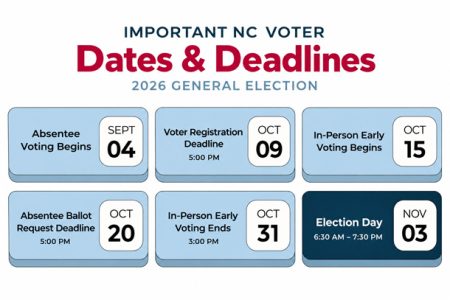
March 3, folks! That’s the date of the NC primary election. It’s time to exercise your precious right, your obligation, in this democratic society. That’s how you keep it a democratic society.
Here are a few basics to keep in mind—first and foremost being that if you have questions this does not answer, simply call the Buncombe County Board of Elections and ask them! Or follow the links below:

Photo: Tim Barnwell
Buncombe County Board of Elections — www.buncombenc.gov/199/Election-Services, or call (828) 250-4200.
Everything You Need to Know About the March 3, 2026 Primary Election
In-Person Early Voting — February 12-28 (NO Early Voting Februray 14-15)
Absentee Voting-by-Mail Begins January 12 — Your completed absentee ballot must submitted by 7:30 p.m. on March 3. Request an absentee ballot by completing an Absentee Ballot Request form, votebymail.ncsbe.gov/app/home.
Candidate List 2026 — Available at media.buncombenc.gov/common/election/reports/candidate-filing/candidates.pdf.
Nelda Holder is the author of The Thirteenth Juror – Ferguson: A Personal Look at the Grand Jury Transcripts.