A New Civil Rights Movement Rises
National Day of Action for Voting Rights
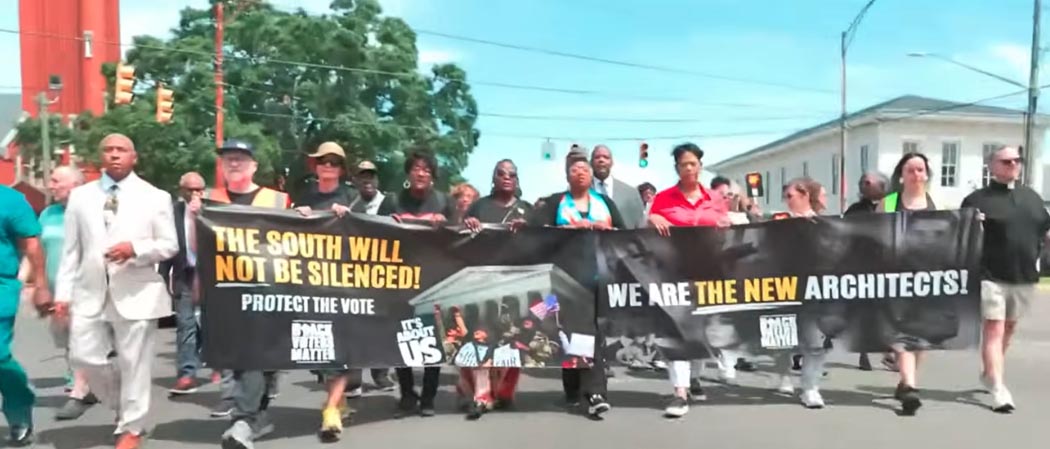
Under a hot Alabama sun, thousands of people from across the South converged on Montgomery for All Roads Lead to the South: National Day of Action for Voting Rights, a mass rally that stretched from the sacred ground of Selma to the steps of the Alabama State Capitol.
The gathering, held on Saturday, May 16, 2026, marked one of the largest coordinated voting‑rights mobilizations of the year, fueled by anger, grief, and determination in the wake of new court rulings that weaken protections for Black voters.
The day began in Selma at the Edmund Pettus Bridge, where faith leaders, local organizers, and national advocates opened with prayer and remembrance—an intentional invocation of the 1965 marchers who faced state‑sanctioned violence for demanding the right to vote.
Organizers framed the event as a direct continuation of that struggle, noting that the Supreme Court’s recent Louisiana v. Callais decision has made it significantly harder to challenge racially discriminatory maps.
From Selma, buses and caravans traveled to Montgomery, where more than 5,000 people gathered for the afternoon rally.
National Day of Action For Voting Rights, Mass Rally, Montgomery, AL
Speakers throughout the day emphasized that the South is once again the epicenter of a national battle over democracy. Across Alabama, Georgia, Louisiana, Tennessee, and Florida, legislatures are advancing redistricting plans that could erase or weaken Black political representation.
Organizers described the rally as both a protest and a launchpad for a sustained summer of organizing—including voter mobilization, civic education, legal advocacy, and direct action. Rev. Dr. Bernice A. King, who joined the Montgomery rally, called the moment “a trumpet call… not for a moment; it is for a movement,” invoking the legacy of her parents, Dr. Martin Luther King Jr. and Coretta Scott King.
The rally featured a multi-generational lineup of clergy, civil‑rights veterans, youth organizers, and elected officials. Many framed the day as a modern Freedom Summer, insisting that the fight for fair representation is inseparable from the fight for dignity, safety, and economic justice.
Participants traveled from across the region—Atlanta, Birmingham, Charlotte, Jackson, Memphis, Mobile, Nashville, and beyond—reflecting a broad coalition of more than 90 civil‑rights, voting‑rights, faith, labor, and community organizations.
One attendee from Birmingham captured the mood thusly: “Our democracy is on the line. Our rights are on the line. They are trying to take it all away.”
The event’s scale and symbolism, beginning at the bridge where marchers were beaten in 1965 and ending at the Capitol where segregationist policies were once defended, sent a clear message: the South remains both the frontline of voter suppression and the birthplace of resistance.
Organizers stressed that the fight does not end with the rally. Solidarity events took place nationwide, and more actions are planned throughout the summer as communities prepare for the 2026 midterm elections.
The May 16 mobilization underscored a truth echoed across speeches, chants, and prayers: despite the legal and political setbacks, a new Southern movement is rising—one rooted in memory, powered by multiracial coalitions, and determined to defend the right to vote.
As one speaker put it, standing before the Capitol, “We’re not at a stopping point. We’re at a starting point.”