Radical Reparations and the Work of True Healing
A bold reimagining of reparations that reaches every dimension of Black life.

Marcus Anthony Hunter’s Radical Reparations arrives at a moment when the national conversation about repair feels both urgent and stuck.
For decades, the idea of reparations has hovered around the same narrow frame—money, land, a long‑overdue debt finally paid. Hunter doesn’t dismiss those needs; he simply refuses to let the conversation end there. His book insists that the wounds of enslavement and racial capitalism run deeper than any check could reach, and that healing must be as expansive as the harm.
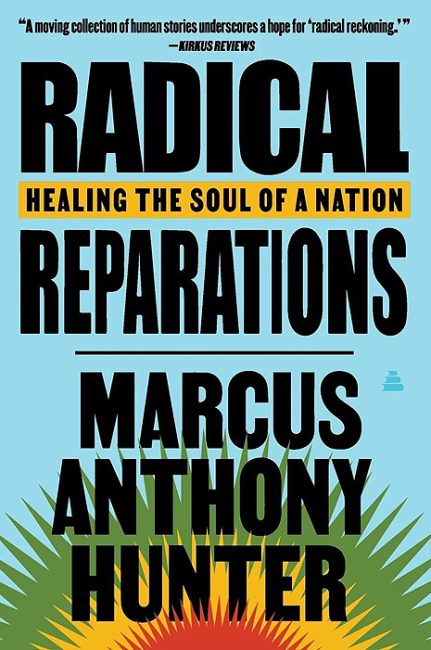 What makes this book compelling is its clarity: Hunter argues that the country has been trying to solve a spiritual, social, and political crisis with an economic toolset. He names the gap plainly. Monetary redress alone would leave entire dimensions of Black life—memory, imagination, safety, belonging—untouched. And in doing so, it would repeat the very neglect that created the crisis in the first place.
Hunter’s framework is the heart of the book. He outlines seven forms of compensation—political, intellectual, legal, economic, spatial, social, and spiritual—each one a doorway into a different kind of healing. He moves between historical documents, international examples, and speculative parables, weaving a narrative that feels both deeply researched and deeply imaginative. The book’s most provocative claim is also its most hopeful: reparations are not simply a matter of repayment; they are an opportunity to redesign the nation’s moral architecture.
Hunter’s voice is steady and insistent. His work grows out of years of engagement with communities, activists, educators, and organizers who already understand that repair must reach every part of our lives. That commitment is evident not only in Radical Reparations but also in his public writing, including his Labor Day essay for The Root, where he argues that the nation still benefits from generations of unpaid and unprotected Black labor—physical, intellectual, creative, and emotional—and that acknowledging this history is itself a form of repair.
Readers who come expecting a traditional policy book may be surprised. Hunter is not offering a checklist or a legislative roadmap. He is offering a shift in consciousness. He is asking the country to imagine reparations not as a transaction but as a practice, a long‑term commitment to healing the soul of a nation that has never fully reckoned with its past.
Profound, challenging, and beautifully timed, Radical Reparations is a conversation‑shifter. It invites us to think beyond scarcity, beyond fear, beyond the limits of what has been politically possible. And it reminds us that the future of reparations—if we are brave enough to pursue it—could be far more transformative than anything we’ve debated so far.
Read Dr. Marcus Anthony Hunter’s article, “A Labor Day Case for Reckoning With Unpaid Black Labor,” at www.theroot.com/opinion-a-labor-day-case-for-reckoning-with-unpaid-bla-2000124252.
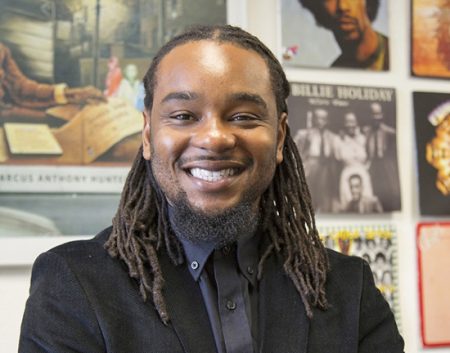
Dr. Marcus Anthony Hunter is a Board Member of the National Black Justice Collective. He has written multiple books, including Radical Reparations: Healing the Soul of a Nation. He is the inventor of the hashtag #BlackLivesMatter.