Housing Remains Out of Reach for Millions of Renters
The disparity between wages and the cost of rent.
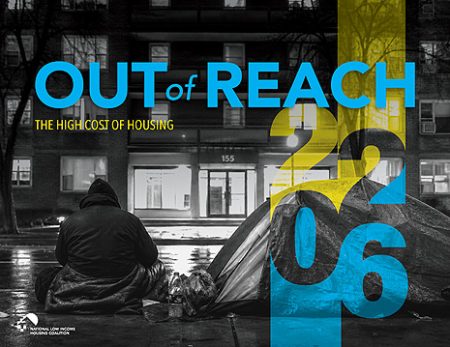 For more than 35 years, the National Low Income Housing Coalition’s (NLIHC) Out of Reach report has highlighted the growing gap between wages and the cost of rental housing in the US.
The 2026 report once again demonstrates that affordable rental homes remain out of reach for millions of low-wage workers, seniors, families, and other renters struggling to keep up with rising housing costs.
At the center of the report is the concept of the Housing Wage, which represents the hourly wage a full-time worker must earn to afford a modest rental home at HUD’s Fair Market Rent (FMR) while spending no more than 30% of their income on housing. This 30% threshold is widely accepted as the standard for housing affordability.
In 2026, a full-time worker must earn $34.73 per hour to afford a modest two-bedroom rental home and $29.19 per hour to afford a one-bedroom rental home nationwide.
The affordability crisis extends across nearly the entire country. In 49 states, the District of Columbia, and Puerto Rico, renters earning the average renter wage must work more than 40 hours per week to afford a modest two-bedroom apartment. In 36 states, average renter wages do not even cover the cost of a one-bedroom rental home at fair market rates.
Workers in many of America’s most common occupations continue to struggle with housing costs. Of the 25 most common jobs in the nation, 17 pay median wages below the Housing Wage for a one-bedroom rental, while 18 fall below the Housing Wage for a two-bedroom rental. These occupations employ approximately 74 million people, nearly half of the US workforce.
Low-income households face especially difficult challenges. Many renters include seniors, people with disabilities, students, and single-parent caregivers who are unable to work full-time or must rely on fixed incomes. In most areas of the country, a family of four living at the poverty level can afford no more than $825 per month in rent.
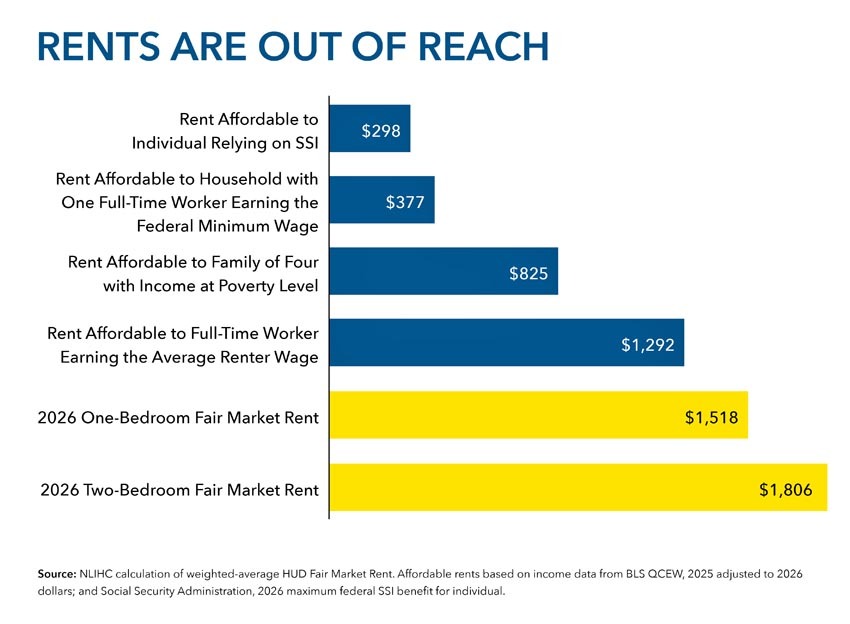 A full-time worker earning a wage of $7.25 per hour can only afford $377 per month, while individuals receiving Supplemental Security Income (SSI) can afford just $298 per month. By comparison, the average fair market rent is $1,518 per month for a one-bedroom home and $1,806 per month for a two-bedroom home.
The report also highlights significant disparities among racial and ethnic groups. While the median wage of a full-time white worker is sufficient to afford a one-bedroom apartment at fair market rent, the same is not true for many Black and Latino workers. Extremely low-income renters account for 18% of Black households, 16% of American Indian and Alaska Native households, and 13% of Latino households, compared with 6% of white households.
Adding to the challenge is the ongoing shortage of affordable housing. Developers report rising labor, material, and financing costs as major obstacles to building additional affordable units. As demand continues to outpace supply, federal housing assistance remains insufficient, with only one in four eligible households receiving assistance due to chronic underfunding.
According to NLIHC President and CEO Renee M. Willis, housing is about more than simply having a roof overhead. It provides stability, opportunity, dignity, and a pathway out of poverty. The report warns that reducing federal housing investments would only worsen existing challenges and deepen the nation’s housing crisis.
North Carolina Statistics
Working at a minimum wage of $7.25/hr. you have to work 132 hours a week to afford a modest 1 bedroom rental home. Working at minimum wage, a full-time worker can afford $377 for rent.
- Minimum Wage …………………………………………………….. $7.25
- Wage Needed to Afford 2-Bedrooms ……………………….. $27.11
- Number of Renter Households …………………………. 1,428,852
- Number of Renter Households Below 30% AMI …… 348,518
- Percent of Renter Households Below 30% AMI ……………. 23%
- Number of Renter Households Below 50% AMI …… 568,236
- Percent of Renter Households Below 50% AMI ……………. 38%
AMI: Area Median Income
The 2026 Out of Reach report underscores a continuing reality: wages have not kept pace with rental housing costs. For millions of Americans, and hundreds of thousands of North Carolinians, affordable housing remains increasingly difficult to find, reinforcing the need for expanded housing production, targeted assistance programs, and sustained public investment.
Read the report and view the statistics for other states at www.nlihc.org/oor.