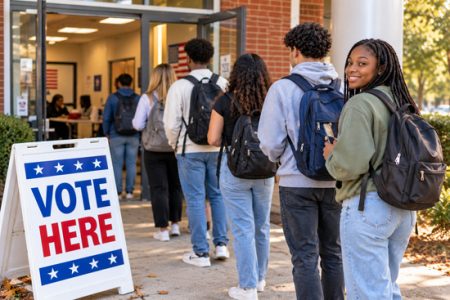
Ready to Vote?
Look Twice at Proposed Amendments
Early voting in North Carolina begins October 15, 2026 (absentee voting is already in progress).
If you are not already registered to vote, you may register and vote in the county where you reside (you must have resided there for at least 30 days) during the in-person early voting period.
If you are already registered to vote, check your registration to make sure it’s correct and up to date. If anything has changed—an address, married name, etc.—give yourself time to update it before you go to vote.
For full voting information, contact the North Carolina State Board of Elections (www.ncsbe.gov) or the Buncombe County Board of Elections (www.buncombenc.gov/199/Election-Services).
In-Person Early Voting begins Thursday, October 15 and ends at 3 p.m. on Saturday, October 31.
Statewide elections on the ballot will include partisan elections for the US Senate, the US House of Representatives, the NC Senate, NC House of Representatives, NC Supreme Court, and three seats on the NC Court of Appeals.
Nonpartisan local races include Asheville mayor, three City Council seats, three Buncombe County Board of Commissioner seats, plus County Clerk of Superior Court, County Sheriff, County Soil and Water Conservation District Board of Supervisors (two seats), and Asheville City Schools Board of Education (four seats). Also open are one NC Superior Court (District 40) seat and five District Court seats, plus District 40 Prosecutorial District Attorney.
We urge you to study the candidates’ values, positions, and track records before you vote. What do their past actions say about how they’ll act if they’re elected? Do a candidate’s values reflect yours?
Voter Alert
There are three state constitutional amendments on this fall’s ballot for which you are asked to vote “For” or “Against.” It should be noted that these amendment proposals were produced by the NC General Assembly this year on heavily partisan grounds; they were met with vetoes from Gov. Josh Stein, but were resuscitated by the Republican-majority General Assembly. Here are the proposals with notes from your friendly columnist.
- Constitutional Amendment to require all voters, not just those presenting to vote in person, to present photo identification before voting.
- Constitutional Amendment to keep the State income tax rate from being raised higher than three and one-half percent (3.5%).
- Constitutional Amendment requiring limits on property tax increases by local governments.
Sound Good?
Or not so good!
If everyone has to show a photo ID to vote, there are serious questions regarding absentee voting, particularly for the elderly or unwell, and perhaps the overseas military.
The state income tax can’t be higher than 3.5%, even for the superwealthy?
And, there must be limits on local government’s property tax increases.
Wow!
Calm down. And take the time to read the following observations (among a number of scathing criticisms of these amendments) supplied by the NC Budget & Tax Center: “Tax Cuts for Corporations and Millionaires, and Higher Costs for Counties and Families” (ncbudget.org/2026-27-north-carolina-budget-report-tax-cuts-for-corporations-and-millionaires-and-higher-costs-for-counties-and-families).
Here’s a clue to their assessment, with which I happen to agree: “More than a decade after tax cuts for corporations and the rich began in North Carolina, and after nearly three years without a new comprehensive state budget, state lawmakers finally approved one in July 2026. But the new budget did little to reverse years of underinvestment or protect North Carolinians after Congress enacted deep federal cuts to health care and food assistance last year in order to finance continued tax cuts for the wealthy few. North Carolinians are struggling to cope with increased costs and hardship.”
The article points out explicit proposals in the 2026 short session that never got to the floor of the Legislature for a vote, such as:
- The governor’s recommended budget, which preserved around $900 million in the year 2027 alone
- An increase in corporate income tax to 5% “in alignment with neighboring states, raising an additional $2 billion a year”
- An increase of $1 billion a year for public schools under the “Fair Share for Public Schools Act” that would have come from an income tax increase on income above $1 million.
If you just read that last paragraph, you’ll have some idea of why the proposed “appearances” on the fall ballot in this state might not be what they seem. And why this voter will be voting in opposition to all three.