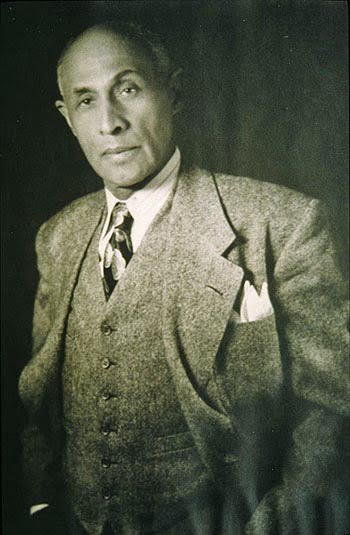
Madison Hemings
The Hemings children reveal how race in America was never biological, only political.

By law, the children of Sally Hemings were classified as Black, even though several later entered white society. Their lives reveal how race in America was never biological, only political.
Racial Identity in Early America
Madison Hemings’ life offers one of the clearest windows into how racial identity in the United States was constructed, enforced, and manipulated. Born in 1805 at Monticello, he was one of the children of Sally Hemings, an enslaved woman of mixed ancestry, and Thomas Jefferson. Although no authenticated images of Sally Hemings exist, her story survives through family testimony, legal records, and the accounts of her children.
After Jefferson’s death, the Hemings children faced choices that reflected the racial landscape of the 19th century. Several siblings entered white society, aided by their appearance and by Jefferson’s informal promise that they would be allowed to “go free.” Passing into Whiteness was a survival strategy in a society that violently enforced racial boundaries. Three siblings married white partners and lived the rest of their lives as white Americans.
Madison Hemings chose a different path.
He identified as a Black man, married a Black woman, and settled in a Black community in Ohio. In an 1873 interview with the Pike County Republican, he described his mother’s life at Monticello and recounted how a white man once promised Sally Hemings a “very fine present” if she named her newborn son Madison, a promise she said was never fulfilled. Hemings used the anecdote to illustrate the unreliability of white promises under slavery.
His testimony remains one of the most important firsthand accounts of life inside Jefferson’s household and the lived reality of racial hierarchy.
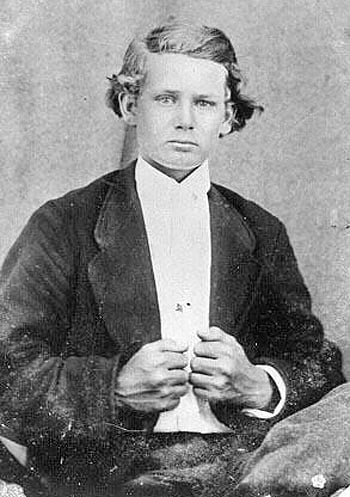
Thomas Eston Hemings
Madison Hemings’ account is only part of the story. His younger brother, Thomas Eston Hemings, reveals the other half, the part that shows how racial identity in America was never biological, only political.
Born in 1808 at Monticello, Eston was the youngest son of Sally Hemings and, as DNA evidence now supports, Thomas Jefferson. Jefferson freed Eston and Madison in his will, and the brothers lived with their mother in Charlottesville until her death in 1835.
Eston married Julia Ann Isaacs, a free woman of color, and built a respected life in Chillicothe, Ohio, where he earned his living as a musician and bandleader. He is remembered as “a master of the violin” and an accomplished caller of dances.
But in the 1850s, Eston made a choice that would define his descendants for generations. He moved his family to Madison, Wisconsin, changed their surname to Jefferson, and the entire household entered white society. His children married into white families, served in the Union Army, and lived the rest of their lives as white Americans. One son, John Wayles Jefferson, became a colonel in an all‑white regiment and later a wealthy cotton broker.
Eston’s life demonstrates with absolute clarity that racial categories were granted, enforced, and policed. His siblings lived as Black; he and his children lived as white. The difference was not ancestry. It was recognition, appearance, community acceptance, and law.
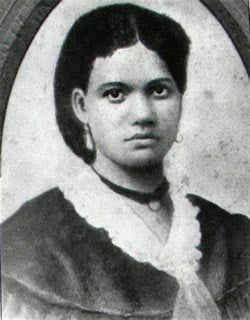
Julia Ann Hemings
The story of racial identity in the Hemings family did not end with Madison and his siblings. It continued into the next generation through Madison’s daughter, Julia Ann Hemings, born in 1835 in Ross County, Ohio. Julia Ann grew up in a free Black farming community where her father was a respected carpenter and where racial identity was shaped by community life rather than by Virginia’s laws.
Her photograph, taken decades after the era of slavery, is one of the earliest documented images of a Hemings descendant. Because no verified image of Sally Hemings exists, Julia Ann’s portrait has often been mistakenly circulated online as Sally Hemings herself. The misidentification erases Julia Ann’s own identity and distorts the historical record, illustrating how the politics of race continue to shape public memory.
Julia Ann’s life reflects the generational shift from enslavement to self-determined Black identity. Her existence, and the survival of her image, underscores the central truth revealed by the Hemings family: race in America was never biological, only political, a system that shaped not only how people lived, but how they were remembered.
The history of the Hemings family forces us to confront the fact that Whiteness was built through law, violence, and selective inclusion, a truth that can feel uncomfortable, but is essential to understanding America.
Race as a Political Invention
Whiteness is not a biological fact, it is a status granted to people who are recognized as white.
For most of human history, “race” was not a biological category. Early European societies classified people by religion, region, or social status. The modern idea of Whiteness emerged gradually, especially during colonization, when European powers sought ideological justification for slavery.
By the 18th and 19th centuries, American lawmakers began codifying Whiteness through legislation. Virginia’s racial integrity laws, culminating in the 1924 Racial Integrity Act, defined Whiteness as a kind of purity and enforced the “one-drop rule,” which classified anyone with African ancestry as Black. These laws were intertwined with eugenics movements that claimed racial mixing would harm society.
Walter Plecker, Virginia’s registrar of vital statistics, aggressively policed racial categories, often reclassifying Native Americans as “Colored” and erasing their identities in official records. His policies remained in place until the Supreme Court struck down bans on interracial marriage in Loving v. Virginia (1967). The state formally denounced its eugenics history in 2001.
Who Gets to Be White
W.E.B. Du Bois wrote that “the discovery of personal Whiteness among peoples is a very modern thing, a nineteenth and twentieth century matter,” arguing that earlier societies treated skin color with “mild curiosity” and that modern Whiteness emerged suddenly as a political project, not a biological reality.
Whiteness has never been a fixed category; groups once excluded, Irish, Italian, Jewish, and Hispanic people, were gradually accepted as white when they assimilated and aligned themselves with existing racial hierarchies. In The Souls of White Folk, Du Bois makes clear that Whiteness is a modern invention shaped by power, economics, and social control.
Madison Hemings’ life sits at the intersection of these shifting definitions. His siblings entered Whiteness because the system allowed them to. He remained Black because he chose to, and because he understood the moral and political stakes of racial identity in a country built on slavery.
His story is not only a family history; it is a window into how America constructed race, enforced it, and continues to grapple with its legacy.
Editorial Notes: This article has been updated. There are no verified photographs of Sally Hemings. A photograph of her descendant, Julia Ann Hemings, was mistakenly labeled as Sally Hemings; the caption has been corrected. The article has also been fully rewritten for clarity and historical accuracy.
The Urban News is committed to accurate storytelling about Black history and the systems that have shaped our communities. Some of the topics we cover can evoke strong emotions, and we understand that discomfort is part of learning. If you spot an error, we welcome corrections and will update our content promptly.