Republicans on State Board of Elections Intent on Eliminating Sunday Voting
Rolls back two long‑standing pillars of early voting access.
By Cash Michaels –
When the five-member State Board of Elections met for its first session of 2026 on January 13, it was clear that the Republican majority was still intent on eliminating Sunday early voting in counties across the state.
It did. By a party-line vote, the GOP-led board voted to eliminate Sunday voting for the upcoming March primaries in those counties where the issue has not been decided, in addition to eliminating on-campus early voting sites at NC A&T State University and other Guilford County campuses.
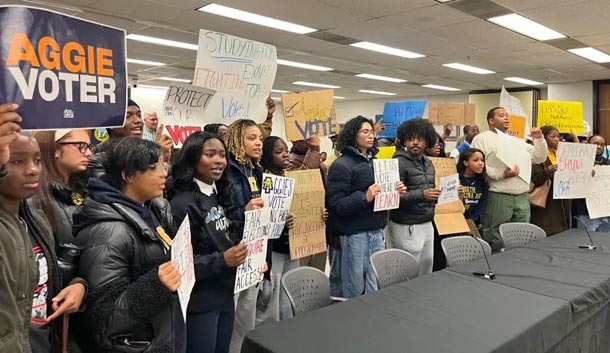
Students from NC A&T demonstrated with protest signs at the meeting even before the controversial decision was made.
When it came to Sunday voting, it was also clear that African American voters who looked forward to what has become known over the years as “Souls to the Polls,” where Black churches would load up their church vans with congregants after service and take them to the nearest early voting site so that they could cast their ballots en masse, were intent on protecting what they see is their right to legally vote on the day of their closing.
But because most Black voters are Democrats, Republican lawmakers have tried to kill Sunday voting.
During the SBOE meeting Tuesday, early voting plans for the March primaries were being reviewed when Sunday voting once again was raised. Republicans have tried to eliminate Sunday voting in the past because of its popularity in Black churches, but their efforts to stop the practice were always stymied by court orders that determined those efforts to be racially biased and unconstitutional.
Republicans, in turn, have tried to argue that poll workers deserve a day of rest given an already mandated six-day early voting schedule. But advocates, like SBOE Board members Jeff Carmon and Sioban Miller—both Democrats—countered that the right to vote to African Americans, especially in the South, was precious, and should be maintained, especially on Sundays if that allows Black citizens to execute their right.
“My father, a Vietnam vet, fought for this country—and, he reminded me last night, came home to a country where he still was treated as a second-class citizen,” Carmon told his fellow board members. “So he charged me to come in here today and fight.”
Carmon then challenged the SBOE Republican chairman.
“At our first meeting with you as chair, you stated you want to have a fair election, make voting easy, and make sure the law is followed and make sure that there is trust in the election system,” Carmon told SBOE Chairman Francis De Luca. De Luca didn’t respond.
But Republican SBOE member Stacy Eggers IV then answered Carmon, saying, “I agree with your sentiments, but we reached a different conclusion.”
The SBOE’s other Democratic member, Siobhan Miller, then made clear that, from her personal knowledge, the public has accepted Sunday voting, so why should Republicans want to end it.
“I got 222 emails just yesterday, and I’ve gotten over 1,000 in the last couple of weeks, and I didn’t hear from anyone that said we shouldn’t have more voting sites, we shouldn’t have Sundays,” Millen said. “Every single one, from people that reached out and used their First Amendment right to petition their government, wanted to keep college voting, wanted to keep Sunday voting.”
But in the end, when the vote was taken, Sunday voting was defeated.
Spectators at the SBOE meeting also knew that on-campus early voting sites would also be voted down, and they loudly let Republicans on the board hear their displeasure. They were warned by SBOE Chairman DeLuca to quiet down, but Democrat Carmon spoke up in their defense.
“I think they should be able to hold their signs up, as long as it’s not blocking someone’s view,” Carmon said. “We don’t have public comment. And they are here, and they want us to know why.”