Read Your Way Through It
A few recommendations to nourish your mind.

Photo: Tim Barnwell
Legislative News by Nelda Holder –
I suspect many of you—most of you—are as disheartened by current political news in this state and country as I am right now. (We won’t include the entire world in this column. Let’s start a wee bit smaller.) So I thought it could be helpful to share part of my therapy: reading.
Yes—by all means start with The Urban News, a feisty independent paper serving Asheville and Buncombe County and beyond with glorious news of the fuller community living in these environs. Owned and published by a feisty, independent woman named Johnnie Grant who created this special news outlet some years ago and presents it—FOR FREE—to the local and extended public on the streets and online at theurbannews.com. Small miracle, that.
And since my own beat is basically state government, I’ll share one of my favorite state news sources—NC Newsline. That’s an online news source focused on state government, and just like Urban News, it’s free of charge. You can sign up for NC Newsline at statesnewsroom.com/subscribe.
I find those two sources trustworthy and highly pertinent regarding local (The Urban News) and state (NC Newsline) coverage of news that is directly related to our lives and wellbeing.
But What About Our Nation?
What prompted me to write about reading, however, is the murkier condition of my—our—country. I think we’re all feeling it. A growing unease with the upheaval of social norms and rights. An unsettling increase in militant power. An economic slide downward for those already in the bottom tiers. A lack of leadership that pursues the ideals we learned to believe in as children. A dishonoring of our place as citizens.
These and other social/political/moral worries grow more and more oppressive. The beliefs we have been encouraged to hold in the value of being an American are being sorely tried in many ways. And this sends me scurrying back to the beginning.
Not that the beginning of this country was exactly perfect. We have never truly atoned for such egregious original sins involved in the very taking of this land from its original inhabitants, and the longstanding racism that ate at its moral core—and is still a factor in the quest for true national equity.
But the beginning I hold on to is the crafting of a government that belonged, in theory, to “the people.” For all its flaws, there was still a bright hope in the cause of “liberty and justice for all,” and there was such brilliance in crafting a governmental framework that could support a working democracy.
Back to the Future?
And so it is that we find ourselves in these current times to be a republic facing its 250th birthday soon while carrying on its back the weighty problems of war, social inequity, sharply increasing poverty, and a narrowed vision of hope.
My personal solace? I turn to history. I turn to books. I have to read about how we started and why (the good and the bad—but mostly the good). I have to try to get my head on straight concerning citizenship and my own obligations to this country … which always leads me to a great need to consult with its founders or with historians who have looked long and hard at these questions I have.
Reading can be calming for the soul and nourishment for the mind. I highly recommend it if you, too, are feeling heightened angst and want to fill your head with tools to repair the breaches. And here are a few recommendations to get you started.
Recommendations
The following are three books and one magazine that I highly recommend for helping to get a grasp of our governmental history:
Hamilton: The Revolution (Lin Manuel Miranda and Jeremy McCarter): This special book from 2016 contains the complete libretto of the Broadway musical “Hamilton” along with the story of its creation. It is a fascinating way to immerse yourself in governmental history and contemporary theater at the same time.
Alexander Hamilton (Ron Chernow): A straight-on, detailed biography of Hamilton that, as one reviewer called in when it came out in 2004, “A monumental contribution to our understanding of the beginnings of the American republic.”
This Is an Uprising: How Nonviolent Revolt Is Shaping the Twenty-First Century (Mark Engler and Paul Engler, 2016): A look at nonviolent movements around the world and discussion of what is possible in America.
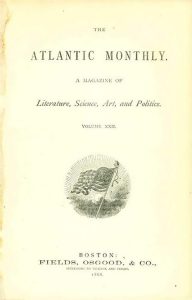
The Atlantic: OK, did you know that The Atlantic magazine was founded in Boston in 1857 as The Atlantic Monthly with an aim to provide a platform “for prominent writers to discuss significant cultural and political issues of the time, including education and the abolition of slavery”? Or that its mission statement was signed by none other than Ralph Waldo Emerson, Herman Melville, Harriet Beecher Stowe, and Nathaniel Hawthorne? It’s still around and still very much in the news, and is now based in Washington, DC.
And here’s a list of recommendations from my favorite and quite prolific reader and friend Mark Jamison (a sometimes columnist for The Urban News), featuring pertinent discussions of today’s United States Supreme Court as well as a taste of the social topics of this era, artificial intelligence and big tech.
Injustices: The Supreme Court’s History of Comforting the Comfortable and Afflicting the Afflicted (Ian Millhiser).
Bad Law: Ten Popular Laws That Are Ruining America: (Elie Mystal).
The Shadow Docket: How the Supreme Court Uses Stealth Rulings to Amass Power and Undermine the Republic (Stephen Vladeck—originally 2023 but the paperback from 2024 has an updated preface).
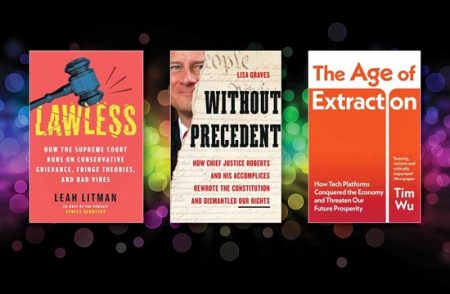
Lawless: How the Supreme Court Runs on Conservative Grievance, Fringe Theories, and Bad Vibes (Leah Litman).
Without Precedent: How Chief Justice Roberts and His Accomplices Rewrote the Constitution and Dismantled Our Rights (Lisa Graves).
Mark notes that “the titles of the above four are pretty explanatory. All of them look at the court from different angles. All are quite accessible.” Then there’s more—
It Was All a Lie: How the Republican Party Became Donald Trump by Stuart Stevens. Stevens is a former Republican campaign manager and operative. This may be one of the best mea culpas from someone who realized that the Republican Party has been headed this way for a long time.
How We Can Win the Civil War: Securing a Multiracial Democracy and Ending White Supremacy for Good by Steve Phillips. Written before Trump’s second election, parts are less desperate than they might be but it’s a good analysis of racial politics. Phillips is an author who was the youngest person elected to office in San Francisco.
The Myth of Artificial Intelligence: Why Computers Can’t Think the Way We Do (Erik J. Larson). A look at some of the fallacies underpinning the claims of AI. Larson is a computer scientist with a philosophical bent. He uses the philosophy of Charles Pierce, a contemporary of William James, to show that AI lacks intuition and inference. He does a really good job of explaining what AI is.
The AI Con: How to Fight Big Tech’s Hype and Create the Future We Want by Emily Bender and Alex Hanna. Bender is a linguist and Hanna is an AI researcher. They do a good job of explaining LLMs (large language models) and how they don’t really “think” in any meaningful way. They cut through a lot of the hyperbole and salesmanship to show what AI is, what it can and cannot be, and how it can be abused.
The Age of Extraction: How Tech Platforms Conquered the Economy and Threaten our Economy by Tim Wu, and Enshittification: Why Everything Got Suddenly Worse and What to Do About It by Cory Doctorow. These two go together to explain how big tech has gone from providing useful services to becoming economic rapists bent on extracting all the value from the economy. Wu is a lawyer who served as a tech advisor to Obama, and Doctorow is a novelist and tech writer.
Easy Money: Cryptocurrency, Casino Capitalism, and the Golden Age of Fraud by Ben Mckenzie with Jacob Silverman. This one is a couple of years old, but it’s a breezy read that explains crypto well and exposes the market manipulations that make its value largely a chimera.
Videos
NYT columnist Jamelle Bouie has produced a series of short, brilliant videos on the courts—a topic of major interest and concern in today’s political milieu.
They’re available on YouTube and have such titles as Voter Fraud Isn’t Real, Clarence Thomas Is Projecting, and Who is ‘Subject to the Jurisdiction’ of the United States. To watch these videos and many others, go to www.youtube.com/@jamelle-bouie.
Non-citizen voting isn’t a real problem. It makes no sense to impose serious burdens in order to address imaginary concerns, and the reason that Donald Trump is obsessed with “fraud” is that “fraud” in his mind refers to the “wrong people” voting, and voting against him specifically.
There Ya Go, Folks!
OK, get your minds busy figuring all this out! It’s our country. It’s our government. Make sure “they” know it!
Nelda Holder is the author of The Thirteenth Juror – Ferguson: A Personal Look at the Grand Jury Transcripts.