The Confirmation of Amy Coney Barrett
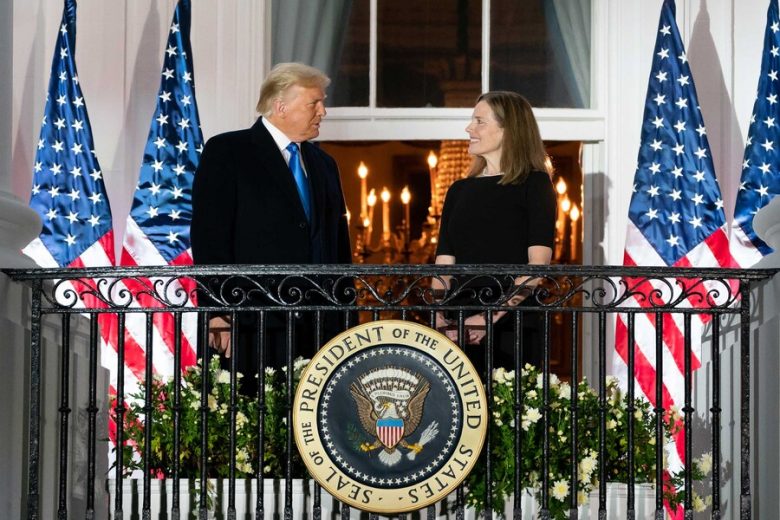
On Monday, October 26, 2020, Amy Coney Barrett was confirmed to the U.S. Supreme Court.
Barrett, a 48-year-old former Notre Dame law school professor, was sworn in as the latest Associate Justice to the Supreme Court following her confirmation by a 52 to 48 margin in the Republican-controlled U.S. Senate.
Rep. Alexandria Ocasio-Cortez had just three initial words to say, “Expand the court,” a sentiment widely shared as the only just recourse after the GOP under President Donald Trump and Senate Majority Leader Mitch McConnell rammed through the third justice for the nation’s highest court in less than four years.
“Republicans do this because they don’t believe Dems have the stones to play hardball like they do,” the New York Democrat added subsequently. “And for a long time they’ve been correct. But do not let them bully the public into thinking their bulldozing is normal but a response isn’t. There is a legal process for expansion.”
Ocasio-Cortez is correct. Democrats–if they are able to regain control of the Senate and the White House, and also retain the House, in next week’s national elections–would have the power to make sweeping changes to the Supreme Court, including increasing the number of seats from the current nine. As MarketPlace recently noted: “Nine isn’t a number that’s set in stone—the Constitution doesn’t state how many justices must be on the Supreme Court. There were originally six justices on the court, with that number fluctuating throughout the country’s history.”
Shortly after Ocasio-Cortez’s tweet, her House colleague and fellow progressive Squad member Rep. Ilhan Omar (D-Minn.) re-shared the message.
“Remember that Republicans have lost 6 of the last 7 popular votes, but have appointed 6 of the last 9 justices,” added Omar. “By expanding the court we fix this broken system and have the court better represent the values of the American people.”
Sen. Elizabeth Warren (D-Mass.) said that while Republicans “are popping champagne tonight to celebrate how they for shoved aside the wishes of the American people to steal a Supreme Court seat and impose their radical agenda on the country,” Democrats are not about to give up the fight.
“Every option needs to be on the table to restore the Supreme Court’s credibility and integrity,” said Warren. “Every option to expand our democracy. Every option to ensure that all Americans have equal justice in our courts and representation in our institutions.”
Barrett is the most inexperienced person nominated to the Supreme Court since 1991, when President George H.W. Bush nominated Clarence Thomas, then just 43, to replace the legendary Thurgood Marshall. Trump has nominated 10 judges that the American Bar Association rated as unqualified to serve on the federal bench; seven of them were confirmed.
When Trump took office, he immediately prioritized the federal judiciary in a way no other president has. To help him fill the bench with religious conservatives, he turned to the Federalist Society, a conservative legal organization established in 1982 that over the years has been funded with millions of dollars in dark money donations in an effort to stack the federal courts with conservative and libertarian judges for decades to come.
By July 2020, the group had helped the GOP-controlled Senate ram through a record 218 Trump judicial nominees–85 percent of them white, and 76 percent male. Its singular focus on youth and ideological purity among the nominees has been instrumental in lowering the standards for judicial office.
A graduate of Notre Dame law school, Barrett has almost no experience practicing law whatsoever–a hole in her resume so glaring that during her 7th Circuit confirmation hearing in 2017, Democratic members of the Senate Judiciary Committee were dismayed that she couldn’t recall more than three cases she’d worked on during her brief two years in private practice.
Barrett has demonstrated hostility toward LGBTQ rights in her words and rulings. She defended the Supreme Court’s dissenters on the landmark marriage equality case of Obergefell v. Hodges, questioning the role of the court in deciding the case. She said Title IX protections do not extend to transgender Americans, claiming it’s a “strain on the text” to reach that interpretation. She misgendered transgender people, referring to transgender women as “physiological males,” while casting doubt on transgender rights. Barrett has also consistently demonstrated opposition to reproductive rights, calling Roe v. Wade an “erroneous decision.” She also refused to rehear a racial segregation case, raising significant concerns about her approach to Civil Rights law.
She has criticized the ruling upholding the Affordable Care Act–which has helped millions attain quality, affordable health care–and expressed opinions that suggest she would strike down the law. Her hostility towards many of society’s most marginalized, victimized and vulnerable groups raises serious concerns about her ability to be impartial and fairly consider the rights of all who come before the Court.
Given the upcoming election, and Trump’s continual assertion that the election is rigged–despite not yet taking place–some journalists are concerned that we are heading to another Bush v. Gore election in which the Supreme Court, and therefore Barrett, are able to determine the outcome of the election.