Redistricting by the General Assembly: Five Legal Considerations
 By Bob Joyce
Citizens throughout the country have a right to representation in the legislative branch that is at least approximately equal. Therefore, representative districts in every state must be redrawn after each census, which according to the US Constitution must be taken every 10 years. Censuses are always conducted in years ending in “0” and the data they compile becomes available in years ending in “1.”
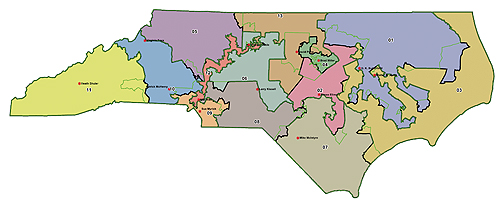
Redistricting means redrawing the districts from which public officials are elected. The General Assembly is responsible for drawing new districts for allocation of seats in the US Congress and the NC House and Senate. Many county commissioners, school board members, and city council members are elected by districts as well. Once adopted, a valid NC Senate or House redistricting plan may not be changed during that decade. If the plan is not precleared under the Voting Rights Act (discussed below) or if the courts overturn a plan, then a new plan may be adopted.

|
| Bob Joyce has practiced law with Chadbourne & Parke in New York, and with Barber & Joyce in Pittsboro, NC. |
Redistricting faces many issues of partisan politics and good
governance, but for the moment let’s focus on five legal considerations.
(As a side matter, keep in mind that, in addition to more than 100
counties, cities, and school units that elect their governing boards
from districts are now undergoing the redistricting task, and for them
the legal issues are principally the same as those facing the General
Assembly).
The first of the five is: Districts must contain about the same number
of people each. This requirement commonly goes by the name
“one-person-one-vote,” and it is a requirement that, as the US Supreme
Court has said for the past fifty years, comes directly from the US
Constitution.
There was a time when state legislatures did not try to make districts
the same size: until the 1960s each county in North Carolina was
entitled under the state Constitution to one member of the state House,
no matter how small the county’s population. But the Supreme Court said
that uneven districts violate the Equal Protection Clause of the
Fourteenth Amendment of the US Constitution, because people living in
more populous districts have votes that count less than people living in
smaller districts. So now the rule of thumb is that for state House and
Senate districts, the spread from the least populous district to the
largest, when the new districts are drawn, cannot exceed 10 percent.
And, the US Supreme Court has said, for seats in Congress the
requirement is even stricter—very little deviation is allowed.
In the last redistricting after the 2000 census, all congressional
districts were drawn to be within one person of the same size. The
one-person-one-vote requirement will be challenging to meet, but the
legal concept behind it is really straightforward.
The second of the five legal considerations is, by contrast,
complicated and subtle: The proper consideration of race in the drawing
of districts. The general legal principle is that race should not be the
dominant factor in the drawing of districts. The US Supreme Court said
exactly that in a redistricting case arising in North Carolina. Yet
there are two circumstances in which the law requires that race be taken
into account, and both of those arise under the federal Voting Rights
Act of 1965. That Act has two central provisions. Section 2 prohibits
discrimination in the administration of elections everywhere in the
country; Section 5 requires the pre-clearance of electoral changes in
some jurisdictions in the country, including 40 North Carolina counties.
The Voting Rights Act and court cases decided under it forbid drawing
districts that dilute minority voting strength. For the 40 counties in
North Carolina covered by Section 5 of the Voting Rights Act, this means
avoiding “retrogression,” or worsening the position of racial
minorities with respect to the effective exercise of their voting
rights.
All 100 counties are subject to Section 2 of the Voting Rights Act,
which may require drawing districts which contain a majority minority
population if three threshold conditions are present: 1) a minority
group is large enough and lives closely enough together so that a
relatively compact district in which the group constitutes a majority
can be drawn, 2) the minority group has a history of political
cohesiveness or voting as a group, and 3) the white majority has a
history of voting as a group sufficient to allow it to usually defeat
the minority group’s preferred candidate.
The totality of circumstances, including a past history of
discrimination that continues to affect the exercise of a minority
group’s right to vote, must also be taken into consideration. These
rules come from Thornburg v. Gingles, a landmark US Supreme Court Voting
Rights Act case arising from North Carolina in the 1980s.
Under Section 2—the general anti-discrimination provision—North
Carolina has seen successful lawsuits that challenged the ways in which
certain elections were conducted, including challenges to the past ways
of drawing legislative districts. The remedies that the courts imposed
in those lawsuits required the consideration of race in the drawing of
districts, mandating the creation of districts that had a majority
African American population, again including a number of legislative
districts, to enhance the opportunities for African American voters to
participate in the electoral process and to elect candidates of their
choice. As a result, the General Assembly is obligated to continue to
consider race in the drawing of districts where those remedies for prior
discrimination have been put into place.
And under Section 5—with respect to those 40 NC counties covered by its
provisions—the law requires that electoral changes, such as redrawing
lines to meet the one-person-one-vote requirement, must not be made in
such a way as to make it harder for African American voters to
participate in the electoral process and to elect candidates of their
choice. Changes that make it harder are termed “retrogressive,” and the
US Department of Justice will not pre-clear such changes, unless perhaps
demographic shifts have made the retrogression unavoidable. The entire
state-wide plans must be submitted for pre-clearance, because every part
of a plan will depend to some extent on every other part.
The third of the five legal requirements: With respect to the state
House and Senate districts, the General Assembly must keep in mind the
“Whole Counties” provisions of the state Constitution. The Constitution
prohibits dividing counties in drawing legislative districts. In
interpreting that provision, our state Supreme Court has recognized that
the primacy of federal law means that considerations under the Voting
Rights Act, as described just above, must be met first, and they may, in
the proper circumstance, require the dividing of counties. Beyond that
consideration, however, the state Supreme Court has given a roadmap of
instructions to the legislature on how to combine counties into
groupings and then to create divisions within the groupings to meet as
fully as possible the one-person-one-vote requirements and the Whole
Counties provision at the same time.
The fourth of the five legal requirements was defined by our state
Supreme Court recently: In the drawing of maps for the state House and
Senate, the General Assembly may not use a mix of single-member and
multi-member districts. Multi-member districts were once common. The
practical consequence now is that all districts must be single-member.
The fifth of the five legal requirements is found in the state
Constitution: All state House and Senate districts must be composed of
contiguous territory.
In addition to these five legal requirements, there are three other
significant concerns. One, the US Supreme Court has been clear that
incumbency protection is a legitimate concern in drawing districts. Two,
there has long been a consensus that compactness in the drawing of
districts is a desirable consideration, even if it may not be literally
required. And three, it is highly desirable from the point of view of
elections administrators that the General Assembly not split voting
precincts in the drawing of districts. Not only is administration eased,
but the likelihood of error is reduced.
Redistricting is inherently a political exercise, but it operates within these legal constraints.
Bob Joyce joined the UNC-CH School of Government (then the Institute
of Government) in 1980. He has practiced law with Chadbourne & Parke
in New York and with Barber & Joyce in Pittsboro, NC. He is a past
member of the executive committees of the Education Law Section of the
North Carolina Bar Association and the North Carolina Council of School
Attorneys. He has served as editor of the School of Government’s
Legislative Reporting Service, School Law Bulletin, and Popular
Government.
His publications include The Law of Employment in North Carolina’s
Public Schools, The Precinct Manual, and chapters in Education Law in
North Carolina. Joyce earned a BA from the University of North Carolina
at Chapel Hill, and a JD from Harvard Law School.