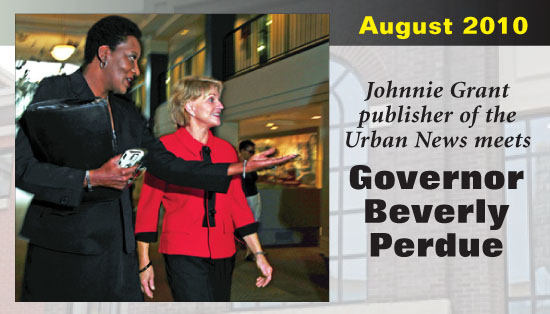
Governor Beverly Perdue Visits The Urban News
The governor noted that in a typical ninth grade classroom, “ten of the
thirty children in the class will not succeed.” She decried that such
failure is happening “in North Carolina, and in many school systems
within America.”
What’s needed is a way to address the disparities in education, which
result in part from economic disparities. Those economic disparities
arise not so much from race, but from inaccessibility. Lack of
broadband coverage means there is little or no high-speed Internet
service in rural western counties, limiting both job opportunities and
education.
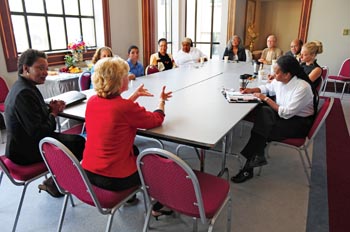 |
| NC Governor Beverly Perdue takes time to answer questions from staff and supporters of The Urban News. Photo: Renato Rotolo |
“There are children who don’t have Internet access in the home, and that
makes it very hard for them to compete in the classroom. Many other
states have huge initiatives; we’re just so stressed economically that I
don’t know how we’d make that happen.” The state has been awarded $83
million in stimulus funds to accomplish that goal, but only part of that
money will go to western counties.
The governor supports allowing municipal governments to set up their own
broadband access, as many activists wanted Asheville to do several
years ago. She noted, “In the 21st century no person in North Carolina
should be without affordable high-speed access to the Internet. Children
and small businesses cannot flourish educationally or economically
without broadband access, and we are trying to lay that down all over
the state.”
A proclaimed hallmark of the Perdue administration is the goal of
raising the high school graduation rate. “It is absolutely unacceptable
that a kid leaves the fourth grade without being able to read and count
on a fourth-grade level. We are going to put an end to that,” the
governor said, asking for help from the community to achieve her goal.
A series of initiatives through the public school system and charter
schools includes “learn and earn” high schools, which offers students
who aren’t traditional learners a different kind of environment, and
which sometimes takes the shape of a school within a school. The
governor also expressed support for ensuring that every student should
have at least one semester of cultural arts education by the ninth
grade.
Governor Perdue is working on a plan that she hopes to present to the
General Assembly in January that would not allow anyone under 18 to earn
a GED (General Educational Development) without also having a career
track in place. Under present laws a dropout of 16 can earn a GED
without having any career plans in place.
“Children who think they can drop out and be a short-order cook and
drive a nice car don’t understand that a GED [diploma] is not a ticket
to a job,” says Perdue.
“They must have career training. And that’s
going to be contentious in NC, but I’ve never been one to back away from
contention. I believe North Carolina can be globally competitive as any
part of America [as long as] churches and communities wrap their arms
around children whose parents might not be able to keep them geared up
and focused on a career or college.”
Jobs and the Economy
 |
| The Urban News office is now located at 2 South Pack Square, on the 3rd floor. |
Another topic of importance was economic issues, ranging from the
economic disparities that plague the state to ways for North Carolina to
recover from the ongoing recession. Initiatives and programs the
governor discussed include both long-term and short-term, ongoing
programs.
One program that has generated 90,000 to 100,000 jobs is a
weatherization program for older homes. The program, underwritten by
funding from the stimulus package (the American Recovery and
Reinvestment Act of 2009), aims to assess 800 houses each month to
identify those that will benefit from the installation of better
insulation, weather-stripping, new windows, and other green-energy
upgrades.
The governor noted that this is an area where civic interest in green
building and environmental awareness have successfully shifted to
commercial implementation; she also noted that the stimulus funding ends
in June, 2011. According to the governor’s website, NC is leading the
nation for energy efficiency in our building codes.
Another job-generating program recently touted by the governor’s office
on its website is the expansion of the Ethan Allen plant in Old Fort,
just over the Buncombe County line in McDowell County. Ethan Allen
Operations Inc., a manufacturer of home furnishings, plans to create 90
jobs and invest $250,000 to expand its production capacity. The project
was made possible in part by a $270,000 grant from the One North
Carolina Fund.
Longer-term economic initiatives that the governor favors include the
possibility of new passenger rail corridors. Under discussion regionally
is high-speed rail line from Washington, D. C. to Richmond, Va., which
could continue some day to central North Carolina. In that case,
passenger rail service could be restored between Raleigh and Asheville,
though there are no plans to develop the system at present.
There has been some additional good economic news, though not nearly
enough to end the long recession. In Cullowhee the governor, joined by
Congressman Heath Shuler (11-D), and Appalachian Regional Commission
(ARC) Federal Co-Chair Earl F. Gohl announced a $300,000 grant to the
Southwestern North Carolina Planning & Economic Development
Commission to assist three Appalachian community colleges in developing a
green workforce-training program.
Through her official website, www.governor.state.nc.us, the governor
also announced that the North Carolina Commission on Volunteerism and
Community Service has awarded more than $3.5 million in grants to 10
AmeriCorps programs across the state for the 2010-11 program year.