Politics and the NFL Combine

by Errington C. Thompson, MD –
For NFL fans, this is a terrible time of the year.
Football fanatics followed the NFL through preseason, then the rollercoaster ride that is the 16-game, 18-week season. Then came all the hype that surrounds the playoffs.
The playoffs end with what is probably the most promoted, most hyped, most anticipated of all sports events: the Super Bowl. After that, fans face a real letdown: basically, no live football.
So the NFL decided to fill this void with something called the NFL Combine. This is where NFL prospects, the college players, get to show their stuff. By running, jumping, and doing drills, these college players can show the NFL that they have the right stuff to become quality NFL players.
The Political Combine
We currently have a system where we can put our politicians through a similar process. Let’s call it a political combine. In Iowa we find out if you are folksy. (I’m not sure what folksiness has to do with running a country, but that’s our process.) Then comes New Hampshire, where you are really tested, where everyday residents take their politics seriously. You are asked serious questions about policies and agendas and how you would run the country.
Sure, even in New Hampshire there are some stupid questions, but for the most part the Granite State residents are as hard and heavy and serious as … granite. The problem is that the electorates of Iowa and New Hampshire—about 98% white, almost all Catholic or protestant—really doesn’t look like the rest of the America.
Then, we finally get to South Carolina, which is the first state where we have a diverse electorate and folks who are serious about politics. (I have no idea what Nevada is doing.)
I admit that in some ways, the process is different in football and politics. In the NFL, decisions are made based on evidence: every team has plenty of game tape to review, so managers—and fans—can see how a player plays in many different situations. The Combine adds more data about the players, including how a player plays with others. More information will hopefully help teams make great decisions.
Poetry & Prose
But in politics, we never see the candidates actually doing the job they want us to hire them for—governing the country—we only see them politicking to get the job. There’s an old saying that “you campaign in poetry and govern in prose.” Well, how can we make a good decision if all we see is the poetry?
Now, for years we have allowed some politicians to convince us that up was down and left was right, when we knew better. (Lying may be a form of “poetic license,” but we shouldn’t fall for it.) But as Americans it’s our responsibility to make good decisions in this next election. That means we have to look beyond the poetry of campaigning at the reality of the issues we face, and what the candidates will do about them—based on their track record, not their promises. I understand that some issues, like illegal immigration, are complex, but that doesn’t mean we shouldn’t take the time to think about what the right answer is.
Immigration
For example, we know that there are two competing interests when we talk about illegal immigration. First, we must understand that there are some companies and industries that benefit from cheap, undocumented workers. Agribusiness, home construction, landscaping, road-building, the hospitality industry, and other influential groups have lobbied our politicians hard to keep our borders open. This is a fact. On the other hand, we know that these workers are taking jobs from some Americans, and that businesses that hire these workers are pushing down wages.
Real wages: high or low
But what we call low wages can be very attractive high wages to immigrants from countries where people live on less than five dollars a day. That’s why we have over 11 million economic refugees in our country. Again, this is a fact. If someone tells you that we could pass some law that will suddenly make 11 million pack up and go home, they are living in Disneyland. If any politician tells you there is a simple answer to this incredibly complex problem, they’re playing you for a fool.
Minimum Wage
One of the ways that we have been bamboozled for decades is over the minimum wage. Conservative politicians (and a few ideological economists) have claimed for years that if we force businesses to raise the minimum wage, smaller businesses will not be able to compete and will be driven out of business. Well, that sounds logical—and fearsome, but it is 100% wrong. We have data. There are plenty of studies, including ones from San Francisco and Santa Fe, which found “no statistically significant negative effects on employment or hours (including in low-wage industries such as restaurants).”
Academic studies as well as real-world analyses show that cities, states, and nations that enforce a higher minimum wage enjoy greater prosperity than those that artificially depress wages. Even Ronald Reagan acknowledged that “a rising tide lifts all boats”—though he didn’t grasp that a tide rises from underneath, not from the top down.
What we need is for state and local politicians to start working for us and not big business. We need elected officials who accept facts as facts instead of denying facts in favor of ideological beliefs. Then we can raise the minimum wage and start helping millions of Americans today.
Building walls
When we think about immigration and how it impacts wages, there’s been a lot of talk about walls. Now, I recall that the city of Babylon had walls that were over 320 feet high and 80 feet thick. That huge wall did not save the city from invaders. China’s 10,000-mile great wall couldn’t stop the determined Manchu from invading. The Berlin Wall worked (for less than 30 years) only because it was so short it could be guarded with machine guns, dogs, and a moat—and people still got over, under, and through it. There is no way that any Republican candidate is going to build a 4,000-mile long wall that’s better these—and have Mexico pay for it. We can stop drinking the Kool-Aid.
So how do we do that, and keep the country as a whole from the Kool-Aid, too? We vote!
Voting consequences
We need to remember that voting does have consequences. Even if we’re going to say that 9/11 was not preventable, the Wall Street crash of 2007-08 was completely preventable. If we had had an administration that was looking out for the American middle class, all the pain and suffering that surrounded the Great Recession could have been prevented. Again, this is not my opinion, this is fact.
Voting access
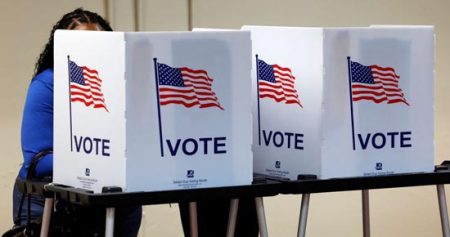
When politicians—including those wearing black robes—limit access to the voting booth, we know that’s not good. It’s important to democracy for every eligible voter to be able to register and, most of all, to vote. The Supreme Court decision that gutted the Voting Rights Act was the consequence of very political decisions by millions of Americans who didn’t vote when they should have—in 1994, 2000, 2010, 2014—and ended up with a Congress and a court that took away the franchise from millions of African American voters across the South. They deliberately turned a blind eye to a history of generations of voter suppression, and they got away with it.
Passing laws that put barriers between eligible voters and voting, that’s just not … the direction that America should be going. So, take out your spreadsheets and let’s do some homework. Let’s do this Political Combine.
We need to be focused and engaged for local, state, and national elections. I don’t want to vote for the prettiest or richest candidate, and you shouldn’t, either. We want to vote for the politician who will focus on the middle class. That’s what we as a nation focused on from the end of World War II until the 1980s, and that 40 years is the period when America was at its greatest.
America does well if the middle class does well, and it’s usually pretty clear which party and which candidates have the middle class at the core of their vision—and which ones don’t!