Interstellar Comet 3I/ATLAS
A traveler from another star system will pass through our cosmic neighborhood.
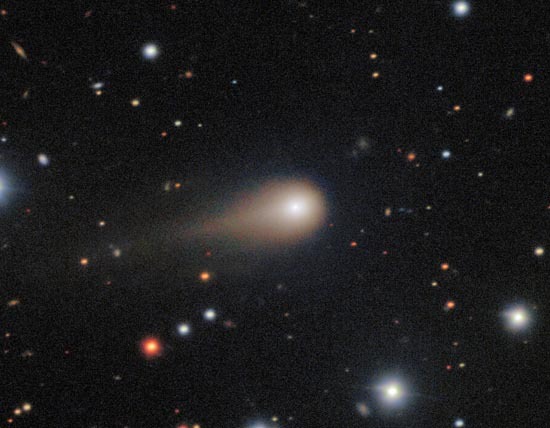
Astronomers and skywatchers alike are preparing for a once-in-a-lifetime spectacle: the interstellar comet 3I/ATLAS passes close to Earth on December 19, 2025 at a distance of about 167 million miles.
At the comet’s closest approach, it will be more than 700 times farther away than the Moon, and is of no danger to us.
Discovered on July 1, 2025 by the ATLAS observatory in Hawaii, astronomers believe 3I/ATLAS is extremely ancient, likely more than 7 billion years old. It is considered one of the oldest comets ever observed, having formed in another star system long before our Sun and planets came into being.
Unlike comets born in our solar system, 3I/ATLAS originated around another star, making its passage an invaluable opportunity for scientists to study the chemistry and structure of distant planetary systems. 3I/ATLAS is traveling on a hyperbolic trajectory, meaning it came from outside our solar system and will never return.
The comet is currently visible in the predawn sky, especially for observers using telescopes or high-powered binoculars. Around December 19, when it reaches its closest point to Earth, amateur astronomers may catch the comet as a faint smudge of light with a delicate tail, depending on local sky conditions.
While not expected to be visible to the naked eye, astrophotographers and observatories are already capturing stunning images of its glowing coma and elongated tail.
Star of Bethlehem and 3I/ATLAS Compared
Astronomers and historians alike are drawing fascinating parallels between this modern celestial visitor and one of the most enduring mysteries of antiquity: the Star of Bethlehem.
The Star of Bethlehem, described in the Gospel of Matthew, was said to guide the Magi to the birthplace of Jesus around 7–2 BCE. Its true nature remains debated—theories range from a rare planetary conjunction of Jupiter and Saturn, to a comet, nova, or supernova.
Regardless of its origin, the star became a powerful symbol of divine guidance and hope, celebrated for more than two millennia.
Though separated by millennia, both the Star of Bethlehem and 3I/ATLAS share themes of rarity, awe, and meaning. One inspired faith and storytelling; the other fuels scientific discovery and cosmic curiosity. Each reminds us that lights in the sky—whether miraculous or measurable—connect us to something greater beyond our world.
Whether they are mysteries of faith or marvels of science, the Star of Bethlehem and 3I/ATLAS inspire wonder, bridging the ancient and the modern in humanity’s search for meaning.