Freedmen of the Cherokee Tribe
Cherokee Nation removes ‘blood clause’ in its constitution, clearing the way for descendants of Black people enslaved by the tribe to have equal rights.
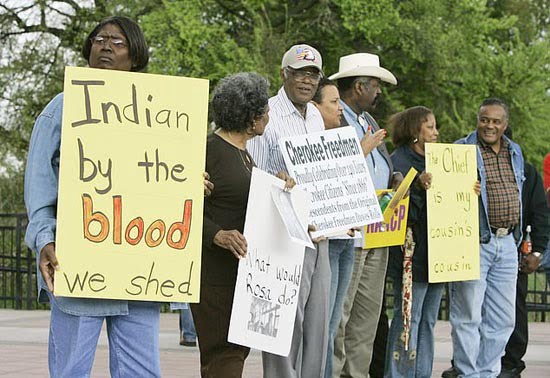
The history of the Cherokee Freedmen is an example of just how complex and layered issues of race, inequality, and marginalization are in the US.
The controversy around the Freedmen of the Cherokee Tribe revolves around a dispute between the Cherokee Nation of Oklahoma and the descendants of Black people who were enslaved by the tribe before the US Civil War.
Several legal proceedings between the two groups have occurred from the late 20th century to August 2017, when the US District Court ruled in favor of the Freedman descendants and the U.S. Department of the Interior in Cherokee Nation v. Raymond Nash et al. and Marilyn Vann et al.
An 1809 census found that 583 Black slaves were held by Cherokee slave owners. By 1835, that number had risen to 1,592, with over seven percent of Cherokee families owning slaves.
Between 1830 to 1850, the Cherokee people and other tribes were forcibly removed by White settlers, an event that become known as the ‘Trail of Tears’, or the ‘Indian Removal’. The tribes took their Black slaves with them.
By 1861, the Cherokee held around 4,000 Black slaves, but following the US Emancipation Proclamation abolishing slavery, the Cherokee Nation followed suit with two acts in 1863.
The acts stated that any Cherokee citizen found to be owning slaves after June 25, 1863 should be fined at least $1,000.
Three years later in 1866, a Reconstruction treaty was signed by a delegation of six Cherokee Nation citizens in Washington DC, that granted Cherokee citizenship to the Freedmen and their descendants.
However, in the early 1980s, the Cherokee Nation administration amended citizenship rules to require direct descent from an ancestor listed on the ‘Cherokee By Blood’ section of the Dawes Rolls.
The change stripped descendants of the Cherokee Freedmen of citizenship and voting rights unless they satisfied this new criterion.
This was ruled unconstitutional in 2006, and that Freedman were entitled to be enrolled as Cherokee Nation citizens, but a special election in 2007 resulted in the passage of a constitutional amendment.
This again excluded Cherokee Freedmen descendants from membership unless they satisfied the ‘Cherokee by blood’ requirement.
The Cherokee Nation District Court voided the 2007 amendment on January 14, 2011, but this decision was then overturned in the Cherokee Nation Supreme Court on August 22, 2011.
This sparked a series of legal battles with the US federal government which put pressure on the tribe to accept Freedman citizenship.
Finally, on August 30, 2017, the US District Court ruled in favor of the Freedmen descendants and the US Department of the Interior, granting Freedman full citizenship rights in the Cherokee Nation.
The nation has accepted this decision, effectively ending the dispute, with the ruling in February 2021 removing the 2007 ‘Blood Clause’, clearing the way for Freedmen to be afforded equal rights to run for tribal office and receive full benefits, such as access to health care and housing.
The Cherokee Nation has about 8,500 enrolled citizens of Freedmen descent.
By Blood
A film released in 2016, By Blood, chronicles American Indians of African descent as they battle to regain their tribal citizenship. The film explores the impact of the battle, which manifested into a broader conflict about race, identity, and the sovereign rights of indigenous people.
The film demonstrates both sides of the battle, the shared emotional impact of the issue, and the rising urgency of the debate: a Native American and African American history has been overlooked, and a tribal body feels as though their sovereignty is under siege.
Stream or download the video at vimeo.com/ondemand/bybloodhv.
The Cherokee Nation Supreme Court order can be found at www.cherokeecourts.org/Supreme-Court/SC-2017-07-In-Re-Effect-of-Cherokee-Nation-v-Nash-and-Vann-v-Zinke
Read more about the decision to remove the ‘blood clause’ in the Cherokee Constitution at:
CNN: The Cherokee Nation acknowledges that descendants of people once enslaved by the tribe should also qualify as Cherokee.
www.cnn.com/2021/02/25/us/cherokee-nation-ruling-freedmen-citizenship-trnd/index.html
The One Feather: Cherokee Nation Supreme Court issues decision that ‘by blood’ reference be stricken from Cherokee Nation Constitution.
theonefeather.com/2021/02/22/cherokee-nation-supreme-court-issues-decision-that-by-blood-reference-be-stricken-from-cherokee-nation-constitution
Daily Mail: Cherokee Nation finally removes ‘blood clause’ in its constitution after a series of legal battles clearing the way for descendants of Black people enslaved by the tribe to have equal rights.
www.dailymail.co.uk/news/article-9299299/Cherokee-Nation-admits-descendants-black-people-enslaved-Civil-War-citizens.html