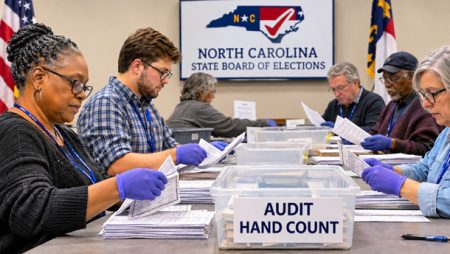
North Carolina Launches Post-Election Audit Process to Verify 2026 Results
Hand counts provide an additional layer of election transparency.
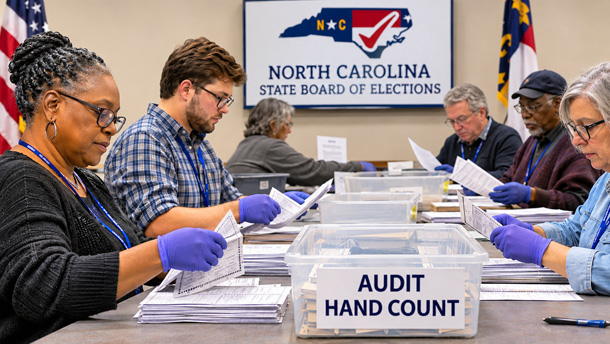
As North Carolina election officials move from voting to certification, all 100 counties will soon take part in a statewide audit designed to verify the accuracy of the 2026 midterm election results.
The North Carolina State Board of Elections announced that randomly selected precincts, early voting sites, and absentee-by-mail ballots will be counted by hand as part of a legally required post-election audit. The process focuses on the US Senate race and serves as an independent check on the machine-tabulated vote totals used on Election Day.
Under state law, county election boards must compare the hand-counted ballots with the totals reported by voting machines. The audit is intended to confirm that tabulation equipment accurately counted ballots and that the reported election results are reliable.
One feature of the audit process is its emphasis on public transparency. Rather than allowing a computer program to make selections behind closed doors, election officials generate a publicly verifiable random seed number by rolling ten 10-sided dice. Each roll contributes one digit, creating a 10-digit number that anyone can observe and record.
That seed number is then entered into a software program along with a file containing all eligible voting groups in each county, including Election Day precincts, early voting sites, and absentee-by-mail ballots. The software uses the information to randomly select two voting groups in every county for the hand count.
Because the seed number, input files, and software code are all made available to the public, anyone with the free software can reproduce the exact same results. Election officials say this approach allows citizens, researchers, candidates, and watchdog organizations to independently verify the random selection process.
Once the random selections are completed, the list of voting groups chosen for review is shared with county election boards. Local officials then conduct manual counts of the selected ballots and compare those totals to the original machine counts. Any discrepancies can be investigated before final certification procedures are completed.
The post-election audit is only one element of North Carolina’s election security framework. Before every election, county boards of elections test all tabulation equipment to ensure ballots are coded correctly and voting machines count votes accurately. The audit serves as an additional safeguard by checking actual ballots after voting has concluded.
The selection process for the 2026 audit is open to public observation. Members of the public may watch online, participate by phone, or attend in person at the State Board of Elections office in Raleigh.
Additional information about North Carolina’s audit procedures and election security measures is available through the State Board of Elections:
- Election Audit Law: www.ncleg.gov/EnactedLegislation/Statutes/HTML/BySection/Chapter_163/GS_163-182.1.html
- State Board of Elections: NCSBE.gov
- Election Security Information: Election Security
- Preparing for Accurate Elections: Preparing for Accurate Elections
- Audit Software Code: dl.ncsbe.gov/?prefix=ENRS/sample_audit/code/
- Audit Input and Output Files: dl.ncsbe.gov/?prefix=ENRS/sample_audit/2026_11_03/
- Public Webex Meeting: ncgov.webex.com/ncgov/j.php
- State Board of Elections Office: 430 N. Salisbury Street, Raleigh, NC 27603
This annual auditing process may not attract the same attention as Election Day itself, but it plays a critical role in maintaining public confidence. By combining machine tabulation, pre-election testing, random audits, and public oversight, election officials aim to provide voters with reassurance that results reflect the ballots cast.