Uncounted Votes in North Carolina
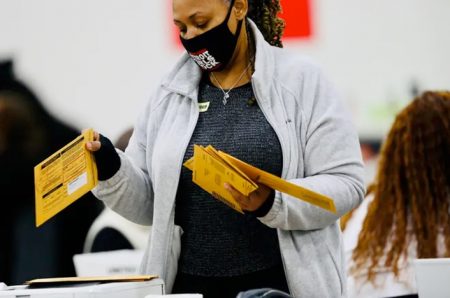 Counting how many ballots need to be counted is underway as they arrive by mail at county election offices. Counting the votes will come during canvassing.
by Jordan Wilkie, courtesy of Carolina Public Press –
Neither the presidential nor U.S. Senate race in North Carolina has been called by major news outlets, which are generally reporting that 5% of the votes are still left to be counted. But state news outlets are reporting a much smaller number, closer to 2%. The difference has quite a few people scratching their heads. Here’s what we know, what we will find out soon and what we’ll have to be patient for.
No one has called the big statewide races because their margins are too close. Additional races that aren’t at the top of the ballot are even closer, including N.C. attorney general and N.C. chief justice of the Supreme Court, as well as several legislative races and many local races.
For even those big statewide races, the number of remaining absentee-by-mail and provisional ballots is greater than the total lead that President Donald Trump has over former Vice President Joe Biden or that U.S. Sen. Thom Tillis has over Cal Cunningham.
But in order for either of those Democratic candidates to win, an improbable number of by-mail ballots would need to arrive in county offices and an unusual number of provisional ballots would need to be counted.
The thing is, we just do not know how many by-mail ballots are still out there, but we will get more hints each day. North Carolina counties are scheduled to finalize their counts on Nov. 13, and the state is scheduled to certify those results on Nov. 24.
For now, the N.C. State Board of Elections is estimating that there are up to 116,200 by-mail ballots that could still be returned. They calculated this by taking the total number of by-mail ballots that were requested, then subtracting duplicate requests, subtracting by-mail votes that have already been turned in, and subtracting people who voted early in person instead of by mail, despite having requested by-mail ballots.
What we don’t know is how many people voted on Election Day instead of by mail after already requesting by-mail ballots. We also don’t know how many people requested by-mail ballots but didn’t mail them in. And we don’t know how many people mailed in their ballots on time but still might not have them delivered by the postal service by the 5 p.m. Nov. 12 deadline.
Some counties will report more data before that final ballot receipt deadline next week, but we won’t know a full statewide number by then, according to a state board spokesperson.
Counties are required to report the number of by-mail ballots they receive each day, all of which need to have been postmarked by Nov. 3 to be counted. Some ballot return envelopes will have errors that will prevent them from being counted, while other voters will have the opportunity to cure those errors — on the envelope, not their ballots — until Nov. 12.
So, North Carolina will get a better and better sense of how many of the outstanding ballots will be returned, but that still may not be enough to call the races before all votes are counted.
Counties will also submit, one by one, their Election Day voter histories. That will tell us how many people requested an absentee-by-mail ballot but voted in person on Nov. 3 instead.
This process will not be completed for all counties before the county canvass, but it will still give insight into the real number of outstanding by-mail votes.
The state board put in a big piece of the puzzle today. Officials announced that there are 40,766 provisional ballots to be reviewed in the state. Some of those will be rejected entirely. On others, only votes in statewide, multicounty or countywide races will be counted.
The total number of provisional ballots and the number of outstanding by-mail ballots, or 156,966 ballots, is a top-line number, the absolute maximum of additional votes that can be counted in this election. The real number of votes counted will be significantly less.
In 2016, for example, only 44% of provisional ballots were counted or partially counted (for partially counted ballots, the votes for statewide races are counted while the more local-level races typically are not). That was about 26,800 provisional votes for the presidential race, which broke slightly in favor of Trump.
Also in 2016, 15% of North Carolina voters who requested a by-mail ballot did not return it. Both the state board and election experts anticipate that the rate of return will be lower this year, with more voters using the by-mail option as insurance in case the pandemic prevented them from voting in person.
In sum, the total number of outstanding ballots that could be counted is marginally greater than the difference in the races between Trump and Biden, and between Tillis and Cunningham. Those races are unlikely to flip their results.
But candidates in a number of races will be anxiously awaiting the vote count on Nov. 13.