Popular Bill May Be Stymied Again

Photo: Urban News
By Nelda Holder –
There is an important bill in the NC Legislature that affects voters all over the state in terms of the districts they belong to and the fairness with which they’re created.
That bill, HB 92 (Nonpartisan Redistricting Commission), has strong bipartisan support, with 75 sponsors and co-sponsors among the 120 members of the House.
In addition, the bill’s legislative intent has the support of approximately 70% of the state’s voters, as measured in a 2013 poll commissioned by the nonpartisan N.C. Center for Voter Education.
Its objective? HB 92 would establish a nonpartisan redistricting process that would take the more controversial part of the redistricting process away from state legislators. Instead, nonpartisan staff would draw the all-important lines that determine the state’s congressional and legislative borders. Legislators would have to approve or disapprove the plan, but could only object for technical reasons—not put a political imprint on a district decision.
North Carolina’s last redistricting in 2011 is still a subject of court battles. And in April, the U.S. Supreme Court overruled an earlier N.C. Supreme Court ruling and told that state court to reconsider whether the legislature relied too heavily on race in drawing its new voting districts.
Nonpartisan redistricting is not a new idea in the Legislature. Various proposals for redistricting reform have been around the Statehouse for years, perhaps most notably the Horton Independent Redistricting Bill of 2009. That was a popular bipartisan proposal named in honor of Hamilton C. “Ham” Horton, Jr.—an eight-term Republican member of the NC General Assembly and attorney from Winston-Salem.
“It’s about making the process fairer,” according to Republican Rep. Paul “Skip” Stam of Apex (quoted in the Fayetteville Observer). Stam said he had been personally trying for 26 years to see partisan redistricting changed.
Change of heart
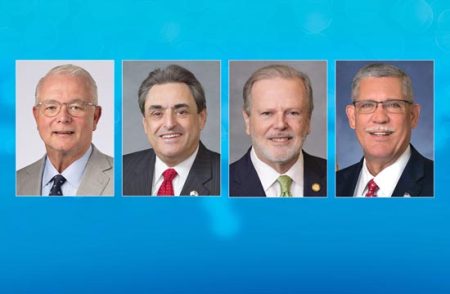
Ironically, two high-ranking former supporters of reform are sitting this one out. Senate President Pro Tempore Phil Berger, formerly a sponsor of several similar bills, has indicated that he does not see an independent commission as improving on the current system, so he has withdrawn his support.
And from the Western North Carolina delegation, Sen. Tom Apodaca, who has sponsored such legislation three times, has also crossed the redistricting line, saying in an interview with WRAL-TV in Raleigh that HB 92 is “dead.” The Hendersonville Republican (who also represents a small section of Buncombe County) should know. As chair of the Senate Rules Committee, he can make it so.
But this bill has a lot of support from outside the Legislature, according to Jane Pinsky, director of the nonpartisan N.C. Coalition for Lobbying and Government Reform based in Raleigh. Pinsky spoke about the reform bill at the annual meeting of the League of Women Voters of Asheville-Buncombe County on May 30.
She listed a number of the statewide organizations that support HB 92 and its purpose, including the League of Women Voters of North Carolina, the NC Family Policy Council, NC Policy Watch, the Sierra Club, and the John Locke Foundation.
There’s very little that particular mix of organizations would all agree on, Pinsky observed, “but they do agree government should be open and responsive to citizens.”
“Asheville has one of the best delegations in terms of support for redistricting reform,” she said. In the Buncombe County delegation, only Apodaca opposes HB 92, while Sen. Terry Van Duyn and Reps. John Ager, Susan Fisher, and Brian Turner (all Democrats) support the measure as co-sponsors. Henderson County Republican Rep. Chuck McGrady is a primary sponsor. And Haywood County’s Democratic Rep. Joe Sam Queen is also a co-sponsor.
The goals of the redistricting bill as Pinsky outlined them are to create districts that:
- follow state and federal law
- keep counties as whole as possible
- keep existing precincts as whole as possible
- take into account the size of the perimeter (there are a couple in N.C. as large as 250-260 miles, Pinsky noted, making legislative contact with constituents more difficult)
- honor communities of interest
- avoid “packing” of minorities into particular districts
Voting patterns and opportunities are changing, Pinsky said, with 47 counties losing population in the past four years and younger people more likely to register unaffiliated because of less interest in party politics.
There are currently (as of May 30) 6,330,924 registered voters in the state of North Carolina. Democrats currently have 2,623,692 registrations; Republicans have 1,933,184. Breathing down their necks now are the unaffiliateds at 1,747,718.
“We are now truly a purple state,” Pinsky said, observing that in the last election, despite the ultimate Republican/Democrat titles of the winners, 50% of the vote itself went to each party.
Although HB 92 has not yet been passed by the House despite its 75 co-sponsors (it is being held in the elections committee), the bill might possibly be moved this session under one of the crossover exemptions because it involves establishing “districts for Congress or State or local entities.” But according to Pinksy, “More realistically, it would get passed through some legislative procedural magic. When the members want to bend the rules, they do it.”
Financial countdown
In other matters before the Legislature, in the House has passed its proposed budget (HB 97, the 2015 Appropriations Act) and is now evidently going to collide with the Senate’s budget ideas. Several weeks of wrangling are likely ahead.
The State Constitution mandates a balanced budget, which means that whatever the spending level the legislators decide on, income levels have to match. Early indications are that the Senate will prefer tax cuts to some of the modest investments in education and economic incentives included in the House version.
Gov. Pat McCrory’s own budget proposal set general fund spending increase of 2.0%. The House budget raises that amount to 6.3%, increasing general fund spending by $1.6 billion. That, according analysis by the Raleigh News & Observer, allows for a new 2.0-% raise for most state employees, more funding for schools, and an extension of some industry-oriented tax credits (including renewable energy). It would also restore a tax deduction for medical expenses—a cut that many taxpayers felt directly when filing taxes for 2014 this year.
Read Nelda Holder’s blog, www.politicallypurplenc.com