Visit the WNC Farmer’s Market
Staff Reports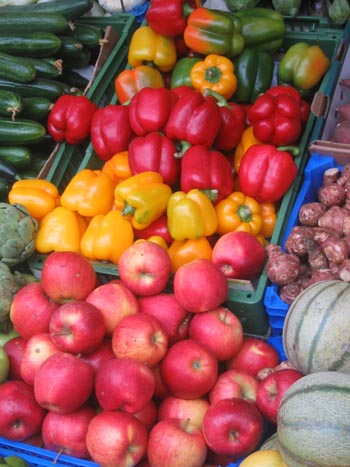
The Western North Carolina Farmers Market, at 570 Brevard Road just south of I-40, is one of the region’s most popular Meccas for lovers of fresh, locally grown food and other farm products. Part of the state Department of Agriculture, the market operates year-round offering seasonal produce and specialty products. The retail sheds are open 8 a.m. to 6 p.m. in summer and 8 a.m. to 5 p.m. in winter.
Fresh, wholesome, and delicious
Many, perhaps most, visitors to the Farmers Market go straight to the retail sheds where they know they can buy everything from picked-that-morning squash to mountain-made cheeses, scrapple, and pickled eggs. Vendors wait years to acquire a good booth, and when they get settled in they stay. As a result, customers seeking their favorite heirloom “Cherokee purple” tomatoes know right where to go to get a bagful, as do buyers who want to pick up a Waynesville farmer’s smoke-cured bacon and a Madison County grower’s organic red-leaf lettuce. One of my favorites: a jar of locally produced apple butter. Mmmmmmm.
Local v. imported
Most of us are so accustomed to shopping at supermarkets where “fresh”
vegetables and fruits are available year-round that we don’t think much
about growing seasons, as our grandparents did. But most supermarket
produce is grown far from here, in balmy Florida or California, in
Mexico and Central America, or even in Africa and the Mideast.
But crops grown for long-distance transport have to be tough enough to
tolerate boxing and packaging, loading and unloading, cooling and
warming on and off planes and trucks—so they need thicker skins than
homegrown varieties. And all that crossbreeding and rough handling means
that veggies have less juice, and less flavor.
What’s in season when? Well, January and February it’s apples, sweet
potatoes, and peanuts; in mid-March numerous leafy greens—think winter
lettuces and kale—show up; by April you can get strawberries, and in May
broccoli, cabbages, and squash are added to the mix. Summer, of course,
offers much of nature’s bounty, but the fall is full of produce, too.
Coming up this month: apples, cukes, grapes, and pumpkins, then broccoli
and pecans ….
And that’s where the Farmers Market can take us back to our own roots as
an agricultural society. Even apartment dwellers or two-working-parent
families who don’t have time to tend their own gardens can eat as if
they do.
Green & growing stuff, too
In addition to the end results of regional farmers’ hard work, the
Farmers Market sells a variety of other products. One can find starter
plants, trees, Christmas wreaths, landscape plants, and other green and
growing things, depending on the season. Fraser fir and other varieties
of Christmas trees show up around Thanksgiving, along with evergreen
wreaths and garlands.
Other services
There are also a couple of well-regarded privately owned businesses on
the grounds. Jesse Israel & Sons is one of the largest retail
suppliers of everything for the garden, whether you are looking to plant
a few tomatoes in a box on your back porch or want to landscape a
brand-new home. With its own greenhouse and nursery, and a large variety
of products, tools, and supplies, it’s a convenient place to shop for
everything the Market vendors don’t carry. And, if you get hungry, a
visit to the Moose Café at the top of the hill will never disappoint
you.