Rebuilding Unity One ‘Bridge’ at a Time
When it comes to racism, Building Bridges board member and facilitator Ron Ballard gives poignant insight to this never ending societal ill.
By T.J. Moore
“Racism has its roots in 300 years of slavery and Jim Crow after that,” he says, “There’s a lot of American history that we can’t rewrite. We can only go forward and teach the children a different way to honor and related to each other.”
Now, if only the adults could just find a different way to relate to each other. Enter Building Bridges.
For nine weeks, western North Carolinians from various races and beliefs put aside their differences, confront negative stereotypes that they may have about one another, and heal the rift that racism is known to create through Building Bridges’ workshops and sessions.
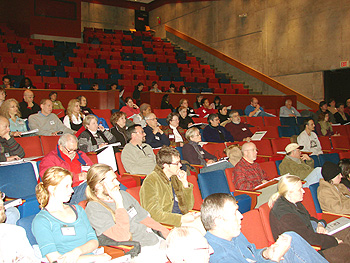 |
| Participants of the Building Bridges’ winter session listen attentively during a group lecture at the MAHEC auditorium. |
In
Asheville, it seems as if Building Bridges would not have to work hard
to accomplish their goal of healing racial divides because the city is
not exactly a hot bed of racial tension.
“Asheville is a
mixed climate. Racially it is not reflective of the Old South,” says
Ballard, “Many moved here (from different regions) and they are very
liberal and informed people.”
Despite the
city’s richness in diversity, blacks and whites in Asheville do not
fully interact with one another. In addition to the separate lives,
Asheville is also not immune to a more subdued form of racism. “(Race
relations) is better than it was in the past. But it is more subtle and
covert than in the past,” Ballard said.
Since Building
Bridges’ inception in 1993 more than 1,000 participants have attended
the program. More than 1,000 people witnessed the program’s innovative
features.
A typical
Building Bridges session begins with a large one hour group meeting.
Participants will then watch videos and listen to guest speakers.
According to Ballard, the second hour is the most critical aspect of
the session. “Where the rubber meets the road is in the small groups
where you listen to each other’s stories,” he said.
The group
examines the variety of racism in steps. Among the topic are
institutionalized racism, and the role that white privilege plays in
racism at large. Sims believe that white privilege is an intricate part
of racial discrimination and bias. At Building Bridges, it is believed
that white privilege is an intricate part of racial discrimination and
bias.
“The white
privilege concept is that I can be anywhere in the U.S. and not worry
about my skin color getting in the way of getting a car or house loan.
That might not seem like a big deal to a white person but to blacks,
(this mindset) is like waves beating against a rock. It can erode you
and wear you down,” said Ballard.
Building Bridges
is not solely about lectures, videos, and discussion, they also have
fun. In the program’s ninth week, there is no presentation. Instead,
each member brings a dish and the group will have a meal. Then, each
participant will have the floor to share their thoughts and feelings
about the program. This part of the experience is what Ballard
thoroughly enjoys. “As a faciliator, this is what gets me going,” he
says, “This gets me charged up because I know that this is the right
thing to do and this is a safe place to share stories.”
Currently,
Building Bridges have two sessions yearly in January and September.
However, the program is in the process of launching a new feature in
the spring. In April, Building Bridges will have daytime sessions for
those who work evenings. The program will also try to address other
forms of discrimination sometime in the future. This concept is in the
early stages of planning.