Manifesting Destinies that Once Were Unthinkable
Coming Together in Spirituality, Science, Gender and Business
reviews by Sharon L. Shervington
While this month’s books are not self-help books in the traditional sense, they cover topics that have the potential to alter individual lives as well as our collective communities.
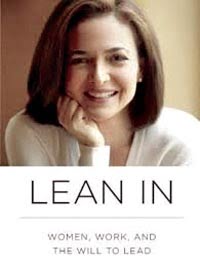 LEAN IN
Lean In, by Sheryl Sandberg, Facebook’s Chief Operating Officer, has hit a sweet spot for thousands of men and women who want a more egalitarian framework in American business and government. Backlash has also been quite intense.
This is an important book on many levels: At its most basic, it urges us to examine the myth of meritocracy that is so much in evidence even today. She discusses at length how gender stereotypes inculcated into boys and girls from childhood play out in the adult world. Some of these ways are simple, such as the documented way men will interrupt women in classrooms and, later, in other settings.
Others are more complex. They include a kind of diffidence among otherwise confident professional women when asking for what they want; a lack of confidence in their leadership skills; and an unproductive attitude in terms of negotiating the full value of what they bring to the table. And that is no wonder, because women have been discouraged from doing just that for decades.
Sandberg manages all this discussion deftly and with humor. In the chapter “Are You my Mentor?” a spin on the beloved children’s classic “Are You my Mother?” she talks about how much more challenging it can be for a woman to find the right mentors. She tells the story of being a page in Washington between her junior and senior years in high school. At that time Tip O’Neill was Speaker of the House. She had really wanted to meet him, but when she was introduced to the legendary politician he patted her on the head and said “She’s pretty.” Then he looked at her and asked “Are you a pom-pom girl?” This inability, on the part of many members of the “old boys’ club,” to see whom they are dealing with when that person is female, still remains widespread today.
Sandberg writes that she felt belittled by the exchange, and yet when she moved on to college that she and many of her peers did not consider themselves feminists, believing that all the work had been done. “We mistakenly thought there was nothing left to fight for,” a position she continued to hold as she moved into the work force. Slowly Ms. Sandberg awoke to the realities of gender bias in the workplace, and she has gone on to promote dialogue on these and related issues – such as the need for men to become full partners in childcare and family life – something that ultimately will be in the best interests of business and society.
A definition of leadership she describes is quite striking: the meaning essentially is that strong leaders make others better with their presence and help them develop skills to maintain that still serve them when they are not there. This book is the work of a leader – people are buzzing, and it’s already been reprinted seven times.
Lean In: Women, Work and the Will to Lead, by Sheryl Sandberg; Knopf; $24.95; 278 pp.
 FAR FROM THE TREE
Far from the Tree is arresting in its basic thesis – how families deal with unexpected differences in their children and how their reactions impact the identities of children and families. Among the areas covered in this sweeping canvas are autism; prodigies; criminality; Down syndrome; children of rape; schizophrenia; transgenderism; and dwarfism. While all of these are consistently represented in populations, they are uncommon enough to be out of the ordinary and to present extraordinary challenges for both parents and children.
The chapter on dwarfism was particularly fascinating and timely for me as I was in the midst of watching Game of Thrones, which features a dwarf, Tyrion Lannister, as one of its main characters. He is the son of Tywin Lannister, the richest and most powerful man in the realm, who is disgusted to have a dwarf for a son – this despite the fact that Tyrion is intellectually brilliant, quite outclassing both his siblings. The tensions and pain involved in this father-son relationship were quite striking and offers a clear sense of what it would be like to have a child who was so different.
It is clear that Tyrion feels quite alone and different, something that Mr. Solomon portrays as a factor in many of these unusual families. It was also fascinating to learn that there is a National Dwarf Conference every year where people come to meet and socialize with others like themselves.
Other chapters that were particularly fascinating included those on prodigies and on autism; each looks at different strategies and pressures in families and how they play out. In one case the daughter was a musical prodigy and her mother controlled every aspect of her daughter’s life. When the young woman got a new manager at 21, her mother told her that unless she was a musician she could not love her.
Far from the Tree: Parents, Children and the Search for Identity, by Andrew Solomon; Scribner; $37.50; 962 pp.
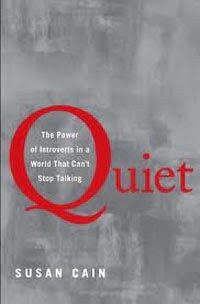 QUIET
QUIET
In Quiet: the Power of Introverts in a World that Can’t Stop Talking” author Susan Cain makes the case that some of the greatest contributions to society have come from people who innovate and create but eschew self-promotion and prefer to spend large chunks of time alone.
This is also a clear analysis of how our society has moved from an introvert, character-driven ideal to the flash and charisma of the extrovert as a model. When one thinks about that in the context of politics or reality television, it’s easy to contrast these two ways of being and to see how the shift might not be such a great thing. Ms. Cain pays particular attention to how this cultural shift might impact children who are sensitive and shy; she also offers strategies and stories that can be used to inspire confidence in them.
Ms. Cain draws on such disparate thinkers and activists as Rosa Parks, Carl Jung, Jawaharlal Gandhi, and Warren Buffett. She also looks at cross-cultural paradigms of introversion and extroversion and assesses various scientific models.
Quiet: the Power of Introverts in a World that Can’t Stop Talking, by Susan Cain; Broadway Books; $16; 352 pp.
 PROOF OF HEAVEN
“Proof of Heaven; a Neurosurgeon’s Journey into the Afterlife,” combines the scientific and the spiritual in a story of his own near death experience. It is a story that offers new information supporting the idea that there is life after death.
Ever since Near Death Experiences, or NDEs, began to be reported and explored, the thousands that experienced them described a sense of extraordinary peace, welcome and joy. Many believed that it was a foretaste of Heaven or a glimpse into the afterlife.
Despite these often quite similar experiences, doctors and scientists insisted that all of them were rooted in the brain’s reactions to trauma and extremity. Everyone in the scientific community seemed convinced that these were the brains’ coping mechanisms in the face of death. Some are now reconsidering this received wisdom, but certainly not all.
One morning, Dr. Alexander, who had been an academic neurosurgeon for over 20 years, woke up in severe, inexplicable pain. Within an hour he had a Grand Mal seizure and was rushed to the hospital. Thinking that he did have some kind of brain infection his doctor performed a Lumbar Puncture test. Just a short while later the doctor went into a coma where he remained for the next seven days. He was able to commune with the Divine source while in the coma. That is not the only miracle.
This book is a heart-warming read; evidence that NDEs are more than we have been led to believe, and finally perhaps a sign that our spiritually may one day reach our level of technology.
Proof of Heaven: a Neurosurgeon’s Journey into the Afterlife; By Eben Alexander M.D.; Simon & Schuster; $15.99; 196 pages