Interview with Tim Moffitt

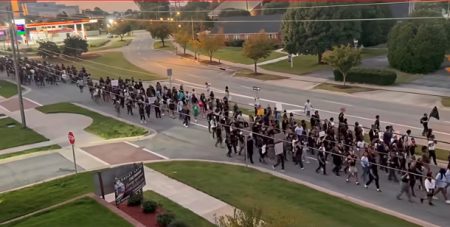
We interviewed Rep. Moffitt August 5 as he walked around the perimeter of the Moral Monday rally.
“I came here as a local elected official to listen to what the people of my district have to say,” he told us when asked why he wished to attend a demonstration designed to challenge his votes in the legislature.
We pointed out that most of those attending felt the legislature had done egregious harm to the state’s economy, education system, environment, and the health and civil rights of its citizens; that its actions had hurt the people they were elected to serve. Particularly in education, the legislature has voted to cut per-student spending on education, moving us to 46th in the country from 25th a few years ago. We also wondered why the budget eliminated extra pay for teachers who put in extra effort to earn a master’s degree and froze salaries for another year.
Tim Moffitt: We passed the highest dollar spending on education in the state’s history.
Urban News: But the per capita spending has gone down, because there are more students and higher costs, except for teacher salaries. Actual per-capita spending has been cut for students.
TM: Now you’re practicing advocacy journalism.
UN: No, Mr. Moffitt, this is simply journalism: stating actual facts and asking you to respond to our questions about the impact of the budget on those facts.
TM: Total spending for schools is higher than it’s ever been. We have faced a difficult structural economic problem. Our growth projections show that by restructuring the tax system we’ll increase total revenues in the long run. And tax reform in North Carolina is long past due.
UN: You’ve already cut the state’s revenue by $500 million this year and at least that much next year. If your growth projections don’t pan out, if growth is slower than you project, then the added tax revenues will never be there; all there will be is cuts to the budget, which have already taken place.
TM: Every vote I’ve taken [in Raleigh] has been designed to get North Carolina to a single destination. I want this to be a great state, I want it to have great cities, I want it to have a great education system.
UN: What about cutting off 170,000 people from unemployment insurance, and cutting the benefits by a third for the people still eligible? That will take a billion dollars out of the economy over the coming year—money that would be spent all over the state by people who need it, who spend every dime they get, and that helps improve the economic picture. How does that help us be a great state?
TM: I don’t consider safety net programs to be sound economic policy.
UN: After the Supreme Court gutted the Voting Rights Act, the state moved within days to pass the most restrictive voter ID laws in the country. The legislature has already gerrymandered districts around the state, but you say you support districts that are cohesive “geographically and with shared interests.” So why did you support splitting Asheville into two separate congressional districts, diluting the vote of its liberal and African American populations?
TM: I wasn’t part of the redistricting committee drawing the maps, but I opposed splitting Asheville. I worked with Susan Fisher to change the Asheville map so it wouldn’t be split.
We called Susan Fisher to inquire about that assertion. She told us, “This was two years ago, in the 2011 session. He might have helped me make sure the amendment I proposed got heard.”
We asked how that might have worked.
“In the committee on redistricting, Democrats were heavily outnumbered by Republicans,” she said. The only way to offer an amendment in the committee, or to get it heard, was if you had a Republican cosponsor. And it’s possible that I asked Representative Moffitt to help me by presenting the amendment—I simply don’t remember that. But however it was presented, my amendment was voted down in the committee, so it never made it to the floor.
“But committees vote by voice vote; there’s no record of how anyone voted. So there’s no way to know whether or not he actually voted for the amendment in committee. But the bottom line is, that when the redistricting bill came to the floor of the House for a final vote, he voted for the redistricting that split Asheville in two.”