News Analysis: A Tale of Two Cities
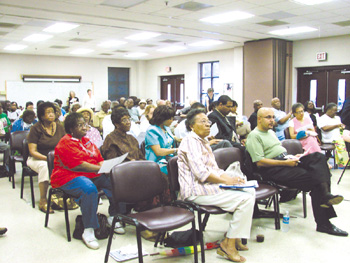 |
| Members of Asheville’s African-American community listen intently as the lead master plan consultant talks about the downtown project. Photo: Urban News |
from Staff Reports
As the City of Asheville’s master planning sessions and the citizen’s dialogue draws to a close, many will watch in anticipation of what comes next. The purpose of these community input sessions was to collect information about what the community wants to happen in the redevelopment of downtown, and to draft ideas for a preliminary redevelopment plan that would succeed among all the citizens of Asheville. The draft strategies would cover three thematic areas of the plan: Experiencing, Shaping, and Managing, Downtown Asheville.
Boston Team’s Outreach
A series of meetings began May 8, with the Goody-Clancy Consulting Group of Boston, Massachusetts as the lead consultant group. With a vision in mind, and ideas for accommodating “smart growth” efforts, the team set out to include all sectors of the community in the projected “plans for growth,” expected to guide growth over the next ten years. Local consultant Tom Gallaher of Heritage Directions, LLC, subcontracted by Goody-Clancy, and Sasha Vrtunski, Project Manager for the City of Asheville downtown master planning office, were also instrumental in developing the plan and other community efforts.
As reported in
previous editions of the Urban News, breakout sessions for community
input were held at Randolph Learning Center, Asheville Community
Theater, and the Civic Center. Themes addressed to help guide
development included green space, business and housing affordability,
artists’ studios, underground parking facilities, an inner-city 24-hour
shuttle transportation system, and the much-discussed performing arts
center.
Noticeably
under-represented at all the planning sessions was the local
African-American community. A request was made by Goody-Clancy to hold
a community input session on July 28 with the Asheville
African-American community to gather a sense of what this community
wanted to see happen with the plan.
Resentment Expressed
As
people made their way into the meeting room of the public works
building on South Charlotte Street, some native Ashevillians voiced
resentment at having a meeting in what was once an African-American
community destroyed by Urban Renewal. Some felt that the city was
adding insult to injury; others were visibly shaken, noting that the
meeting was taking place in a building on a site that once was home to
families who had experienced the gentrification in the ‘60s and ‘70s.
David
Dixon, lead consultant from Goody-Clancy, shared his visions of
“enabling everyone to share in the benefits of prosperity,” with
detailed information, artists’ renderings, and drawings. The audience
listened skeptically, and when the floor was opened to public comments
at the end of the presentation, several themes emerged. Some speakers
considered that final decisions are a foregone conclusion, and that the
presentation was simply a necessary part of the mandate behind the
grant — little more than “dotting the I’s and crossing the T’s.”
Black Community an Afterthought?
A
relative newcomer to Asheville, businessman Jesse Junior asked why the
Mayor and members of the City Council weren’t in attendance. “They’ve
shown up at other master planning sessions, why aren’t they here?” (He
left the meeting after another member of the audience addressed the
Mayor’s whereabouts.)
Johnnie
Grant, a native of Asheville and publisher of The Urban News, began her
remarks with, “Welcome to my living room. This building stands where my
family once lived [on South Charlotte St.], and it’s very difficult
speaking about one’s desires of a city redevelopment project and the
desires of the African-American community.” Ms. Grant pointed out a
noticeable imbalance in the makeup of the development planning group.
“If the city values this community,” she asked, “why aren’t any
African-Americans on the consultant team?”
Viola
Williams echoed that theme, expressing the widely held opinion that
“the input of the African-American community always falls on deaf ears.
You are offending the intelligence of our community,” she said. “We’ve
been here before.” Pointing out that the benefits of master plans
rarely help minorities, she noted, “We cannot afford to shop, or have
businesses in these locations downtown.”
Rev.
John H. Grant, pastor of Mt. Zion Church on Eagle Street, spoke about
how, during the recent Bele Chere festival, street access was blocked
in the historic Block district beginning at Eagle Street and ending on
South Charlotte, and from Sycamore Hill to South Market. During this
event most area businesses, including the church, use their parking
lots as a fundraiser; that was impossible this year with the streets
closed.
Community Needs Ignored
Willie
Mae Brown’s family also lived on what is now South Charlotte Street.
Well known for her wide-ranging volunteer work ranging from education
programs to Quality Forward to political activism, Ms. Brown noted,
“Every time there is an urban redevelopment project in Asheville, the
black community gets torn apart. Why can’t we get the Community
Development Block Grant (CDGB) funds to create wealth in our own
community?”
Thomas
Jones, a downtown property owner and native Ashevillian, drove from
Greenville, SC to attend the meeting. As Jones took the mike, he
encouraged the public to stand up for their own future, dismissing the
idea that the black community needs a helping hand to succeed. “Let me
dispel a myth,” he said. “I purchased a home in an affluent white
neighborhood, and I made the front yard look like a park. I did such a
great job at it, I drove the property values up in the community. As a
community, we can do what it is we need to do for ourselves,” concluded
Jones.
Skepticism The Last Word
As
the meeting wound down to a close, retired Asheville journalist Henry
Robinson expressed the skepticism that was widespread among those
attending. “You know,” he said, “this reminds me of a radio show I
listened to as a child named ‘Let’s Just Pretend.’ On the show you were
asked to pretend that you were doing something great, wonderful, and
creative — you were allowed to let your imagination run wild, to be
creative in your thinking. Listening to this information on the
downtown master plan as it relates to the African-American community is
much like that radio program — Let’s Just Pretend.”