Grand Jury Charges One Officer Involved in Breonna Taylor Shooting
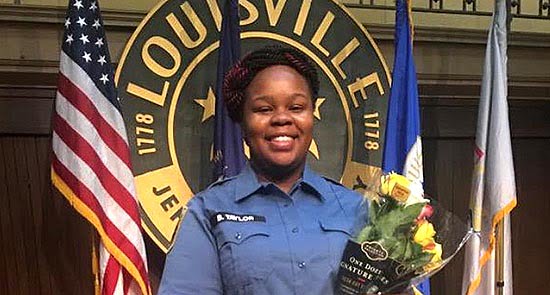
The charges are not for killing Taylor, but for endangering her neighbors with wild shots.
Six months after Taylor’s death, a grand jury in Louisville, Kentucky returned three criminal charges against Brett Hankison, one of the police officers involved in the botched March 2020 drug raid that killed 26-year-old Breonna Taylor. The charges are not directly related to Taylor’s death, but rather for endangering her neighbors with wild shots. None of the police officers involved in the murder of Breonna Taylor will be charged in her death.
“According to Kentucky law, the use of force[…] was justified to protect themselves,” Republican Kentucky Attorney General Daniel Cameron said at a press conference announcing the charges. “This justification bars us from pursuing criminal charges in Ms. Breonna Taylor’s death.”
In a series of tweets, Benjamin Crump, a civil rights attorney representing Taylor’s family, said the failure to indict any of the officers on charges directly related to Taylor’s murder was “outrageous and offensive.” Crump added, “If Brett Hankison’s behavior was wanton endangerment to people in neighboring apartments, then it should have been wanton endangerment in Breonna Taylor’s apartment too.”
Carl Takei, senior staff attorney with the American Civil Liberties Union, said in a statement that the grand jury’s decision “is the manifestation of what the millions of people who have taken to the streets to protest police violence already know: Modern policing and our criminal legal system are rotten to the core.”
Lawyers for Taylor’s family say she was asleep in bed with her boyfriend, Kenneth Walker, on the night of March 13, when LMPD officers serving a no-knock narcotics warrant broke down their door with a battering ram. Walker, a registered gun owner, shot at the officers believing it was a home invasion, hitting one officer in the leg. The officers fired back and hit Taylor eight times, killing her. No drugs were found.
Brett Hankison was also involved in a botched 2018 home invasion that terrified a family wrongly suspected of growing marijuana. At least four other Louisville police officers who participated in the case that led to Taylor’s death were also involved in the 2018 home invasion. While no one died during that raid, things easily could have turned out differently.
In both cases police broke into people’s homes based on dubious evidence and the residents thought they were being robbed. In Taylor’s case, her boyfriend, Kenneth Walker, grabbed a gun and fired at the intruders, injuring one of them in the leg. Police responded with a hail of more than 20 bullets, at least eight of which struck Taylor, who was unarmed. According to the acting police chief, Hankison “displayed an extreme indifference to the value of human life” when he “wantonly and blindly fired 10 rounds” into Taylor’s apartment.
Detective Joshua Jaynes obtained the no-knock warrant to search Taylor’s apartment, which Hankison and two other plainclothes officers, Jonathan Mattingly and Myles Cosgrove, executed in the middle of the night on March 13, 2020 based entirely on guilt by association. Because Taylor, a 26-year-old EMT and aspiring nurse, remained friendly with a former boyfriend suspected of drug dealing, who sometimes received packages at her apartment, Jaynes suggested that she was involved in illegal activity. But a local postal inspector later said there was nothing suspicious about those packages, which reportedly contained clothing and shoes.
The warrant to search the house where Mario Daugherty and Ashlea Burr lived, which police executed on the morning of October 26, 2018, was based on a tip about a prior tenant, who allegedly was growing marijuana there. According to a lawsuit that Daugherty and Burr filed a year later, 14 SWAT officers stormed into their home without warning, breaking the front door, tossing flash-bang grenades, and shouting commands while threatening them and their three teenaged children with “assault rifles.”
There is often little practical difference between a no-knock search and a knock-and-announce search. In Taylor’s case, police had a no-knock warrant, but they nevertheless banged on the door for 30 seconds or so, and they claim they announced themselves, a point disputed by her boyfriend and her neighbors. Even if the cops did say something as they broke down the door, that announcement could easily have been missed by Taylor and her boyfriend, who were sleeping at the time of the raid.
During the 2018 raid, the residents clearly did not realize the people invading their home were police officers. According to their lawsuit, one of the couple’s daughters, Zariyah, who was 14 at the time, “ran through the back door and into the yard in an effort to reach her grandmother’s house next door.” The cops pursued her with assault weapons.
Nobody in the house was growing marijuana or had bags of marijuana packaged for sale. Daugherty and Burr’s lawsuit alleges that the Louisville Metro Police Department “fails to adequately train its officers regarding obtaining search warrants in order to protect citizens’ Fourth Amendment rights.”
The Louisville Metro Council banned no-knock raids in legislation named after Breonna. In early September the city of Louisville approved a $12 million payout to settle a civil lawsuit filed by Taylor’s family.
Right now, every state allows no-knock warrants except Florida and Oregon. Add your name to this petition right now to demand that every state pass Breonna’s Law immediately.
Sign the Petition
The Grassroots Law Project (GLP) is pressuring every single state to pass Breonna’s Law, banning no-knock warrants, the kind of warrant that was used to murder Breonna Taylor. The GLP combines the best of grassroots organizing with legal expertise to radically transform policing and justice in America. For more information, please visit www.grassrootslaw.org.