NC Adequate Yearly Progress Status for Asheville City Schools

Read! Read! Read! That’s what all our students must be able to do by the third grade.”
~ Allen Johnson, Superintendent, Asheville City Schools
Staff reports
Only one of nine Asheville City schools, the School of Inquiry and Life Sciences at Asheville High, met the federal government’s Adequate Yearly Progress (AYP) standards for the 2010-11 school year, according to testing scores for students in grades 3-10 released by the state in late July. Yet all nine met North Carolna’s ABC growth standards under the state’s 15-year program of accountability testing; five of the nine exceeded expected growth standards by at least 10 percent.
The two sets of measurement highlight the differences between state standards that aim for annual growth at a steady, measurable pace and federal standards under No Child Left Behind (NCLB) that jump by large factors every three years and do not allow a school to pass if even one subset of students performs poorly.
“We are pleased to report that district students across all grade levels are meeting or exceeding the state’s rigorous academic growth standards,” City Schools Superintendent Allen Johnson said when the results were released Thursday morning. “Our classroom teachers are motivated, well-prepared and working hard to ensure students are prepared for each successive grade level.”
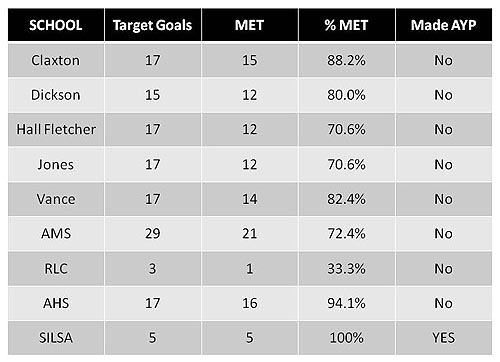
SILSA, which began in 2005 with a grant from the Bill and Melinda gates Foundation’s “small schools” project, was faced with five goals, all of which it met under federal AYP standards. Under NC measurement, it was named an Honor School of Excellence, reflecting its high academic growth standards, 90-percent proficiency on state ABCs, and meet NCLB’s all-or-nothing AYP measurement. “We’re thrilled by our continued success,” SILSA principal Greg Townsend said when he saw the results. “Our size enables us to create a family-style environment that nurtures students’ growth. Also, there is no substitute for great teachers.”
Two schools serving students in grades K-5 were recognized by the state as Schools of Distinction: Isaac Dickson and Vance Elementary Schools. Schools of Distinction must meet or exceed expected growth plus post a student proficiency composite in the 80-89% range.
Other district schools, except for the Randolph Learning Center, faced from 15 to 29 goals, and on average met 78 percent of them. RLC, with its small population of students who have faced disciplinary, attendance, or other problems at previous schools, met only one of its three goals.
No Child Left Behind requires that in each school, every target population must pass in every goal area for the school as a whole to pass. Thus, if a school has subgroups of White, Black, Hispanic, Economically Disadvantaged students who all meet all their goals, but a subgroup of “Students with Disabilities” does not meet its goals in one program area, the entire school fails. At Asheville High School, for example, 16 of 17 goals were met, leading to a 94.1 percent success rate – so by the NSLB reckoning, the school failed to meet its AYP standards.
“Our students experienced positive academic growth this past school year based on the state’s rigorous ABCs accountability measure,” said Johnson. “But the federal AYP model is ‘all or nothing’ by design, and the academic targets moved up significantly last school year,” Johnson explained.
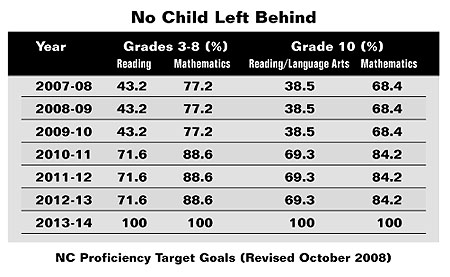
Reading-proficiency levels (see chart) for grades three to eight had been set at 43.2 percent from 2007-10; for 2010-11 they jumped to 71.6 percent. In math, the previous standard went from 77.2 percent to 88.6 percent. For grade 10, the change was even greater, from 38.5 percent in 2007-10 to 69.3 percent in 2010-11. In mathematics, the standard went from 68.4 percent to 84.2 percent.
“We anticipated that fewer schools would ‘make AYP’ for 2010-11. For example, the AYP proficiency target in reading, grades 3-8, moved up 28 percentage points from the previous year. In reality, that’s a 67 percent increase in the number of students required to be proficient in reading to meet the AYP goal for any and all subgroups,” Johnson said.
Preliminary Asheville City Schools data reveals that in reading, 71.7 percent of 1,550 students in grades 3-8 achieved proficiency and in math, 82.4 percent of those same students were proficient. Tenth-grade scores also form a component of the federal AYP standards. The district tested 270 tenth graders, and 70.7 percent were proficient in reading and 80.1 percent in math. The district also met attendance (95.6 percent) and four-year graduation (80.7 percent) AYP targets. The table below shows Asheville’s AYP status for 2010-11.
As subgroups, the district’s Black, Hispanic, Economically Disadvantaged and Students with Disabilities populations did not meet the significantly higher standards for the percentage of students proficient in reading [target – 71.6 percent] and math [target – 88.6 percent], accounting for eight ‘targets’ missed by the district as a whole. In math, 82.4 percent of the district’s third- through eighth-graders were proficient for 2010-11, falling short of the new 88.6 percent standard and accounting for the ninth district target missed.

From a district standpoint, Asheville City Schools met 39 of the 48 No Child Left Behind target goals (81.2 percent), a slight decline from the previous year, yet all but one school failed the rigid AYP standards. Under the state’s ABC targets, schools with Composite Performance proficiency percentages ranging from 73.1 percent to 84.4 percent met or exceeded their goals. The chart above shows a comparison of ABC and AYP status for the nine schools.
State Schools Superintendent June Atkinson said of the No Child Left Behind program, “I continue to believe that the NCLB method of labeling schools is unfair and unrealistic. There is no recognition for schools that are making significant progress and performing well with nearly all of their students.” Atkinson said she hopes this issue will be addressed when the ESEA is re-authorized by Congress.
“Improving achievement for all 3,900 students we serve in Asheville City Schools is our number one priority,” Johnson reiterated. “Our renewed focus on the achievement gap began with a gap summit in February of this year. Based on the ideas generated there, we are moving forward with three initiatives that will form the nucleus of a renewed emphasis on early childhood education: understanding and addressing poverty; fidelity to our academic core and the issue of time. Read! Read! Read! That’s what all our students must be able to do by the third grade.”
Federal law requires local districts to release this data in time for parents to take advantage of opportunities for public school choice or tutoring options for their students, if applicable.
The table below shows North Carolina’s “stepping stone” AYP proficiency target goals as the state and nation grow closer to the original No Child Left Behind goal of having all students proficient by 2013-14. Notice that the percentage of students in each subgroup required to be proficient in the disciplines measured for AYP increased significantly for 2010-11.
For more information, contact Allen Johnson, Superintendent, (828) 350-6145;
Kelvin Cyrus, Assistant Superintendent, (828) 350-6121; Greg Townsend, (828) 350-2700; Charlie Glazener, (828) 273-2123.