A Glimpse Into the Life of Mr. Levie Wilson
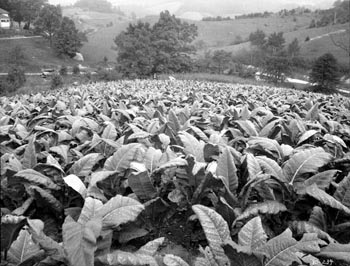 |
| Tobacco field. From the Ewart M. Ball Collection, D.H. Ramsey Library, Special Collections, University of North Carolina at Asheville. |
by Sarah Williams
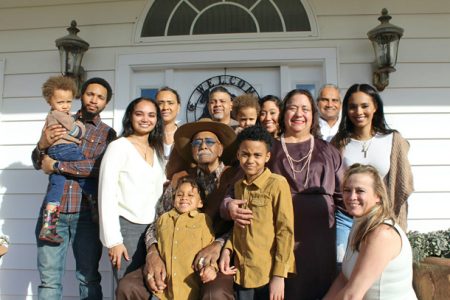
Talkative, energetic, and cute as a button is the only way to describe Mr. Levie Wilson, now 104 years old and truly a living treasure. I sat with Mr. Wilson and his daughter, Beverly Wilson, on their porch on one of those sunny, it’s-great-to-be-alive days, as he reminisced about bygone days.
Mr. Wilson was born on Bald Creek in Yancey County, one of ten children (one died at birth). His mother, Sallie Kay Wilson, and her siblings were the children of slaves, the first generation of their family born free.
When Mr. Wilson was a boy living in Burnsville, the Yancey County seat,
President Woodrow Wilson came to town, his mission to clean up the town
in order to build a school. The president asked for Levie Wilson’s help
getting things cleaned up; Levie’s grandmother, Cindi, donated the land
to build the school. Levie does not remember there being any schools
before that time, but he does remember that only two or three “colored”
people lived there in those days.
At twenty, he moved to Forks of Ivy, where he farmed tobacco and tomato
crops. Later he worked as a chauffeur, and as a cook at Moore General
Hospital, a Veterans Administration facility, Mission Hospital, and
privately in Biltmore Forest. In his job as a gentleman’s gentleman he
catered to the needs of Mr. Charlie Waddell and his family. Waddell, a
civil engineer with an office in the Grove Arcade, built the roads that
lead into Biltmore Forest.
While working at Moore General Hospital, he was in charge of the
kitchen. During those days, most whites did not feel that African
Americans should be in charge, and often his hands were tied when it
came to giving instructions to the white staff who resented his position
as their boss.
Mr. Wilson also became a landowner, with twenty-one lots in Shiloh near
Rock Hill Baptist Church as well as properties on Hill Street and Herman
Avenue.
His wife, Mary Jane Catherine Hayes, was in training at Allen Home
School (later Allen High School) to become a schoolteacher. The school
was a private school for young African American women, and Mr. Wilson
recommended her for her first teaching position in Mars Hill, where she
began her career.
Despite the growing number of centenarians in the United States, not
often does one have an opportunity to meet a man who has lived so long.
And while some 100-year-olds attribute their longevity to this, that, or
the other good habits, Mr. Wilson says, “My family didn’t live as long
as I have. I don’t know why I’ve lived this long.” But he has not
allowed his age to keep him from enjoying life. Farming is what he
likes, and he has a garden in back of his house today. He told us that
he had squash growing in it as we spoke.