A Collection of Villages
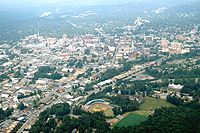
Many great cities are described as a collection of villages, but at their heart they are made up of small communities, cultural and geographic, defined or intangible.
By Moe White –
New York, Chicago, Los Angeles, and Miami (to say nothing of Paris, Tokyo, and London) comprise large geographical areas and diverse populations, but at their heart they are made up of small communities, cultural and geographic, defined or intangible.
As David L. Swain writes in “Urban Values, Urban Needs” elsewhere on this site, the city functions as the core of our body politic, anchoring economic, political, cultural, and sociological development, Despite its borders (and controversies over annexation, zoning, etc.) it incorporates what the Federal government calls the “metropolitan statistical area,” or MSA, that includes the surrounding region of Buncombe County and beyond.
But what really makes a city, and makes it work, is all the villages that comprise it, whether based on profession or industry (think of the legal community, the education community, the medical community, etc.); interest groups (“progressives,” city boosters, developers, “values voters”); ethnic and racial groups; and neighborhoods.
Asheville is no different except in scale. It includes dozens of distinctive neighborhoods and tightly knit communities, and its population includes as much cultural diversity as some much larger cities.
Many local citizens identify themselves as residents of West Asheville, Shiloh, Beaver Lake, Oakley, Emma, or any of a dozen other communities, and more than 30 Asheville “villages” have established Neighborhood Associations.
Their umbrella group, the Coalition of Asheville Neighborhoods, held its first-ever Congress of Asheville Neighborhoods May 6 to “provide Asheville residents the tools to help manage and plan new growth in a way that preserves and enhances our community” and to help residents who want “to start or strengthen” their own neighborhood association.
Neighborhood groups speak out on the concerns and issues important to area residents, whether the impact of development or the need for sidewalks and parks or the pervasive feeling that “my neighborhood” is being slighted by the city. Beverly Hills residents (and more recently West Asheville activists) were outspoken about WalMart Superstores in the same way that stakeholders on The Block address downtown development.
Some neighborhood groups sponsor block parties and other community celebrations and events. The West Asheville Business Association hosts its own mini-Bele Chere, Westfest, designed both to celebrate the reemergence of West Asheville as a strong, vibrant community and to invite for a visit people who, not too long ago, thought of the area as the city’s blighted boondocks.
Similarly, ethnic groups establish and maintain strong ties through their common heritage, language, experience, and interests. After the first Greek family moved to Asheville nearly a century ago, others followed, and soon enough they were joined by additional immigrants from their home villages, by siblings and cousins and family friends. They helped each other find jobs and homes, established a church, helped raise each other\’s children, and kept their culture and language and family ties alive and thriving. Ultimately, even as they were assimilated into American life, they were, and are, able to maintain a strong sense of community.
Jews who settled in Asheville followed essentially the same pattern, and there\’s no doubt that the Ukrainian, Hispanic, and Korean immigrants who are more recent arrivals will do so as well. The first immigrants struggle with English and keep to the old ways as much as possible while they try to figure out how to make a life in a new homeland.
A second generation will grow up here, speaking English and the heritage language with equal facility, comfortable with American customs (and frustrated by their parents\’ conservatism). Their children, like the grandchildren of the Greeks and Jews, will speak English as fluently as any sixth-generation WNC resident, and probably won\’t speak Ukrainian or Spanish much better than most other students master foreign languages.
But even as recently arrived ethnic groups assimilate, they maintain a cultural identity in the foods they prefer, the family celebrations that matter, the churches they attend, their choice of marriage partners, and numerous other artifacts. It\’s no more difficult to imagine a future young adult treasuring her heirloom mantilla or his grandmother\’s samovar than someone else proudly displaying a great-grandfather\’s plow or an Ikon brought over from Greece — or an ancestor’s letters home from the Civil War.
While Asheville has its share of power brokers and civic groups, professional brotherhoods and activists, the villages that especially interest us — because of their very nature, because they are essentially urban villages, and because of the impact they have had and will continue to have on our city — are ethnic groups and neighborhoods. One of each is the focus of this issue of The Urban News & Observer.
Hispanics, or Latinos/Latinas, are one of the fastest-growing populations in Asheville and surrounding areas, and they are making a visible impact on the region. Through organizations such as ALAS (Asheville Latin-Americans for Advancement Society — 828-277-1797) and Afrotina Coalition, events like Fiesta Latina, and outreach programs like Western North Carolina Community Health Services, people with a Spanish-language background are making their voices heard. As a group and as individuals, Latinos participate in and contribute to our economy, culture, religious groups, schools, and other aspects of our civic life.
Stumptown is one of Asheville’s oldest neighborhoods, located on the edge of the Montford community. While Montford and Cumberland Avenues, West Chestnut and Flint Streets, and Pearson Drive were filling up with elegant, expensive homes for Asheville’s most prominent citizens, Stumptown developed as a humbler, affordable, congenial community for African Americans. Now more than a century old, and still thriving, Stumptown has an active community association supporting the ongoing interests of both current residents and many adults who grew up there and moved elsewhere but still maintain strong ties to the neighborhood.
All of us come from, or live in, a village of some sort. Many of us, perhaps most, are members of several distinct communities — geographic, ethnic, cultural, professional, or religious. Like everyone who calls Asheville or Buncombe County home, families whose ancestral language is Spanish and the present and former residents of Stumptown are equally members of the larger community and of their own villages. That might not be “news” to some of us; it’s certainly a story worth reporting.
______________________________________________
Among the neighborhoods that jumped into the writer\’s mind on first thinking about Asheville’s villages are: Beaucatcher Mountain, Beaver Lake, Beaverdam, Beverly Hills, Biltmore, Burton Street, Chicken Hill, Chunns Cove, Deaverview, East End, Emma, Five Points, Grove Park, Haw Creek, Kenilworth, The Manor, Montford, Oakley, Riceville, Riverview Drive, Shiloh, Starnes Cove, Town Mountain, (the former) Valley Street, Venable, West Asheville, and Woodfin. We’d welcome your feedback on other neighborhoods that I overlooked.