Bob White and the Pisgah View Community Peace Garden
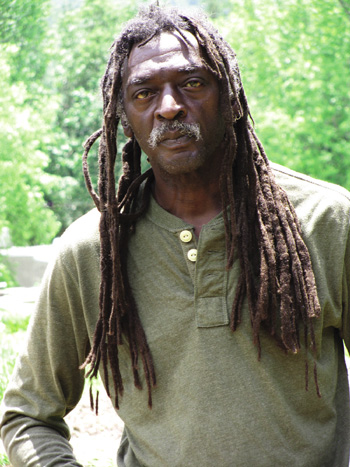 |
| Bob White, Director of Pisgah View Peace Garden Project. |
by Michael Hopping
All Bob White wanted from the Asheville Housing Authority three years ago was the use of a little land in the Pisgah View complex where he and his family live. Although the unemployed carpenter had no agricultural background, the idea for a community-based organic garden wouldn’t leave him alone. The Housing Authority offered White an entire baseball field.
It was a challenge almost too enormous to consider. But the Pisgah View Community Peace Garden soon took on a life of its own. “Things just happened spontaneously. I met people in the strangest places who wanted to help,” White said. Agency grants and contracts appeared. “As the garden unfolded,” White says, “the vision of what was needed for this community became clearer.”
Row upon row of greens, fruits and vegetables now provide healthy
food for people often unfamiliar with garden fresh produce. A portion
goes to volunteer workers and needy residents. The remainder is sold
onsite. “I want to undercut everybody on price,” White says. “Get a
food stamp machine to make the food we grow more accessible for Pisgah
View residents who want to buy.”
He’s proud that the garden is bringing money into the community.
It’s also producing opportunities for residents to gain work experience
and organic farming skills. “We’re developing infrastructure for
ourselves instead of sitting back and waiting for the government.”
Early on White had to do most of that developing himself.
Engaging other residents wasn’t easy. “The hard part in life is to show
people you have to give in order to get. Sometimes there’s even giving
without expecting to get. People didn’t see or understand that until
two years into this project. Now they come and ask questions. Some stay
for a period of time.”
Each season has brought expansion. This year the garden added
peanuts and 22 laying hens. White foresees full or part-time paid
employment for three or four people, including himself, by next year.
Down the road he believes the garden will evolve into a training
facility for sustainable organic agriculture.
The “divine inspiration” that once pestered him has taken root.
It’s growing into a valuable community resource. White says he’s
reaping a life-changing lesson as well. “Thoughts truly become things.
It really is about the power of intention. I’d never tried to live in
that before. I got on this path by thinking this world into existence.
It started working and it hasn’t stopped yet.”