World-Renowned Author Salman Rushdie Speaks at UNC Asheville about the Power of Literature
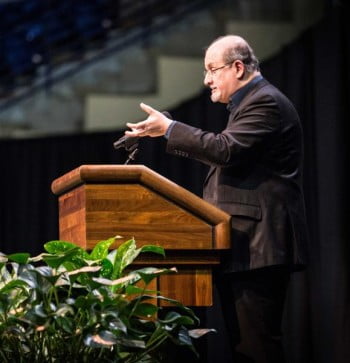
Asheville, NC – Sir Salman Rushdie, award-winning novelist and advocate for freedom of expression, delivered a public lecture, Public Events, Private Lives: Literature + Politics in the Modern World, to an audience of some 3,000 people at UNC Asheville’s Kimmel Arena on Feb. 18, 2016.
He also met with UNC Asheville students earlier in the day for a discussion about the role of literature and about writing craft.
Rushdie’s own life – with his novels banned in parts of the Islamic world and a fatwa issued calling for his death – demonstrates literature’s powerful connection with the public arena and politics. Rushdie chronicled that link from ancient Roman times up to the present.
“In the 18th and 19th centuries – the great moments of the novel – it used to be a very important part of the function of the novel to bring the news. The novel literally brought news of their own country to readers,” said Rushdie. “Nowadays, in this so-called information age, you would presume that particular function of literature has dwindled, but that might not be correct.
Salman Rushdie drew an audience of some 3,000 people to UNC Asheville’s Kimmel Arena.
“What literature continues to do is to bring us not the news as in the headlines, but the truth about the lived experience of the world. We have all these parts of the world with which this country is now seriously engaged – Afghanistan, Pakistan, Iran, Korea, etc. – and when you see these places in the news, what you essentially see is explosions. What literature tells you is what it’s like to be there and what the experience of being an Afghan, or Pakistani, or Korean might be like. And we need to know this.”
Describing the contemporary world’s conflicts as clashes between irreconcilable narratives, competing versions of reality, Rushdie said, “The world no longer has the solidity that it had in the age of the great realist novel, where the writer and the reader could basically have the same description of the world. … Now we live in a much more fractured moment in which there is no such agreement. … The world is becoming, in a way, fictionalized. … The real has become a problem – we don’t agree on what the real is. That really is where the work of the novelist begins.”
When he met with students to discuss his writing, Rushdie described his most recent novel, Two Years Eight Months and Twenty-Eight Nights (Random House, 2015), this way: “I wanted it to be about the world we live in but I didn’t want it to be a lecture – that’s where comedy and fantasy come in.”
Senior Hannah Capps, a math and German major who participated in the discussion, said, “It was the first work of magic realism I have read. I just finished the book and was still figuring out for myself what I understood about it. I was pleasantly surprised how richly we got to talk to him about a lot of different things.”
Rushdie described how he constantly revises as he writes and because of that, is satisfied if he can add just a few hundred words a day to a novel. That came as a comfort, of sorts, to senior English major Jarred Worley, also a writer. “You have these larger-than-life people who are struggling with the same things you are,” said Worley.
Senior Christina Simonelli, also an English major, said, “I feel like it was one of those once-in-a-lifetime things, to talk to someone who has written such a vastly changing body of work. … It’s been really intriguing to me as a writer.”
For other students, it was the fatwa against Rushdie and the threat on his life that piqued their curiosity. “I would much prefer that writers not be persecuted, but they are and probably always will be,” Rushdie told the students. “Many others have faced much worse than me. Seeing what others have faced and knowing that I’m not the first and won’t be the last inspires me to do good work. You have to get on with it.”
Rushdie reiterated this stance at the close of his public talk in Kimmel Arena. “Literature itself is unusually strong, powerful and durable, and can outlast and defeat the tyrannies that try to crush it. Writers however, are not that strong and can very often get into lots of trouble. And one of the reasons why many of us are active in groups like PEN American Center, which defends writers in trouble, is precisely because we understand that while art is long, life is short.
“Art tries to open the universe. It tries to increase the sum total of what it is possible for us to understand, to know, to see, and in the end, to be. … The artist can’t do that by sitting safely in the middle ground. … It’s a very dangerous time to be a writer. But all these writers, facing up to power, speaking truth to it, would agree that despite these dangers, it’s the job.”