News Analysis: What the… Health Care are They Doing?
by Moe White
Senate Republicans responded to the passage of health care reform last month by saying 147 yeas. That is, they offered 147 amendments designed to kill the reconciliation bill or, at least, to cast it back from whence it came. In short, the Republicans wanted to make the amendments as hard to vote against as possible. True to their long-term policy approach, they decided if you can’t beat them—humiliate them.
Because the bill was being passed under rules of reconciliation, the two
parties had twenty hours, starting Wednesday, to debate the amendments,
rather than the typical unlimited debate allowed in the Senate. Knowing
the bill was going to pass no matter what they did, the Republicans
wanted to milk every last minute of delay.
The party has long been expert at forcing Democrats to cast embarrassing
votes, ever since Lee Atwater, Newt Gingrich, Frank Luntz, and other
advisors developed the use of “wedge issues” into a fine art. But this
time, because the Senate version of health care reform had already been
passed by the House, Senate Democrats were determined to defeat any
amendment that would require another House vote.
Dems grow a spine
Such determination exposed a new attribute of Democratic officials—a
spine. After three years in the majority, and a full year with both a
filibuster-proof supermajority and a Democrat in the White House, they
discovered that they could announce their plan to use reconciliation,
limit debate, rely on the Senate Parliamentarian to rule on whether or
not amendments were germane (two were not and did require an additional
House vote), and…pass, for the second time, the bill they had already approved with sixty votes on Christmas eve!
The Majority Leader, Harry Reid, brought the bill to the floor, and the
Dems stood up, felt their backbones stiffen (especially those who had
long since forgotten they existed), and did what they, and the
president, had been elected to do: use the Constitutional requirement of
majority rule to pass health care insurance reform.
All forty-one Republicans voted against the bill, as did right-wing
Democrats Ben Nelson (Neb.), Blanch Lincoln (Ark.) and Mary Landrieu
(La.). Pretend-moderate Republicans like Olympia Snowe and Susan Collins
of Maine marched in lockstep with their Minority Leader, Kentucky’s
Mitch McConnell. Newly elected and self-proclaimed “independent
Republican” Scott Brown of Massachusetts bent over for McConnell, too,
despite the fact that the Senate health care plan was modeled on the
universal coverage plan enacted in Massachusetts under Republican
Governor Mitt Romney—a plan that Scott Brown supported as a Republican
state legislator.
The Bill
Whether looked at by the left, the right, or the center, the health care
bill is hardly perfect. It will not cover all citizens, and it will
leave millions of non-citizen aliens, both legal and illegal, without
health care access. That’s bad because viruses and bacteria and
epidemics do not pay attention to their hosts’ national origin or
immigration status, so non-citizens will be more susceptible to illness
and disease than citizens with insurance—increasing the spread of the
infectious agents among all the rest of us. Keep an eye out for a
recurrence of TB and other infectious diseases in years to come.
Also, there’s also no public insurance plan to compete with for-profit
insurers, so starting in 2014 many people with limited incomes will find
it more sensible to pay the tax than to try to buy coverage. There’s
also little control over insurance companies’ freedom to jack up rates
for those with pre-existing conditions: even though the companies are
prohibited from denying coverage, they will be able to charge outrageous
prices for it. Nor does the bill allow the importation of less
expensive drugs from across the border—a sop to big Pharma that bought
their tepid support (or at least precluded their “Harry &
Louise”-style outright opposition).
Perhaps the most far-reaching change is the requirement that everyone
buy a policy, so that even those who are younger and healthier will have
to be covered. The reason that works is that it increases the pool of
the insured: the more people in the pool, the less the risk from and to
any particular person. The reason it could backfire is that there’s no
public option to force competition on the “free-market” insurance
companies (all of which loathe real capitalism).
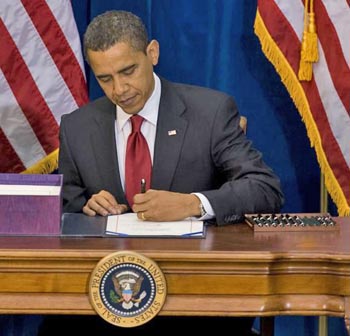 |
| For the first time in our nation’s history, Congress has passed comprehensive health care reform. America waited a hundred years and fought for decades to reach this moment. This struggle became a test of whether the American people could still rally together when the cause was right — and actually create the change we believe in. Thanks to your mighty efforts, the answer is indisputable: Yes we can. Thank you. ~ President Barack Obama |
The Good…
But there’s a lot good in the bill, too. Ending annual and lifetime caps
on coverage, ending the ability of insurers to drop the insured when
they actually get sick and want to use their insurance policies, ending
the insurers’ right to bar people with pre-existing conditions (which
they do retroactively on a regular basis)….
One of the biggest boons to families is that they can keep their adult
sons and daughters on their policies through age 26, allowing those
offspring to finish their education, find a job, get themselves
established in, or at least started on, their careers, without the added
burden of finding and paying for coverage on their own. This change
will also give young people more freedom to start their own businesses,
encouraging the kind of start-up entrepreneurial spirit that has driven
American prosperity for generations (a spirit that, again, Republicans
love unless Democrats are for it, in which case . . . “bad”).
For seniors on Medicare Part D, the reform plan has a different, but
equally important, benefit: it will close, in stages, the “donut hole”
the Republicans’ prescription drug plan created. That expensive
boondoggle helped some seniors (who could afford to buy into it) whose
medications cost up to a couple of hundred dollars monthly; and it was
very valuable to those who were spending five hundred dollars or more on
pills each month. But those in between —who constitute a vast
proportion of all seniors—had to make up the difference of more than
three thousand dollars a year before the higher coverage kicked in. The
“Obamacare” bill will close that donut hole by $250 the first year and
in stages thereafter until there is, finally, the complete coverage for
Medicare prescriptions that Republicans promised but never delivered.
Another benefit to seniors is that Medicare recipients are entitled to
an annual checkup at no cost.
…the Bad…
Despite, or because of, these changes, the new Republican theme—their
declared election mantra—is to “Repeal and Replace” this reform bill
with one of their own. An interesting concept…until one recalls that
they had unfettered power for six years under George W. Bush and,
instead of trying to fix the system, they allowed the number of
uninsured to grow from 31 million to 45 million. They’ve also had the
same fourteen months that Democrats have had since Obama’s inauguration
to devise, develop, and present a healthcare plan of their own, and they
came up with…a four-page outline of political principals.
Those principals center around stripping people of their right to sue
hospitals, doctors, and other medical care providers who cut off the
wrong foot or leave a mother in a coma instead of good health. They call
it tort reform because it’s tort law that allows anyone to sue for
damages against those who have wronged them; they like it because more
lawyers vote Democratic than Republican, while most doctors support the
GOP.
Though they failed to hand President Obama his Waterloo, in the words of
Sen. Jim DeMint (R-SC), the year of mudslinging, lies, and unprintable
epithets has unleashed and encouraged the worst instincts of white
supremacists, ignorant hypocrites, and terrified-of-change reactionaries
who fear that “those people” have taken over their nation and who are
determined to “take back my America.”
…the Ugly
Many of those reactionaries have found their natural home in the Tea
Party movement, which began a year ago and has been funded, guided, and
maneuvered by former House Republican leader Dick Armey and his Freedom
Works organization. The membership insists on its independent
grass-roots nature, but whenever Republican pollster Frank Luntz
distributes his inside-the-beltway newsletter on talking points and
tactics to defeat Obama, somehow his phrases and plans find their way
into Tea Party signs, web sites, and blogs within hours.
Just before and after the Senate approved health care for the final
time, these incidents stood out as the truest expression of tea-party
behavior:
• Politico.com reports that Rep. Bart Stupak of Michigan, whose price
for supporting the bill was an executive order restricting abortion
access, received obscene phone calls including death threats. The
archconservative anti-abortion activist was called a “baby killer” on
the House floor.
• House Rules Committee Chair Louise Slaughter of New York also got
phone messages threatening the lives of her family: her grandchildren
are now receiving police protection.
• Rep. James Clyburn, acccording to CNN.com, received a fax of a
noose; this was after Georgia Congressman and Civil Rights icon John
Lewis was called the “N-word” as he walked to the capitol to vote, and
Barney Frank (D-Mass.) was called a “faggot.”
Praising with Faint Damns
The GOP’s reaction to such overt hate has been to create a false
equivalence between their supporters and pro-reform activists. They
mumble that it is not an appropriate part of politics, but they cheered
the spectator who called Stupak a baby-killer. They condemn overly
demonstrative behavior, but they stood on the Truman balcony egging on
the tea baggers screaming outside Congress—while Democrats were inside
trying to govern. With no evidence, they insist that “both sides” are
guilty of hate speech and mob behavior; they blame the Democrats for
angering the public by “ramming the bill down our throats” or, in the
case of Republican whip Eric Cantor, blame Democrats for complaining
about the treatment, since “whining” only encourages more of it.
Cantor also falsely claimed that his office had been targeted by a
sniper, suggesting it was because he’s Jewish; Richmond police quickly
exposed Cantor’s lie with their report that it was a stray bullet shot
into the air from such a great distance that it didn’t even pierce the
window blinds—nor was the broken window even in his office, but in a
shared conference room in the same building.
Words to Action
Phone calls, spitting on congressmen, and hurled epithets are not the
only reaction from the rabid right. According to Politico.com, “vandals
allegedly broke windows at Slaughter’s office in New York and
Rep. Gabrielle Giffords’s office in Arizona.” Democratic party
headquarters and individual Democrats’ offices have had bricks thrown at
their glass doors. Police have confirmed that a gas line was
deliberately severed at the home of Virginia freshman Rep. Tom
Perriello’s brother; apparently the activists were so blinded by their
hatred that they were unable to differentiate between the two men.
This is the state of our nation in the aftermath of the passage of
President Barack Obama’s signature domestic policy achievement. Let us
hope that, having lost their signature fight—Obama’s “Waterloo”—the
angry, frightened, hate-filled mobs that have filled our television
screens the past eight months will turn their energy and frustration in a
more productive direction.