
Historic African American Churches and Affiliates – Asheville, NC

By Johnnie N. Grant –
(Not a complete list)
Founded in 1832-1865 — Trinity Chapel, now St. Matthias Episcopal Church, stands at the top of Dundee Street in Asheville’s East End, one of the city’s oldest African American neighborhoods. The Episcopal Diocese welcomed free blacks in North Carolina in 1832, and founded St. Matthias for newly freed slaves in 1865.
Believed to be the oldest African American congregation in Asheville, the church was first known as Freedmen’s Church, and served as both a place of worship and as a parochial day school to provide education for black children and adults. The present structure was consecrated in 1898 as St. Matthias Episcopal Church and contains elaborate woodwork, stained glass windows, a Midmer (tracker) pipe organ, and superb acoustics. Construction was supervised by member (and former slave) James Vester Miller. St. Matthias was placed on the National Register of Historic Places in 1979.

Founded in 1867 — Nazareth First Baptist Church grew out of a schism in First Baptist Church in downtown Asheville. The movement had its roots in the Sunday school organized and taught by Mary Patton, daughter of Captain Tom Patton, between 1862-1865 in the basement of her father’s home at Beaverdam.
When white members of First Baptist grew unhappy with post-war integration, African American members established their own church, led by Rev. Thomas Stadley, in the East End community, on land donated by Patton, “Chinquapin Ridge,” the present site of the church.
Reverend Dr. Charles R. Mosley, a 1957 graduate of Stephens-Lee High School, has served as pastor since 1975.
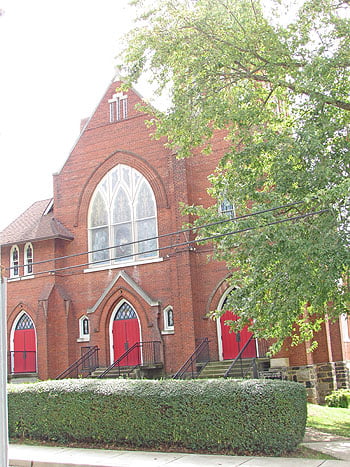
Founded in 1868 — Hopkins Chapel AME Zion Church. A few years after the Civil War ended, and following the refusal of the pastor of Central United Methodist Church to allow a visiting black minister to preach there, black members decided to withdraw from that church. The group marched, singing, to the lower reaches of Beaucatcher Mountain, where they established Hopkins Chapel, soon named in honor of the first pastor of the new congregation.
Among the prominent community leaders from the church were the late tuberculosis specialist Dr. J. W. Walker, former president of Livingstone College Dr. W. J. Trent (deceased), attorney Floyd B. McKissick, Sr., national director of CORE, and Dr. Albert Manley, President of Spelman College. Reverend Keith L. Lipsey is the current pastor.
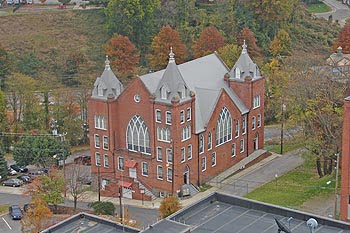
Founded in 1880 — Mt. Zion Missionary Baptist Church. In the spring of 1880, Rev. Robert Parker Rumley established a Baptist church in Asheville, and soon thereafter invited Rev. Frederick Brown from Greenville, South Carolina, to conduct a revival. During the revival Rev. Brown said, “I will call this church Mount Zion because I have never known a Mount Zion that did not thrive.” Thomas Wolfe’s short story “Child by Tiger” draws upon Reverend Rumley’s rich and colorful sermons. The church’s academic support system allowed many of its members to attend Shaw University for further education.
Reverend Dr. John H. Grant is the fifth and current pastor of Mt. Zion, having served since 1989. Each of his predecessors lives with a sobriquet reflecting his ministry: “The Founder,” Rev. Robert Parker Rumley (1880-97); “The Builder,” Rev. Jacob Nelson (1897-1926); “The Organizer,” Rev. John W. Hairston (1926-47); and “The Dedicator,” Rev. Dr. John W. White (1947-89). The large number of art glass windows that ornament the towers and walls are a notable feature. The church was built by the James V. Miller Construction Company.
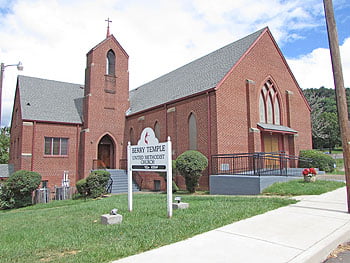
Founded in 1887 — Berry Temple United Methodist Church was founded by Miss Alsie Dole, Superintendent of Allen Home School, where services were held in the school chapel for its first 18 years.
In 1896 a church lot was purchased, but it proved unsatisfactory, and in 1900 the congregation moved to its present site on College Place. Over the next five years, under the leadership of Rev. N.O. Shamborguer, construction continued. On opening in 1905 the church was named for Bishop Berry. In 1940 Rev. L.A. Brown was assigned to Berry Temple and served for seventeen years; he was followed by Rev. Marshall McCollum, Rev. James T. Jones, Rev. M.C. Hickman, and current pastor Rev. Patricia Bacon.
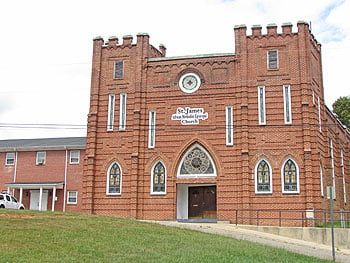
Founded in 1887 — St. James AME Church, then known as Levy’s Chapel or Long’s Chapel, began humbly on Biltmore Ave. (then called South Main), but two years later took its present name and relocated to Hildebrand Street near the intersection with Pine Street (now Martin Luther King Jr. Drive). When the adjoining lot at the intersection became available, it was purchased by the church and a parsonage was built. Then, in 1917, under the leadership of Dr. John E. Holt, the parsonage was moved back on the lot, the basement of a new church was begun, and the old church was remodeled into the St. James Apartments.
Completed in 1930, the new church, like many others, was built by James Vester Miller. Donors of the stained glass windows, the pipes and chimes for the organ, the lighted cross behind the pulpit, etc., are commemorated by plaques throughout the sanctuary. Fifty years later, St. James added the Haith Educational Building, spearheaded by Associate Pastor Rev. Lacy T. Haith.
St. James is the only African American Episcopal Church west of Morganton in the state; the current pastor is the Rev. Brent La Prince Edwards.

Founded in 1891 — Calvary Presbyterian Church was founded by Dr. Charles B. Dusenbury. The Home Mission of the Presbyterian Church had already established two schools in the area, both for whites: the Asheville Normal, located on the present site of Memorial Mission hospital, and the farm school, which is now Warren Wilson College. The Mission dispatched Dr. Dusenbury to establish a church for Asheville-area black citizens.
In 1892 a site on Eagle St. was purchased, on which was erected a sanctuary and later a manse.
Public schools for blacks in Asheville had just begun. In keeping with the policy of the board of Home Missions, a parochial school was started in 1894 in the basement of the church, and continued to 1927. Many students became members of the Sunday school and after completing their training joined the church. The present pastor is Rev. Patricia Bacon.
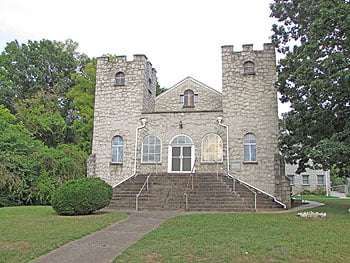
Founded 1898 — Rock Hill Missionary Baptist Church was organized under the pastorate of Reverend L.W. Simpson in a log building on Rock Hill Road. As the membership grew, a wooden structure was built, later destroyed by fire, and another structure was built at the same site. In 1925 the church moved to Caribou Road. That site later became the home of the church parsonage, when a new, $100,000 edifice, was dedicated in 1952. At each stage of Rock Hill’s development and growth, the church operated on a pay-as-you-go basis: each building was paid in full when finished.
In 2001 Reverend Spencer E. Hardaway became pastor of the church.

Founded in 1915 — Hill Street Missionary Baptist Church began in 1915 when a small congregation, led by the Reverend D.D. Moore, was stirred to build a monument to the glory of God. Rev. Moore and his early successors—the Revs. T.J. Davis, H.E. Gudger, C. Kennedy, F. Hatchett, E.C. Miller, and C.H. Williams – were the leaders who established what would be known as Hill Street Missionary Baptist Church.
In 1932 Rev. E.W. Dixon, publisher of the area’s first African American newspaper, The Church Advocate, was called to lead the congregation of Hill Street. Fifteen years later, the congregation agreed on the need for a larger home, and the new building was completed in 1949.
Pastor Nilous Avery and First Lady P. Avery were equally strong advocates for education of young people, and over their decades of leadership, additional construction was undertaken. The Hill Street Nursery began as a small four-room dwelling which only enrolled four children; today, the Center cares for over sixty children and is one of the top ranked Four-Star Child Care Centers in Western North Carolina. In 1993 ground was broken for the Dr. Nilous M. Avery Multi-purpose Educational Building, containing classrooms, offices, a library, conference room, and a fellowship hall.
Dr. Avery retired in 2002 after fifty-one years of dedicated service to the Lord, and in December, 2003 he was succeeded by current pastor Rev. Dr. Keith Ogden.



How can we add more to this list?
Hi Janine, feel free to send us any information you may have. Send to [email protected].
Rev. Homer B. Ferguson built the Rock Hill Baptist Church and was pastor there for many years. ~ Submitted by Kathy Garrison