Occupy Wall Street, Asheville – a Grassroots Initiative
|
| Photo: Urban News |
Staff Reports
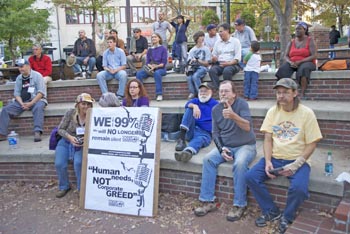
The Occupy Wall Street movement has gained momentum across the country, capturing the passion of millions of Americans who have lost hope as they gain certainty that our nation’s policymakers are not representing them. In Asheville, one such non-violent, nonpartisan group comprises people from all walks of life who are turning out with their friends and neighbors in parks, churches, and community centers.
People are gathering to express their frustration and discontent about our country’s staggering wealth gap, the lack of jobs for people who want to work, and the corrupting of our politics by business and financial elites—all calling for fundamental and societal changes.
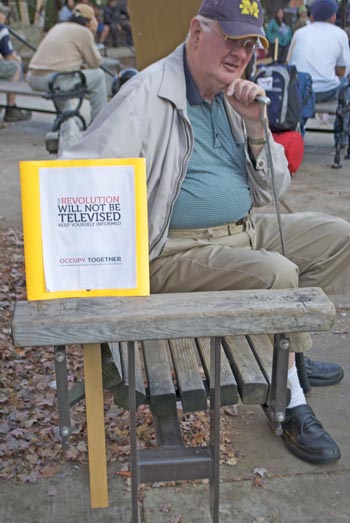
One Occupy Asheville advocate, Lisa Landis, commented, “This is a
movement by all the people. Not just a group of people who say this or
that is wrong. The people who do the work to keep our country running
are being robbed not only of income, but of a voice. It is time for all
of us—the 99 percent—to be heard.”
|
| Photo: Urban News |
Implicit in her remarks are the statistics showing that during the past
thirty years, and especially over the past decade, the concentration of
wealth in the hands of the one percent—a few thousand families each
worth hundreds of millions or billions of dollars—has reached levels
seen before only during the Gilded Age of the late 19th century, when
“robber barons” and owners of industrial trusts controlled the vast
majority of the nation’s wealth.
In combination with the Supreme Court’s 2010 in Citizens United
decision, that wealth has given the tiny minority of the super-rich,
acting directly or through the corporations they control, virtually
unlimited power to control elections and buy and sell the loyalty of
elected officials.
A newfound determination to fight against that power and put control of
the people’s government back in the hands of the people is at the core
of the Occupy Wall Street movement. The fact that OWS groups have
appeared and grown exponentially in cities as different as Dallas,
Chicago, Seattle, and Asheville shows the depth and breadth of that
determination.