To Be Young, Gifted… and Mayor
By T.J. Moore
In October 2005, Asheville’s voting public wanted a mayor who could balance intelligence with fairness.
The voters also wanted a mayor that could bring fresh and innovative ideas to this sometimes rigid city. Well, the voting public received all of those attributes when they elected Terry Bellamy as mayor of Asheville.
Bellamy made history even before holding her first City Council session by being Asheville’s first African-American mayor, and being the city’s youngest ever to take office.
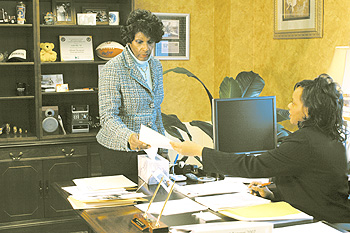 |
| Always ‘on task’ Mayor Bellamy and Administrative Assistant Nancy Farmer work together to complete scheduled projects. Photo by Renato Rotolo |
With a progressive and productive first year behind her, Bellamy talked to the Urban News’ Johnnie Grant and T.J. Moore about her second year goals and aspirations, her thoughts about being the first African-American mayor, and her plans to create a solid bond between city government and the city’s youth.
UNews: Do you feel as if you accomplished your first year goals?
Mayor Bellamy: Yes. In 2006, some of the things I definitely wanted to accomplish was more community outreach, and making sure our communities knew what was going on in government. The first thing we did before going into our retreat was to have a community input session to talk about some of the main issues that were needing to be addressed in our community. I believe that looking at what the community put forward ,and what the council put together for our strategic plan, a lot of that( outreach) has been accomplished.
We are continuing to talk about issues such as the Civic Center, and the city of Asheville did adopt an actual plan-which has not been done since the building of the Civic Center. So, we have dedicated between $400,000 to $500,000 annually, for the renovation of the Civic Center. We changed our redevelopment plan to make the documents easier to read and more user- friendly.
We have also added a pay plan for our police officers because we found that our police officers, fire fighters, and some of the people in our engineering department were underpaid. What we did was to get a five year step plan and last year, we implemented the first year of that plan. We did have some increases (in salary) by doing this. We also brought along two fire stations, and we will probably do our third station this year in order to increase service areas for our community.  For basic city services, we put more money into streets and sidewalks this year. For example, the community members in Haw Creek have been asking for sidewalks for a long time; so we put sidewalks in areas of Haw Creek. We will do some on Patton Avenue- which is a high visibility area, and a lot of people use that area to get back and forth to work. So, (based on what was mentioned) I think last year was a great year.
UNews: What do you hope to accomplish in your second year of office?
Mayor Bellamy: For our second year, we want to continue with the capital improvement project for the city, and looking at our long term needs-whether that’s with the police department, with cars for the police officers, whether that’s looking at the fire stations and the long term needs of fire services for our community. Capital improvement-making sure that we have the money to support the infrastructure that’s needed for our community. Basic city services and enhancements-making sure that sidewalks and streets are being addressed making sure your trash is picked up, making sure that those key elements are done. These are the things that our city charter mandates that we take care of.
Intergovernmental relationships and trying to work better with other municipalities and other forms of government is another goal. One of those aspects to look at is, how we insure people who grow up in our community can get a job with the city of Asheville. For example, there are a lot of people who have come into this organization that have only graduated from high school, and retire 30 years later.
Currently we see a lot of people with, and those who need a degree in a lot of career fields. Well what about experience? How does (job and educational) experience balance with life experiences and maybe an associate degree from A-B Tech? The concept for my idea is that the city will send you back (to school) to get your graduate degree or your BA or your BS. The council bought into that ideal at the retreat, and I was real excited about that.
I’ll tell you that my position as mayor is two fold. There are two sides that I take. One is the policy side and the other is the ambassador side. The bonds and city services is the policy side. The ambassador side is for community outreach. For instance, I want to help develop a youth conference, and the focus of the conference is to hear from our youth and to talk about their issues.
What is important to our youth? What can we do as a city to help you? What are the problems you are facing? What do you see as your future? How does your community embrace you and how do I embrace you? What can we do to make it better?
I talked to Cassandra Ingram at Asheville Middle School and she had the same idea (about a youth conference), and I said I am excited about what you want to do and we’ll work together to make that happen.
UNews: Speaking of the youth, there are high dropout rates for minority students, how do you plan to address this burgeoning problem?
Mayor Bellamy: I talked to a couple of school board members and the superintendent about a uniform pilot project at Asheville Middle School. What that means is the students will wear school uniforms to see how that helps matters. The uniforms are believed to keep them focused more on academics than on other things that interfere with their education.
You have some people who may be involved with activities that shouldn’t be at school. If I am picking on you for what you have or are wearing, that item can be taken from you or be removed. However, if everyone has khaki pants and a blue shirt or green shirt or a red shirt or a burgundy shirt – we all look alike, so what are you going to pick on now?
The thing is to level the playing field so the kids can focus on academics and not be worried about what someone else is wearing, or if they have on the latest Baby Phat, or Phat Farm. So, that is one of my goals for the beginning part of this year, to have the uniform pilot project for this fall, see if it works, and see if it does make a difference. The parents may love this ideal because the parents have to buy school clothes, and this (uniform idea) may be cheaper for them.
UNews: Are there any plans for Eagle-Market redevelopment anytime in the near future? If so, what will the redevelopment involve?
Mayor Bellamy: Right now we are developing an RFQ, and that is a request for qualification forms for consulting firms to help us draft a request for proposal. The form looks at city owned land as well as the Eagle-Market Street Area. We are looking for a master planner- somebody who will help us look at Eagle Market Street as well as the properties adjacent to the city. Hopefully, the firms will come back during the second quarter of the year.
UNews: 20 years ago, the city developed a downtown renovation plan named 2010. How many elements from this document and past downtown renovation documents are currently in the center city plan?
Mayor Bellamy: Actually, the way that downtown has developed was born out of the 2010 plan, as well as the center city plan. The people who were involved in the 2010 are still around and still active; whether that’s on a downtown commission or the merchant’s association. So, a lot of the same people are still involved, and a lot of people who invested in downtown at that time are helping to revitalize downtown.
I would say that the majority of the 2010 plan and the center city plan, those issues still carry forward even in a 2025 plan which is a more recent visions for our community.
UNews: Since you are the first African-American mayor of Asheville, Do you feel any additional pressure to perform your duties at a high level?
Mayor Bellamy: First of all, I want to say that it is truly an honor to serve all the citizens of Asheville. I am always humbled when I think about the office that I hold. As an African-American woman, I cannot think that the standards in which I do my job can be the same as others. I always have to look at how can I do something differently, or better.
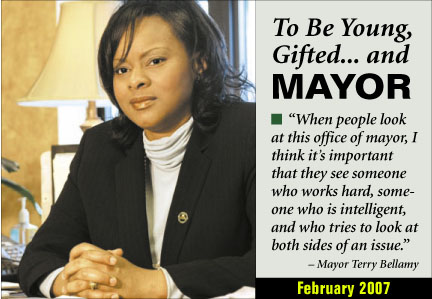
For me, when people look at this office of mayor, I think it’s important that they see someone who works hard, (someone who is) intelligent and who tries to look at both sides of an issue. They are looking for someone who is willing to at least, hear them out and be fair before making decisions. I try to be a good role model for everyone.
UNews: What is the difference between workforce housing and affordable housing? Who will and what income level will workforce housing cater to?
Mayor Bellamy: I think that so many people have in their minds thought that affordable housing is a negative word, but all it means is housing that people can afford. When I think about it, I think of teacher’s assistants, teachers, firefighters, the people who are tellers at our banks and reporters who report on our news they all need housing that they can afford.
UNews: Instead of closing public housing, why can’t the people be more responsible for their units and the neighborhood, and if responsible for drug activity use eviction as a deterrent?
Mayor Bellamy: The city’s housing authority has that rule. They have a one strike rule. It is a HUD Regulation if you are caught selling drugs and you live in public housing, you are out. If the police catch you running and you are going into a house and you are caught with drugs, you are evicted. They (housing authority) have that currently. There’s no public housing being closed in Asheville.
We can call them and get the logistics of it, but our goal for the city of Asheville was to look at the feasibility of saving public housing because that’s 100 units. Now, the occupancy is below 50 percent I do believe that accountability is first and foremost. Just like you are accountable for your house, and I am accountable for my home. I do think that housing authority is enforcing that. I do think that of course the city has a role in plans of making sure that all neighborhoods in Asheville are safe.
As I look at the successful neighborhoods, there are people who are low income, high income and middle income those are mixed income neighborhoods. There is nothing wrong with integrating neighborhoods financially.