Bangin’… in Asheville?
 To the average Ashevillian, the thought of gangs and gang violence being linked to the city sounds foreign and teeters on the absurd.
By T.J. Moore
However, based on a November 2005 shootout in Livingston Heights and an Asheville Police document five months ago, the ‘absurd’ became a very true and dangerous reality.
Currently, there are an estimated 387 different gangs in North Carolina and smaller, rural towns and cities such as Asheville are not immune to the gangster element, lifestyle and the crime that comes with it.
According
to the Buncombe County Gang Violence Prevention Project Assessment
Report, 414 crimes suggested gang related activity in Asheville during
the past fiscal year. These developments prompted Asheville Police
Chief Bill Hogan and Mayor Terry Bellamy to join other civic officials
in Raleigh to discuss North Carolina’s burgeoning gang problem, and to
ask state government officials for action.
While some may
be surprised by the incidents of gang activity in Asheville, City
Councilman Carl Mumpower is not shocked by the findings. “No, I’m not
surprised at all,” he says, “What happens elsewhere comes to our
community eventually. We seem to fall and get caught up in the same
kind of goofiness as other communities in our country.”
The Spread
In the 1980’s
and for most of the 90’s, gangs such as the Bloods and Crips were
primarily on the West Coast. From the mid to the late 90’s, there were
reports of gang activity in places such as Tulsa, OK, and Little Rock,
AK. After growth in the Midwest, it took the gangs no time to hit the
cities and rural areas of the north and southeast. One reason for the
growth of gangs in Asheville could be as simple as expansion. “People
try to move into an area and try to stimulate gang activity,” says
Asheville Police Chief Bill Hogan, “They expand the market, set up and
recruit.” Police Captain, Tim Splain agrees. “You see this (trend) from
the Midwest,” he says, “The gangs from California move into places like
Little Rock to expand.”
University of
Southern California Professor Emeritus Dr. Malcolm Klien thinks that
the growth of gangs to other regions of the country has little to do
with gang members moving from California to other places. “Most gang
problems, no matter where you are, tend to be a local problem,” he says
“Now there may be those from L.A. who move to an area and start a gang,
but for the most part, gangs are started by local kids who have never
seen the insides of Los Angeles. This is a local problem with the
veneer of national rhetoric.”
The core of the city’s gang problem
December’s
report from the Buncombe County Gang Violence Prevention Project
surveyed 41 Buncombe County and Asheville City school students and
found that 46 percent considered gangs to be a problem at school, and
56 percent said that their classmates belong to a gang. So what is
prompting Asheville’s youth to turn to gangs? Is it their physical and
economical environment? Is it the allure of the gangster lifestyle; or
are both cases valid.
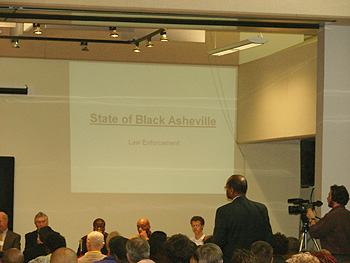 |
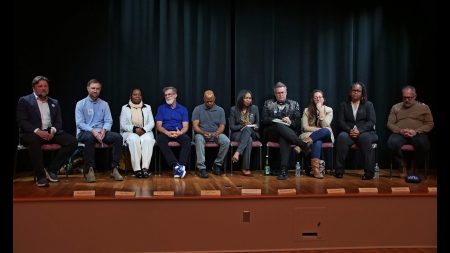
| Concerned community members address Asheville – Buncombe law enforcement panel at the “State of Black Asheville Summit.” |
Just like any
other middle-class city in the nation, Asheville has its share of rough
areas. The report implies that a huge percentage of gang activities
occur in the city’s housing projects. According to the report, the
isolation of Asheville’s housing projects ‘may be lending itself to a
certain type of gang activity as well as limiting the awareness and
perception surrounding gangs for other Buncombe County residents’.
Eleven percent
of Asheville’s population is under the poverty line, and may be a
factor in gang activity. Mumpower believe that economics and other
factors are contributing to this issue. “That (economics) is a factor,”
he says. “But we have plenty of people who come from poor families that
don’t chose to go to bad places. There are other factors that are more
crucial to gang formation like the ‘need to belong’, parental neglect,
peer pressure and a societal message that there are shortcuts to
happiness and it is okay to take them.”
While
environment may play a role in the development of gangs in Asheville,
popular images may even play a greater role. Many are aware of the
movies, songs, and shows that mention and even seen as glorifying the
gang culture, and it is believed that the images are the cause of the
rise of gang participation. Mumpower is a staunch believer in how
powerful popular images are, and believes that Rap music is a catalyst
in the interest of this lifestyle. “We need to challenge this hip-hop
anything goes value system that teaches men to be boys and treat girls
like toys,” he said.
Imagery may be
ironically the reason why there are fewer gang related crimes in
Asheville than in other cities of the state. “We are seeing some
‘wannabes’, says Hogan, “They may claim that they are affiliated with
national gangs, and may know something about them, but they don’t
necessarily have national gang connections.”
Not everyone
believes that these images are causing a spike in gang membership.
“Gang members are just as likely to pick up style,” says Klien. “(I
believe) gang members are causing the imitation more than imitation is
causing membership.”
Is Defense and Prevention the best offense?
Recently, North
Carolina received an $184,359 gang prevention grant, and Buncombe
County is immediately putting some of that money to use. One of those
investments is the Buncombe County Gang Violence Prevention Project.
This multilayered group takes an interesting approach in keeping a
slight problem from growing into a full-scale one. “We are a
collaboration that works with different types of youth,” says Mediation
Center youth program director Megan Leshak, “For instance, Horse Sense
may work with gangs in youth development while the SOS YWCA program may
work with those who have risk factors for gangs.”
As far as the
program’s success rate is concerned, Leshak is confident that the
Project will make a significant difference. “We are following a model
that’s been successfully used in places like Detroit and Houston. We
focused heavily on prevention and this is going to be helpful,” she
said.
As a former Job
Corp instructor, Leshak witnessed first hand the struggle of reform for
gang members who want to turn their lives around, and understands the
importance of rehabilitation and prevention methods. “I taught and
worked with a lot of kids that struggled to leave the gang life
behind,” she said.
Leshak also
believes the very things that draws the youth to gangs is the same
thing that they find hard to escape. “For a lot of them (gang members)
it was a sense of family,” she says, “They may not like school and
don’t have access to a lot of things in mainstream society, so they
turn to gangs to have a sense of family and camaraderie, and even
structure.”
Meanwhile, the
Asheville Police Department will lend its hand to the prevention ranks
when they join the Gang Resistance Education and Training (G.R.E.A.T.)
program. Similar to the D.A.R.E. program for drug abuse, G.R.E.A.T. is
a national program for elementary and middle school students to help
them avoid gangs, violence and other delinquent behavior. Despite the
noble mission of this 16-year-old program, it is not without its
critics. One of these critics believes that the problem of gangs needs
a more heartfelt solution.
“In truth, I
don’t think that programs, government initiatives, and throwing money
at problems is the answer,” Mumpower replied, “We need our churches and
our moms and dads to provide more love, attention, and opportunity for
our children. Success is going to come from the hands of caring people
not the hollow promises of the government.”
Regarding
G.R.E.A.T., Mumpower may be right in his assessment. According to a
2001 report in the Journal of Criminology and Public Policy,
G.R.E.A.T.’s impact on curbing gang activity was modest at best. The
article, “How great is G.R.E.A.T” supported its claim by conducting
short term and long-term observations. While the program was moderately
successful during the short term, the four year, long-term period told
a different story.
Rehabilitation and Redemption
Despite the
efforts of city officials, some feel as if all the prevention and
rehabilitation programs would be useless without an active hand. Robert
Morgan, Jr. a self-proclaimed ex ‘hustler’ believes that nothing can be
done from a desk. “More one on one training is needed,” he says, “we
have a lot of dictators but no one is actually coming down and doing
the work.”
Morgan knows
about the rehabilitation process all too well. After being released
from prison, and determined to never return, he went through quite a
few rehabilitation programs only to discover the difficulties in
starting over. For years, Morgan would work with the programs and apply
for job after job with nothing to show for it. Eventually, he would
land a job as a chef. Morgan’s story is one of perseverance. “I just
didn’t give up” he said, “It took a lot of willpower and the thoughts
of my kids to keep going.”
In addition to
perseverance, Morgan believed that it was his new-found attitude that
helped him land his current position. “(The employer looked at) the way
I carried myself,” he says, “It took a long time to get out of that one
track mind. All my old habits went away but everyday is a struggle. It
(change) is a reward in the end if you keep trying.”