Urban Asheville
By Sam Powers
Asheville is considered an urban place by the US Census Bureau, but it is much more than that statistical designation.
I believe
fits the definition of urban for many other reasons. The topography of our City
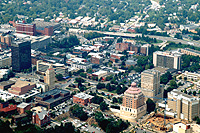
has caused it to grow in a more dense way than many similar populated
communities. This greater density gives
the feel of a much larger city because the population is in a highly
concentrated area.
Asheville\’s size also leads to a walkable downtown, which increases pedestrian traffic; the large number of people on the street adds to the sense of urbanization.
 |
Asheville has a very significant daytime population increase as people come into the city to work. According to the US Census Bureau, the city has one of the highest percentage increases of daytime population of any US city of 50,000 to 100,000 people. Again, this increase of people in the city gives us a feel of a much larger area.
Add in the millions of tourists who visit Asheville each year and we get even more urban flavor. The many tourists and workers who come to Asheville help support businesses. For a small city, Asheville has a great diversity of restaurants of almost all ethnic flavors — Cajun, French, Middle Eastern, Indian, Caribbean, Spanish, Mexican, Soul Food, Cuban, Japanese, Chinese, Thai, and German, among others. I feel confident that many cities of Asheville\’s size could never hope to match the range of restaurants that we support here. And these businesses help us all broaden our horizons by educating us to different cultures — another mark of an urban area.
Asheville also supports a growing entertainment industry — music, live theatre, book readings, etc. — that helps our city grow the urban sense of place that is becoming known around the USA. On any given night a patron seeking live entertainment can find almost any type of music being performed. When people come out to find entertainment, there is additional pedestrian activity downtown. Such nighttime street life is what people see and expect in an urban area, and we have it here every night of the week.
As Asheville City Planning Director Scott Shuford likes to point out, the “re-densification” of Asheville is making it possible to proactively address our transportation, fiscal, affordable housing, and other growth challenges that urban areas face. Transit systems work better at high densities, and if people live closer to where they work, they don\’t have to travel as far and therefore can use the money saved on transportation for other things — such as partaking of Asheville\’s urban offerings.
_________________________________________
Sam Powers is the Director of Economic Development for the city of Asheville.