The state of the community
 Through interviews, statistics, and analysis, we have compiled
several views of what we are calling The State of the Community — the
“minority” communities of our area\’s diverse, vibrant, changing
citizenry. We started with a basic question: How has Asheville — its
intercommunity relationships, job opportunities, acceptance of
diversity, etc. — changed over the past 25 years or so? There are as
many different responses as there are people to ask; this is our first
attempt to address, if not answer, that question.
Twenty-six years ago a coalition of community leaders led by Dr. John
White reorganized the 85-year-old YMI (Young Men\’s Institute) building
into the YMI Cultural Center. The building was in terrible shape, and
the preservation plan was extensive and expensive. The organizers\’
vision was to develop the YMICC as a self-sustaining, independent,
nonprofit organization dedicated to chronicling, preserving, and
furthering the region\’s African-American cultural history.
site of Asheville\’s first Prayer Breakfast honoring the legacy of Dr.
Martin Luther King. Charged to come up with an event each month to get
the community involved in the Center, Assistant Director Oralene
Simmons, suggested the prayer breakfast to Leslie Anderson, at the time
a supervisor in the Parks & Recreation Department.
Today, the YMICC
is the cornerstone, both literally and figuratively, of The Block,
Asheville\’s historic African American business district, [see “The YMI
Cultural Center,”] and the Prayer Breakfast has grown into a major
cultural and social event held at the Grove Park Inn each January for
an audience of more than 1,100 from throughout Buncombe County and
beyond. The quarter century bracketed on one end by those two events
and, on the other, by the 2005 election of Terry Bellamy as Mayor of
Asheville, marks a generation of change. It encompasses an influx of
Hispanic and Ukrainian immigrants (and other minority groups) that
highlight real differences between then and now, both in the City\’s and
County\’s ethnic makeup and in the common attitudes towards that
diversity. A visible change is that formerly white, “establishment”
jobs are now held by nonwhites, who achieved their current roles and
status through paths that have long been available to WASPs: 1) being
chosen through electoral politics; 2) climbing the corporate ladder; 3)
earning credentials and promotions in an institution of higher
learning; 4) striking out as a self-made entrepreneur.
 |
|
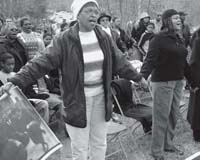
Community members gather in solidarity during Martin Luther King, Jr. march. |
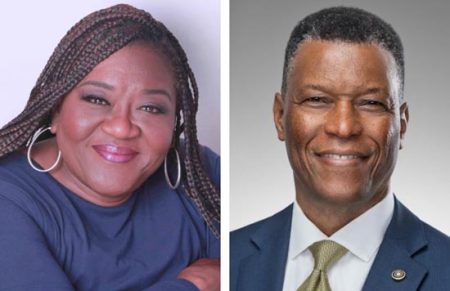
1) Terry Bellamy, Mayor of Asheville, is the first African American to
hold that office. She leads a city in which less than a fifth of the
population (17.6%, 2000 Census) is African American, and election
returns showed high levels of support from some overwhelmingly white
districts. Her campaign reflected a personal conservatism and a
progressive view of what political leadership can do to identify and
address problems, bring in diverse points of view and ideas, and build
coalitions to find win-win solutions. [see “
Invite Citizen Input,”] After six years on City Council, Bellamy
was perceived as a young mother with a successful career (as Marketing
Director for Mountain Housing Opportunities), which gave her good
credentials among liberals, families, working people, and progressive
groups. She had the qualifications that voters wanted, and they voted
her in, breaking through a barrier that has been unbreachable in many
other places.
2) Virgil Smith is President and Publisher of The Asheville
Citizen-Times, an independent, middle-of-the-road, reasonably popular,
and thoroughly corporate organ of the nationally influential Gannett
Corporation. Corporate decisions like appointing a publisher are almost
never made for charitable reasons. They might be made because of
favoritism, nepotism, or some other “ism,” but they also have to
satisfy stockholders, who want to see results reflected in the bottom
line.
Smith\’s appointment as publisher raised eyebrows both in Asheville and
in the media universe, and the fact that the paper is thriving under
his leadership a decade later — and that he himself is a power player
in the community — demonstrates both his competence and Gannett\’s good
sense in thinking him the right man for the job.
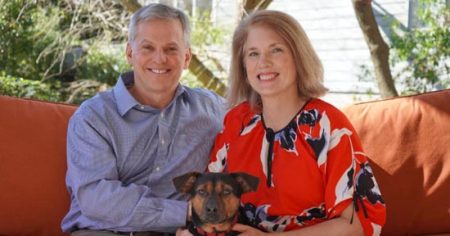
3) Both Dwight Mullen and Dolly Mullen are professors of political
science at UNC Asheville. She is an Associate Professor and chair of
the Department, and he is a full Professor and former chair. They
achieved their positions by credentials and talent. They both have PhDs
(Clark Atlanta University and Atlanta University, respectively), they
have paid their dues, and they\’re both highly regarded teachers. Their
experience and ability are what matter.
4) Eugene Ellison is one of Asheville\’s most prominent attorneys, a
former City Councilman and Vice Mayor, and co-owner of the thriving
Ritz Restaurant. He\’s known as a power broker and a person of
influence, not just in the African American community but also in
legal, political, and business circles.
Ellison grew up in public housing — the “projects” — owned and operated
by the city of Asheville. He had drive, initiative, a will to succeed,
and he has clearly made his mark as a professional and an entrepreneur.
He is, in fact, the proto-typical self-made man, with all the
attributes that mark tens of thousands of other self-made men and
women. [see “Eugene Ellison on The State of the Community,”]
Historical records make it clear that these four mini-profiles would
not have been possible in Asheville a generation ago. Mayors,
university department heads, publishers (and most editors), and other
movers and shakers were white, and mostly male. So were the vast
majority of people in visible mid-level positions. One would be hard
pressed to find 1970s equivalents of African Americans Ben Durant,
Asheville\’s Finance Director, or Kerra Bolton, the Citizen- Times\’s
political reporter in Raleigh. It\’s easy to see these prominent people
as a sign of how far Asheville has come in the past twenty-five years;
yet it\’s equally easy to look at them and say, instead, “Is that all?
You can come up with only half a dozen success stories in a city of
70,000 people?” The fact is, there are many other success stories, but
underlying them all is the fact that the atmosphere has changed. Almost
anyone over 40 can recall when it was common for whites to ask out
loud, “Who do they think they are?” when encountering an African
American with aspirations for real success. Many can recall when
“uppity” was a term of both derision and warning, used not just by
whites but by some black elders. Today, for the most part, success is
celebrated regardless of race, and accomplishment is rewarded, at least
for those with drive, determination, talent, and/or luck. [see
“Asheville — A Newcomer\’s Perspective”]
But there are also aspects of life in this community where it seems
nothing has changed at all. Not long ago a two-page advertisement
appeared in the Citizen-Times recognizing the realtors who had achieved
Platinum, Gold, Silver, and other award levels at a major real estate
brokerage. Each of these achievers had sold between $1 million and $25
million worth of real estate. Of the two hundred faces shown, only one
was non-white. In the same day\’s newspaper, another, smaller real
estate agency celebrated its 24 top agents for the year: all were
white. To some extent this inequity probably reflects simple realities:
that most of those with the resources to buy more expensive homes are
white; that a white agent is more likely to meet potential clients with
those resources; that many white buyers feel more comfortable with a
white realtor. Also, the average African American household has a net
worth that is one-tenth the average net worth of white households. It\’s
likely that when enough minority families have the resources to buy
up-market homes and turn to brokers to help find them, the realty
companies will hire more minority brokers and realtors to serve them.
We asked Oralene Simmons, the founder of the Martin Luther King Prayer
Breakfast, if Asheville is a good place to retire/raise my family/get
ahead with my career?” “I welcome you to come live in Asheville,”
answers Simmons, “because we need you. We need you to bring something
good with you to Asheville. And I probably would have answered the same
way twenty- five years ago,” though she adds, with a chuckle, “I
probably would have had higher hopes then.”
 |
| PHOTO BY CATHRYN SHAFFER |
She sees a community in which everyone — black, white, Hispanic,
immigrants from Europe, migrants and retirees from other parts of the
US — takes great pride. “People here are interested in molding and
shaping Asheville into a better place to live.” Simmons is particularly
optimistic about the engagement of older people in looking after
generations coming up. “After integration,” she points out, “we walked
away and left education solely to the teachers. And a lot of us went
out for jobs and opportunities we hadn\’t had before, so the children
didn\’t get the reinforcement from home that they needed. We trusted the
schools, the system, with this; now we see that we need to help our
own, to do our part.”
And, she says, “Now there\’s a generation of retired people, with good
health and time on their hands, giving volunteer time to help children
in schools, recreation centers, to tutor, to make a difference in their
education.”
She recognizes the many problems students face. “So many parents were
busy working, they haven\’t been as visible and active as they were when
there were neighborhood schools, when the schools were still
segregated. But children need that, and parents are beginning to step
back in. We\’re taking responsibility for our youth.” Has Asheville
changed for the better since the YMI Cultural Center was incorporated
and the King Prayer Breakfast began? With Bellamy\’s election as
Asheville\’s first African American Mayor, it\’s clear that it has.
Asheville collectively is more open, inclusive, and welcoming of
diversity — but we echo Ms. Simmons: “we see that we need to help our
own, to do our part.”