Eagle – Market Streets redevelopment community meeting
BY CLARE HUBBARD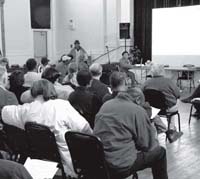 On February 21, 2006, a community input meeting regarding the development on Eagle and Market streets in downtown Asheville was held at the YMICC (Young Men\’s Institute Cultural Center). Local business owners, community members and representatives from numerous community organizations gathered to discuss the current and future development of the historically African American area. Facilitated by James E. Ferguson II, attorney at law at Ferguson -Stein and Chambers located in Charlotte, NC, the meeting began with a welcome from Eagle Market Streets Development Corporation (EMSDC) and a general overview of previous development of the area.
The purpose of the meeting was as stated: “ To hear your ideas, input
for continued redevelopment in the South Pack Square area and to
revisit this first in the light of the South Pack Square Redevelopment
Plan, to look at the strategies suggested by the plan, and to develop
community consensus for desired redevelopment for Eagle and Market
Streets,” Attorney Ferguson stated.
The scope of the South Pack Square (SPS) Redevelopment Project is known
as “The Block”, and is comprised of 22 acres that is located on Eagle
and Market streets. With a history of racial segregation, blight and
crime, The Block has been a focus for commercial and economic
revitalization. The EMSDC began renovating in 1999, and partnered with
the Asheville Police Department for increased police presence, created
a Food Bank operation and job training and employment programs for 400+
community members, and created many partnerships with business
development corporations in the area.
Marilyn Bass from Bassociates expressed the goals of the corporation
and explained the redevelopment strategy for the area, including
investment opportunities, growth and expansion, rehabilitation of
properties, and sustaining the “unique historic African American
neighborhood that has been designated as a National Historic District.”
Elizabeth Russell, Director of the EMSDC, continued the conversation by
presenting slides of zoning areas and pictures of past projects.
Some SPS Plan objectives included “creating a close working
relationship with local corporations and organizations, residents,
merchant and business owners… to ensure development occurs that is
compatible with the needs and desires of the community…to attract and
nurture African American businesses… and to stimulate commercial and
residential investment and work to prevent the loss of property owners,
merchants and residents presently in the area.” Current issues facing
the development plan may create timely procedures for the operations.
The community and EMSDC must work together to acquire properties, find
developers, complete plans, create successful marketing strategies, and
create partnerships and financing, which all takes time. The main
buildings included in the development plans are the Del Cardo Building,
located at 38 Market St., and the Collette Building, located at 17-23
Eagle Street. Numerous options were mapped out regarding the
development of these buildings, including developing with local
investor partners, phasing rehabilitation from Eagle Street by starting
with the Collette building first, or engaging a new developer partner
either by selling properties to developers in exchange for long-term
revenue stream or partnering with developer to “add scale of project
and lower cost thresholds.” “An issue we faced with this last option is
that most developers are searching for 25,000 sq. ft. or more.
Obviously, we fall short, and this could pose a problem for creating
development strategies,” Russell said. After the initial development
overview, the floor was opened to local business and property owners.
The greater area of Asheville is facing development issues of its own,
which has many community members at unrest because of recent
investments. Meeting attendees expressed this concern through voiced
apprehensions of affordability and generic assimilation. Russell then
addressed these issues of affordability, which many people saw as the
main issue facing development progress. “I am going to be honest.
Affordability has been a big issue for us. We are trying to create
partnerships that will help eliminate this issue. What excites us most
is partners that want to focus on affordability with us,” said Russell.
Gene Ellison, owner of 42-44 S. Market St., said he has a large
interest and an even larger investment in the project, and that he had
a vision for the opportunities of development. “[EMSDC] is the
cornerstone of The Block. We aren\’t here to challenge EMSDC; we want to
work together to [eliminate] prostitutes and drug dealers. I want the
block to be successful. “ He also mentioned the problems in the past
that have affected the block. “Our fight has been about the lack of
respect to the old buildings, old businesses, owners and investors.
There are at least 3-4 local bankers who are willing to help this
development,” said Ellison. Issues of whether The Block should maintain
its African American identity also arose at the meeting. Views were
mixed, and many were adamant about their positions. “Asheville doesn\’t
have a color.
This is for everyone. There are at least 3-4 bankers who are willing to
help this development. Everyone has a role,” Ellison said. Kai Felder,
owner of Shoe Fetish located at 6 Eagle Street, had a different
perspective. “This area needs to be preserved as a Black historical
area. There is a great need for us to be represented as a people. 10
years ago, it was only drug dealers. Now, it\’s a chance to do
business.” Bob Smith, Director of Buncombe County Community Relations
Council, spoke of past racial tensions and issues with business
operations. “We have seen some real contention in the area, with white
merchants separating themselves from black merchants and vice versa,”
he said. Smith also mentioned possibilities of the project. “This is a
long process, but I see real possibilities. I hope we can see this
moment as a great opportunity.”
Louella Whitmire mentioned the more positive aspects of development.
“When you invite all people to be a part of something, that\’s a good
thing. Please remember the people that need help or grew up in the
area.” Valeria Watson-Doost, a newcomer to the area, was excited to be
a part of the changes. “I am so excited to be a part of the community.
I\’ve noticed there is a vibrant art and music scene, but it\’s around
the corner. I want these things to be here.” Curtis James, Vice
President of the Just Folks Organization (a community based service and
outreach program), spoke of the affect development and EMSDC has on his
organization. “We were having small festivals in the park and EMSDC is
helping us continue our goals. We have a big interest in the area. I
grew up here, and it IS a Black thing, we want to preserve that, but we
want to help everyone because that is part of being black.”
The greater area of Asheville is facing development issues of its own,
which has many community members at unrest because of recent
investments. Meeting attendees expressed this concern through voiced
apprehensions of affordability and generic assimilation. Russell then
addressed these issues of affordability, which many people saw as the
main issue facing development progress. “I am going to be honest.
Affordability has been a big issue for us. We are trying to create
partnerships that will help eliminate this issue. What excites us most
is partners that want to focus on affordability with us,” said Russell.
Bonnie Love then spoke of her own view of the issues facing The Block.
“The Block is supposed to be a place of unity and entrepreneurship.
It\’s going to take us working together to come up with a plan that is
in the best interest of the community, “she said. Many members of the
community spoke with differing reactions to the development plans.
Issues were mainly rooted in the preservation of the historically Black
community and the problem of finding investors that will preserve this
identity.
The consensus appeared to lean in support of general economic
development with the understanding and nurturing of the current
community and business owners located in the area. The greater area of
Asheville is facing development issues of its own, which has many
community members at unrest because of recent investments. Meeting
attendees expressed this concern through voiced apprehensions of
affordability and generic assimilation. Russell then addressed these
issues of affordability, which many people saw as the main issue facing
development progress. “I am going to be honest. Affordability has been
a big issue for us. We are trying to create partnerships that will help
eliminate this issue. What excites us most is partners that want to
focus on affordability with us,” said Russell.
To close, Darryl Hart, Chairman of EMSDC took a moment to focus on the
positive aspects of the plan. “I believe something good will come out
of this. I also believe all of us here tonight wish to see the block
develop and progress through us coming together and demonstrating our
support to move forward.”