Trooper Makes Fayetteville Man Walk Six Miles to His Car
By Cash Michaels –
Black, alone, and from out of town.
How much worse could it get? Greg Smith was about to find out.
Smith’s ordeal August 6, 2021 was every Black driver’s nightmare come true—being stopped in the middle of the night on the road by police for no legal reason; faced with the possibility, if not the likelihood, of being physically assaulted, or hauled off to jail, or both.
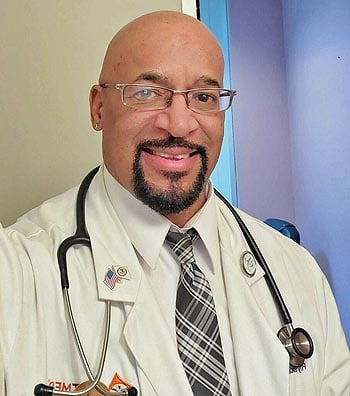
And to make matters worse, Smith was a clinical director from Fayetteville, NC who had just flown in to Missouri—documented as one of the worst states in the nation for racial profiling—for a medical conference.
He had already refused to show his driver’s license to the irritated white Missouri state trooper who stopped him until a supervisor arrived, keeping both his hands on the steering wheel of his rental car, and having called 9-1-1 so that the operator could both hear and record the entire confrontation from his car until he was aggressively taken out, arrested, handcuffed, and taken away.
And yet the whole time, Smith had no idea why he was “legally” stopped.
“There was never a crime committed nor law broken,” Smith maintains.
He was taken to a Platte City Highway Patrol station, where at first he was charged with speeding. Except that he could prove he was doing 65 mph in a 70-mph zone, and vigorously defended himself while still handcuffed, sitting in a chair. Indeed, the arresting officer had to account to the desk sergeant as to why Smith was even brought in in the first place.
Missouri law enforcement looked for Smith’s criminal record through their computers and discovered that … he didn’t have one. He’s a Black man who is who he is. Eventually he was uncuffed.
And yet there was still a problem. Smith was informed by the desk sergeant that they just can’t let him go because of the way the arresting officer wrote up the traffic stop in the computer: “PERSON WILLFULLY RESISTS OPPOSES A MEMBER OF THE PATROL IN THE PROPER DISCHARGE OF THEIR DUTIES.”
Smith had to pay $1,040 to bond himself out in order to be released, or he would have to remain in jail “for a while.” Fortunately, Smith says, he had his Visa card on him.
But even that would not help Smith find his rental car, which was taken to a Quick Stop all-night gas station approximately six miles away by officers and left there. If Smith wanted his car back, he’d have to call a taxi to take him to it. He’d also have to stay in the building downstairs in order to have any kind of shelter and safety.
After 90 minutes of “shelter and safety” and five fruitless calls waiting for a taxi, a tired and frustrated Greg Smith decided to strike out on his own, so he walked the dark streets of Platte City to find his rental car.
After getting confusing directions from officers, he went. Using the flashlight on his cellphone, Smith reached a gas station about a mile and a half away, where an attendant told him that his rental car was most likely at another station six miles away.
Smith finally reached the vehicle, and then took himself to an emergency room because of “the incredible pain” from the handcuffs. To Smith, it was apparent that the irritated white trooper “really wanted to injure me,” given the bruises on his wrists.”
“You’re questioning my authority, so I’m going to do this, or this to you,” Smith surmises the trooper’s alleged rough actions meant.
The Fayetteville man says through it all he thought of previous well-known victims of racial police violence like Sandra Bland, Eric Garner, and Michael Brown—the last-named, killed right there in Ferguson, Missouri by a police officer in August 2014. That’s why he so strongly felt the responsibility to speak out against what happened to him.
It’s one of the reasons Smith felt it important to keep his hands on the steering wheel where they could be seen when stopped and never move them; dial 9-1-1 so that the operator could hear and record all that was going on; and demand a highway patrol supervisor to the scene so that any arrest could be conducted properly, if at all.
Smith has engaged a Black attorney in Missouri and is ready to fight what happened to him.
“Reports of racial profiling by police in Missouri are not unusual and are supported by the data submitted by law enforcement officials each year,” said Luz Maria Henriquez, executive director of the ACLU of Missouri, in a statement.
As previously reported, as high a public official as the Missouri State Attorney General’s Office has confirmed that African Americans were 75% to 85% racially profiled by Missouri law enforcement in previous years. The problem was so bad that the Missouri NAACP issued a travel advisory for Black visitors to the state to travel with “with extremely caution.”
“Year after year, the data confirm that Black and brown drivers are subject to racial profiling by law enforcement in Missouri—in terms of stops, arrests, and searches,” Henriquez continued. “Yet for more than twenty years, the state has refused to update its racial profiling law to pinpoint officers who perpetuate this practice.”
“Racial profiling is bad policing,” the Missouri ACLU leader maintained, “not only discriminating against Black and brown people throughout Missouri, but also wasting police resources on encounters with those who are committing no serious crime and pose no danger to anyone.”
Greg Smith’s court date in Missouri for the resisting arrest charge is Nov. 16, 2021. He says he plans to sue the Missouri State Highway Patrol.
Editor’s note—This is Part 2 of a story about a Black North Carolina medical professional who flew to Missouri for a medical conference in August and found himself the target of alleged police abuse within a half hour of arrival.