Practicing Democracy in the Old North State

Photo: Tim Barnwell
Legislative News by Nelda Holder –
Local and national organizations working to safeguard public decision‑making.
It was 1967, and I lived in Durham, North Carolina. My husband and I had just produced a bouncing baby boy named Christopher—a happy little fellow who soon got involved in politics when his mom rolled him in his stroller out onto the tarmac at the Raleigh-Durham Airport to see a visiting presidential candidate (I’ll keep that identity a secret) and then rolled him into her voting booth in downtown Durham.
But my fondest memory of that baby activist period was placing him in his portable carrier on the long table at League of Women Voters directors’ meetings in town, where he watched the women make decisions about many things electoral and political. He was a cheery little mascot.
Years later, he’s continued to take an active interest in politics. And I’ve remained a member of the nonpartisan League of Women Voters for over 50 years. I salute that historic group, founded more than 100 years ago (in 1920) to educate women about the political process in the wake of the passage of the 19th Amendment giving women the right to vote. The new political organization was a merger of the National Council of Women Voters and the National American Women’s Suffrage Association.
How to Do Democracy
It’s interesting to me that the national League of Women Voters, which works at state and local levels, has set forth an expanded vision of their mission in these days and times. Here’s what they include:
- Expanding voter access
- Fighting voter suppression
- Money in politics
- Redistricting
- Safe and fair elections
Additionally, the League works to promote social and economic justice through attention to health care, the environment, immigration reform, and the Census.
They come to mind first since I’ve been familiar with their work for so long. But here are some other civic organizations promoting democracy in the state of North Carolina who advocate for democracy and responsible government in our state, in case you’d like to join forces with one or more in order to contribute to strengthening our political framework.
These groups can be an excellent way to give back to this state and country and society of ours, and help to fulfill the goals of this nation.
Organizations Promoting Democracy
Democracy North Carolina: Nonpartisan organization that uses research, organizing and advocacy to strengthen democratic structures, build power among disenfranchised communities, and inspire confidence in a transformed political process that works for all. Core values: equity, community-based leadership, empathy, bold action. Go to democracync.org. See their publication NCVoter, www.ncvoter.org, for important dates and other information.
Democracy Out Loud: Champions fair and inclusive democracy; centered in the Raleigh area with peaceful advocacy at NC General Assembly. Weekly online meetings Tuesdays, 11:30 a.m. to 12:30 p.m. Go to democracyoutloud.org.
Keep Our Republic: Works to safeguard the foundations of American democracy by anticipating threats, preparing practical solutions, and educating the public on the constitutional and civic principles that sustain our republic. In 1787, at the Constitutional Convention in Philadelphia, Benjamin Franklin was asked by a passerby about the kind of political system we would have, and he reportedly replied: “A Republic, if you can keep it.” This organization says, “We pledge to keep it.” Go to keepourrepublic.org.
Indivisible: Nationwide movement to stop the rise of authoritarianism and “build a real democracy that works for all of us.” Go to indivisible.org.
Indivisible Asheville: Weekly email; monthly letter-writing events; fighting extremism and building a representative democracy. Go to indivisibleavl.org.
NC For The People: Pro-democracy coalition, aimed at educating the public on how to build a democracy in which everyone participates, every vote is counted, voting rights are fully enforced, and everyone’s voice is heard. Focused on Racial Justice, Constitutional Crisis Prevention, Protection of Dissent, Judicial Integrity, money in politics, redistricting, voting rights, structural democracy. Go to ncforthepeople.com.
Voting Organizations
Common Cause North Carolina: Focuses on both national and state voting news, plus “nonpartisan tools to advocate for free and fair elections in North Carolina.” Go to www.commoncause.org/north-carolina.
NC Voter Project: Research-backed strategies to promote registered, informed voters participating fully in elections. Go to ncvoterproject.org.
North Carolina Asian Americans Together: Fostering community among Asian Americans and allies in North Carolina through civic engagement, leadership development, grassroots mobilization, and political participation. Go to ncaat.org.
You Can Vote: Nonpartisan nonprofit that educates and promotes civic action. Founded in 2014 as grassroots response to Shelby v. Holder, a Supreme Court decision that struck down key protections of the Voting Rights Act. Works with low-income people, formerly incarcerated people, new citizens, citizens with disabilities, educators, and youth. Go to www.youcanvote.org.
Established Organizations
Conservative Coalition North Carolina: Statistics from CCNC’s home page include these noteworthy numbers: 7.8 Million North Carolinians are eligible to vote; 2.8 million are unaffiliated voters who could decide the outcome of the election; 80% of eligible voters did not participate in the 2026 Primary. Go to www.weareccnc.org.
League of Women Voters: A political grassroots network and membership organization asserting that the freedom to vote is a nonpartisan issue and working as a woman-led organization to empower voters for more than a century. Go to www.lwv.org.
League of Women Voters of North Carolina: A snappy collection of chapters from around the state focused on elections and election supervision and integrity in NC’s voting processes. Go to www.lwv.org/local-leagues/lwv-north-carolina.
NC NAACP: Works to achieve equity, political rights, and social inclusion by advancing policies and practices that expand human and civil rights, eliminate discrimination, and accelerate the well-being, education, and economic security of Black people and all persons of color. Go to ncnaacp.org.
North Carolina Voter Protection Alliance: Focuses on systems, decisions, and actions that determine who can vote, how elections are run, and whether the process is fair and trustworthy. On-the-ground Infrastructure that protects voters before, during, and after elections. Includes supporting poll workers, legal volunteers, and rapid response efforts for problems. Go to ncvpa.org.
NC Newsline Articles
NC Election Process: ncnewsline.com/2026/07/07/what-goes-on-behind-the-scenes-in-an-nc-election-this-nonprofit-wants-you-to-know.
Voting Rights Groups: ncnewsline.com/2026/07/27/nc-voting-rights-groups-say-theyll-increase-efforts-to-help-voters-overcome-obstacles.
This list is by no means exhaustive, and you are encouraged to write to The Urban News to name others you find helpful.
Meanwhile, in the Governor’s Office …
Two questionable election bills sat in the Gov. Stein’s office—at least metaphorically speaking—over the second weekend of August: House Bill 958 and House Bill 834. Let’s take a look.
HB 958 (An Act to Make Various Changes to the Election Laws) This rambling 17-page bill covers such matters as shortening the early voting period for primary and runoff elections from 17 to 10 days; suspension and training of precinct officials; appointment of observers in nonpartisan elections; date change for certain municipal elections; the period for registration with a party to be eligible to file as a candidate in that party’s primary increased from 90 to 365 days before the primary; required use of federal decennial census for population estimates in establishing district boundaries; and a host of voter registration regulations.
Opposition to the bill has been serious. The American Civil Liberties Union, for example, noted these detrimental changes to the state’s current regulation:
- Attempting to restrict voting access
- Further politicizing the State Board of Elections
- Opening the door to election sabotage by giving the State Auditor the power to audit all machines, county offices, and personnel after ballots have been cast. It also allows the Auditor to direct county board chairs to challenge the ballots of specific voters in specific counties.
Sound like possible trouble? Here’s potentially a little bit more.
HB 834 (SBOE Administrative Changes) Not as onerous as HB 958, this bill still raises eyebrows, particularly for reducing early voting days and for expanding forum hearings for challenges to the State Board of Elections—which is located in Raleigh. HB 834 proposes allowing such hearings in the superior court in the county of the person seeking review.
The question now is this: Will the governor veto either or both of these bills? And if so, will the legislature be able to override his veto once again?
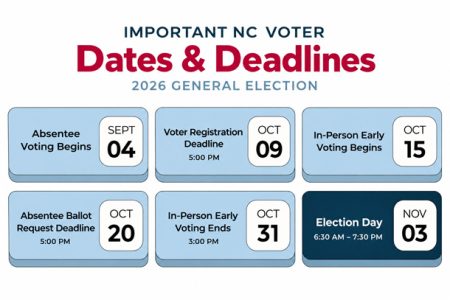
2026 Voting Schedule
- Friday, September 4 – Absentee Ballots mailed as requested
- Friday, October 9 – Voter Registration Deadline (due by 5 p.m.)
- Thursday, October 15 – First Day of Early Voting (NOTE: subject to change)
- Tuesday, October 20 – Absentee Ballot Request Deadline (due by 5 p.m.)
- Saturday, October 31 – Last Day of Early Voting (ends at 3 p.m.)
- Tuesday, November 3 – Election Day (6:30 a.m. to 7:30 p.m.)
- Tuesday, November 3 – Absentee Ballot Return Deadline (due by 7:30 p.m.)
Nelda Holder is the author of The Thirteenth Juror – Ferguson: A Personal Look at the Grand Jury Transcripts.