All the Power, All the Time
Budget wrangling, voting rights, and a potentially destructive education bill.

Photo: Tim Barnwell
Legislative News by Nelda Holder –
The North Carolina General Assembly is sputtering its way towards the grand finale: the budget wrangle with the governor.
But as of this writing, they are still massaging some gnarly pieces of legislation, not the least of which is SB 747 (Elections Law Changes) that directly affect the voting rights of the citizens of this fair state. And the picture is not pretty.
Of course, there’s also the basic mess they are making of education, environmental protection, state funding, women’s rights, human rights, and now—as of June 1—a proposed mash-up of our voting rights. And perhaps even scarier is the mess they are making of state government itself as they shift more and more power to themselves and away from the governor and various leadership slots heretofore not under their control.
Think of it as an “all-the-power-all-the-time” mantra. That’s what a veto-proof majority can get you. (Well, that and sports gambling and the cost to the state of attendant social services—not to mention the potential social/financial costs to families.)
This has led me to cogitate more and more on the idea of term limits for legislators. Fifteen states have them, with six additional states now having approval by voters to institute them. North Carolina had them—from 1990 to 2012. You could serve only three two-year terms in the House of Representatives (six years total), or two four-year terms in the Senate (eight years total).
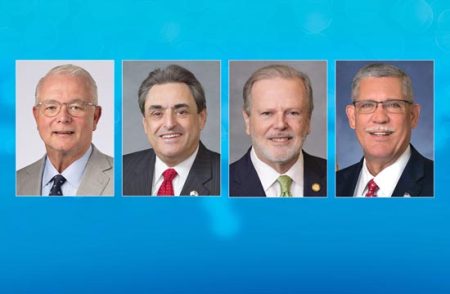
But in 2010, the ruling party in our legislature changed from Democratic to Republican for the first time in a century. (Think about that for a moment!) And now Phil Berger (R-Guilford/Rockingham) has served in the NC Senate since his 2000 election, and became Senate leader one year after that Republican sweep. He is now the longest-serving state legislative leader in the country, in his 22nd year as president pro tempore.
Tim Moore (R-Cleveland/Ruther-ford) is in his 21st year in the House, where he has served as speaker since 2015. (Ironically, Moore has proposed a national constitutional convention which—among other things—would establish term limits for members of the US Congress, according to Spectrum News.)
Perhaps we shall revisit this topic again in, say, another year—when the campaigning whips up some good old-fashioned public debate.
Do not, for one brief moment, let the voting changes keep you from voting
That’s about as plain as I can say it. And we’ll follow up on exactly what you need to know to make that easier.
Meanwhile, the voting rights bill, SB 747 (Election Law Changes) that hit the floor on June 1 courtesy of Senators Ralph Hise (R-Alleghany, Ashe, Avery, Caldwell, Haywood, Madison, Mitchell, Watauga, Yancey), Paul Newton (R-Cabarrus), and Warren Daniel (R-Buncombe, Burke, McDowell) is a 16-page document seemingly designed to produce headaches for the boards of elections across the state. If it becomes law (a strong possibility now that both the House and Senate have Republican super-majorities), we will offer careful instructions here to help you navigate the new regulations.
Some of the discussion/protest regarding this bill has to do with the reported “source” of much of its content. Early reports from a number of sources including the League of Women Voters of North Carolina note that the bill “was drafted from a playbook designed by the national election denier movement,” which does cause eyebrows to shoot up. Some of the LWV’s highlights from the original bill include:
- Elimination of the three-day mail-in grace period for absentee ballots (ballots to be received by the close of polls on election day)
- Expansion of voter challenges from precinct to entire county
- Requirement that boards of elections use Signature Verification Software for absentee ballots
- Public inspection of absentee ballots and container envelopes allowed
- Same-day voter registration ballots become provisional until verified
- Requirement for SBI investigation of election-related felony offenses (prosecutorial discretion removed from local district attorney level)
- Requires two-factor authentication process for mail-in absentee ballots
Will you need a photo ID to vote?
The 2022 elections produced a turnaround on the NC Supreme Court that placed a five-member majority of Republicans on the high bench. One of the earliest undertakings was a rehearing of Holmes v. Moore which (with much attendant publicity) struck down what the former Democratic majority on the court found to be a racially discriminatory voter ID law, Harper v. Hall.
The new court reinstated the voter ID requirement, applicable to the upcoming elections this fall.
So, when you do go to vote, you will be asked to show an approved photo ID, which can be as simple as pulling out your driver’s license. Don’t have one? The state is also gearing up to offer free photo IDs through the NC Division of Motor Vehicles. And county board of elections will soon be able to offer free photo IDs as well.
Note that all voters will be allowed to vote with or without a photo ID by filling out an ID Exception Form (including absentee-by-mail voters). But we’re starting early to get you used to the idea and to encourage you to make sure you are a photo-carrying member of the voting public.
It may not be too late
Of all the bills we’ve studied/discussed this session, one of the most potentially destructive to the fabric of our state and its long-honored public education program is SB 406 (HB 823)—the “Choose Your School, Choose Your Future” bill that was discussed in last month’s column.
Perhaps it sounds innocuous (if expensive). That would be after you get past the idea of giving money to promote “school choice” instead of paying the bills already owed to the public school system to help them upgrade as needed for all the children of the state. But I’m an old school-bus driver. My route went miles through the farmland of the state’s piedmont, picking up children who lived in the back corners far, far, far from any high quality (or low quality) private school. This bill does not serve such children. Nor does it serve thousands and thousands more who live in situations that make tuition or transportation, or simply the clothing wardrobe to fit in, unattainable.
Nor does it serve the public good. As I have stressed here before, there is no accountability demanded of the private school education getting this public money. Racial discrimination is not forbidden. Curriculums and material are not approved by any state standards. There are no qualifications demanded of teachers. Perhaps the legislators pushing this bill have a vision of high-quality private schools of stature where, say, the children of well-established legislators might matriculate. Think again. Or … just think.
The existing voucher program already spends $133 million dollars to send 25,000 voucher recipients to private schools (90% attending religious schools, according to the NC State Education Assistance Authority). The massive expansion plan has been inserted into the initial Senate budget, but has not yet been moved from the House and Senate to the Governor’s desk. Meanwhile, Gov. Roy Cooper has released his opinion in a statement charging that this would have “disastrous impacts on public school budgets.”
The program would “drain funding for public schools by pouring taxpayer money into private school vouchers while simultaneously handing wealthy people and corporations more massive tax breaks,” the governor told an audience at a Raleigh magnet school on May 23, 2023.
Cooper’s press release noted that billions in taxpayer money would go to private schools that are unaccountable to the public, and would force public schools—“especially those in rural and poorer counties”—to make steep cuts affecting their hiring of adequate numbers of teachers and otherwise (to) support students.
“In FY 2026-27 alone, public schools across the state would see a decline in state funding of more than $203 million,” according to Cooper’s missive. “(Thirty-one) counties would see a 3% or greater decline in total state funding.
The governor notes that the voucher proposal would also exacerbate the state’s teacher shortage. His own proposal for education would give a pay raise of 18% over the next two years to the state’s teachers, contrasted to the legislature’s proposal to raise the pay of veteran teachers by $250 (total) over the next two years.
(The governor’s full remarks are available in writing at nc-governor.medium.com.)
Tell ’em what you think
If any of the topics we cover here create the urge to call or write to your legislators, I once again refer you to the easy-to-navigate NC General Assembly (ncleg.gov). You can “Find Your Legislators” at the very top of the page, look up bills by their numbers (also at the top of that page), and lots more—enough to make you a real wonk. It is, after all, your legislature. Each legislator’s page offers full contact information—back home or in Raleigh.
Nelda Holder is the author of The Thirteenth Juror – Ferguson: A Personal Look at the Grand Jury Transcripts.