Political Analysis
NC: A Purple State with a Red-ocracy.

By Moe White –
North Carolina has proven itself to be among the purplest states.
Its governorship has flipped between Democrats and Republicans several times over the past two decades, while its Senate seats have been held primarily by Republicans in the same period, the one exception being Kay Hagan, who held office from 2009 to 2015.
Hagan was elected along with Barack Obama’s blue wave, but many political observers believe she could have kept the seat in the election of 2014. However, she chose to retire for personal reasons—apparently her health, as she died at the age of 66 just four years after leaving office. As a result of her retirement, NC House Speaker Thom Tillis ran successfully for the open seat, and won reelection in 2022.
But the NC Congressional delegation gives a truer picture of the state’s political divide. Following the 2020 census and the resulting reapportionment, the Tarheel state gained a seat in the House of Representatives, and this year for the first time the 14-member delegation to Washington will be evenly split, with seven Democrats and seven Republicans.
The Courts v. the Legislature
In part that is because numerous court cases required that maps be redrawn and redrawn again to ensure fair elections, and the subsequent district maps have done so at last.
Why were court rulings necessary? For the simple reason that the Repub-licans put every ounce of energy and every dollar available into winning the NC Legislature in the previous census year of 2010. When they took over the state House and Senate, they immediately set about writing laws and establishing maps for themselves that would ensure their majority control of the Legislature far into the future. By doing so, and creating congressional maps with the same intent, they managed to hold a large majority of NC’s US House seats throughout the next decade.
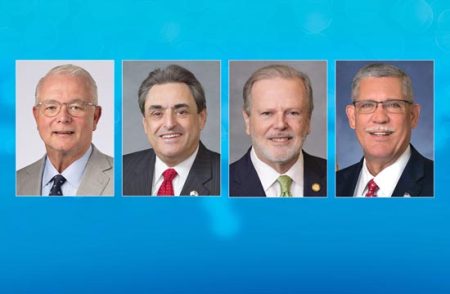
Numerous court rulings threw out the GOP’s maps, one noting that they were drawn “with surgical precision” to minimize the power of Democrats and of African Americans to elect the representatives of their choice. But the Legislature, under then-NC House Majority Leader Thom Tillis and current NC Senate president pro tem Phil Berger, drew maps over and over again to accomplish the same goals, and for the most part, they succeeded.
One legislative leader even explained that the reason the Republicans planned to hold 10 of the state’s 13 House seats was that “I do not believe it’s possible to draw a map with 11 Republicans and two Democrats.”
But finally the NC State Supreme Court got its way, and following the addition of a fourteenth seat in 2021, NC’s congressional maps were redrawn to represent the interests and the votes of all state residents. And lo and behold, We the People elected seven Democrats and seven Republicans to those seats.
Our Divided Electorate
Those number represent, to some degree, the division of the state’s 7.4 million registered voters:
- Unaffiliated: 2,637,581 or 36%
- Democrats: 2,495,097 or 34%
- Republican: 2,221,179 or 30%
- And 50,511 or 0.7% were registered to another party.
Many Democrats, of course, are conservative, and many unaffiliated voters lean strongly toward one party or the other. Given that, an even split in the delegation makes sense.
What doesn’t compute, and what repeated court cases have tried to overcome, is that in the same state African Americans, younger people, and registered Democrats cannot gain an evenly divided delegation in the NC House or Senate. Gerrymandering is the primary culprit, though straightforward voter suppression is another cause of the GOP’s domination of both houses by nearly two-to-one majorities.
Raw Political Power
Come December, Republicans in the NC Senate will hold 30 of 50 seats, or 60%, exactly twice their share of the electorate. In the House they’ll have 71 of 120 seats—one shy of a two-thirds, or supermajority—but still double their share of the electorate.
A Partisan Court
The worst news for Democrats in 2022 is that the NC Supreme Court, which had had a scant 4-3 majority of Democratic justices, was flipped to a strongly conservative, Republican 5-2 majority. That means that many of the rulings that came down on the side of citizens and their right to vote—especially Black citizens, other people of color, young voters (like those in college), and those with lower incomes, lack of transportation, and other challenges—will likely now be reversed by a highly partisan court. Such an outcome will echo the partisanship and right-wing bias of the US Supreme Court under its 6-3 Republican skew.
We shall have to see what this new reality portends for our state and its residents … and the rights of all our citizens.