Early Voting Days Restored in Ohio, But Not in NC
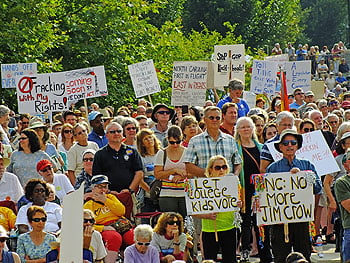
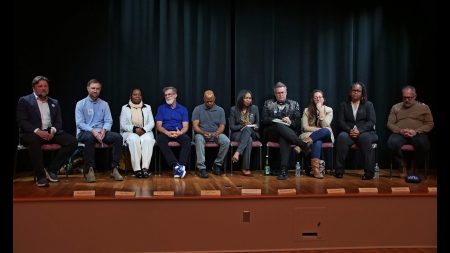
and other state-wide issues. Photo: Urban News
A federal judge ruled September 4 that cuts to early voting in Ohio must be restored in time for the November election.
The American Civil Liberties Union is challenging state laws and directives that have dramatically slashed early voting opportunities in Ohio.
The ACLU was in court last month to ask the judge to restore the cuts prior to full trial, in time for the midterm election. “This ruling will safeguard the vote for thousands of Ohioans during the midterm election,” said Dale Ho, director of the ACLU’s Voting Rights Project.
“If these cuts had been allowed to remain in place, many voters would have lost a critical opportunity to participate in our democratic process this November. This is a huge victory for Ohio voters and for all those who believe in protecting the integrity of our elections.”
The ruling restores the first week of early voting, often referred to in Ohio as “Golden Week,” in which voters are able to register and cast a ballot on the same day. It also restores evening early voting, as well as multiple Sundays.
The ACLU and the ACLU of Ohio filed the legal challenge to the restrictive voter law and directives in May on behalf of the Ohio Conference of the National Association for the Advancement of Colored People, the League of Women Voters of Ohio, and several African American churches. On August 11, the ACLU argued its motion for preliminary injunction asking the court to stop the cutbacks before the November election.
Laws restrict access nationwide
Ohio is not the only state in which restrictive voter laws have been challenged. North Carolina, Florida, Texas, and other states’ legislatures have passed laws that are now under intensive scrutiny by the ACLU, the League of Women Voters, and the U.S. Department of Justice, for many of the same reasons.
Early voting has been extremely popular with African American populations in many states, as it allows people to vote at a time that is convenient and when transportation is available. For elderly or low-income people, it can be literally impossible to get to the polls during a 10-hour window on a particular day. Many have no access to public transportation, or limited money for taxis; others face disabilities that make travel alone impossible, rigid job schedules, no access to day-care while voting, or other obstacles.
To combat these obstacles, thousands of black churches around the country, particularly in the South, have helped transport their parishioners to the polls on Sundays after church.
In most of the legal challenges that have been brought to such laws, those factors have been identified as evidence that Republican lawmakers who have passed so-called “Voter ID” laws and similar bills have specifically aimed the restrictions at African Americans, who use early voting options at higher rates than whites, and who are far more likely to vote Democratic. In Pennsylvania in 2012, a Republican legislator, Mike Turzai, said on tape that the voter ID law the legislature had just passed “is gonna allow Governor Romney to win the state of Pennsylvania.”
Same rules, opposite rulings
The Ohio ruling was in direct contrast to a similar case brought in North Carolina earlier this year. In that case, Thomas Schroeder, an extremely conservative judge appointed by George W. Bush, ruled in early August that many aspects of the state’s voter ID law will not take effect until the 2016 election, and therefore are “not ripe” for adjudication. He also refused to issue a preliminary injunction sought by the NAACP and other groups to shortening the state’s early voting schedule.
His rationale, based on the concept that the case won’t be “ripe” until someone actually can show harm from the law, fundamentally asserts that the shorter time-frame probably won’t really inconvenience anyone that much … and simultaneously, that if it does it will inconvenience everyone equally, and therefore probably isn’t discriminatory—even though 70% of those affected will be black voters.
Speaking of the Ohio ruling, ACLU of Ohio Managing Attorney Freda Levenson said, “Early voting opportunities are vital to Ohioans who have inflexible work schedules, childcare duties or other responsibilities that make it impossible to get to the Board of Elections during regular business hours. This ruling means voters will not see their access to the ballot compromised during the upcoming election. This is great news, and we look forward to the full trial and when these measures are fully struck down once and for all.”
In North Carolina, those hoping to overturn even more restrictive laws will have to find other methods. Meanwhile, all the organizations fighting for greater voter access are working to increase registration and voter turnout.
For details of the Ohio ruling, visit aclu.org/voting-rights/naacp-v-husted-order-granting-preliminary-injunctive-relief.