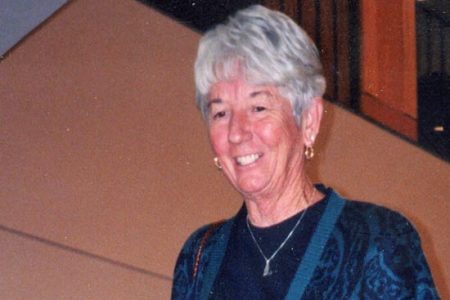
Carol Rogoff Hallstrom
My father was born in Ukraine in 1905; he was five when he and his parents escaped the persecution of the Jews during the pogroms. His other brothers and sisters were born here. It’s the classic immigrant story: my grandfather was a carpenter, the family settled first in New York City, and because of relatives they ended up in New Haven, Connecticut.
My father was very smart. He went to public school in New Haven, at Hill House High School. Yale University [in New Haven] had a history of providing a full scholarship to the kid who graduated first in his class from the local high school, though I don’t think they counted on it being Jacob Rogoff of the Ukraine. But he got the scholarship and found himself at Yale. He did very well as an undergraduate, and subsequently he received a full scholarship to medical school; thus, instead of becoming a carpenter like his father, he became a physician.
His stories about this experience were really very grim. This was the
Roaring ’20s, Stutz-Bearcats, raccoon coats—and prejudice. He had some
really ugly stories. But he graduated first in his medical school class
and became a public health physician.
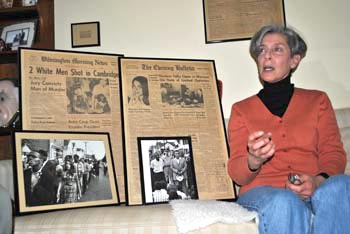 |
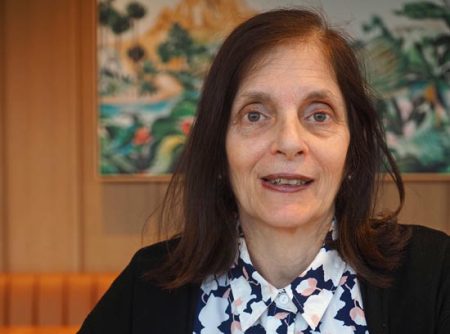
| Surrounded by memorabilia of her days in the civil rights movement, Carol Rogoff Hallstrom talks about her work to achieve social justice and equality. She hopes that her message will motivate more young people to commit themselves to work for justice. Photo: The Urban News |
He was a humble human being, his appreciation of the opportunities his
family had in America was boundless. He so believed in the promise of
this country that he was willing to put up with more than I ever faced
in regard to anti-Semitism, including physical violence. He was a slight
man, not tall, and his glasses made him look both studious and
vulnerable.
In World War II, here he was, the father of two children, a public
health service doctor—the public health service was doing lot of work
with the military here at home—and because of us children, he wasn’t
subject to the draft. But when stories began to come back about the
systematic annihilation of Jews in Poland and Germany, he enlisted.
Across the decades in our family, his decision generated great tension.
Why would he take such an unnecessary risk? But he was unquestioning: he
had escaped, his parents had escaped, they had survived, he had been
given this opportunity for this marvelous education…So he had to step
up.
Until I put together the Greensboro sit-ins [to desegregate Woolworths
and other places] with the Kennedy election and his call for
service—“Ask not what your country can do for you; ask what you can do
for your country.”—when I put those events together that’s when I
realized that his choice was a model for me. That I, too, had a
responsibility, that I had to step up. So I began working for SNCC—the
Student Non-violent Coordinating Committee—in 1962.
Father was terrified every time a story broke about my work in civil
rights. He told everybody he and my mother would rather I not do it;
they used to always say, “We’ll never bail you out.” He lived in fear
for me, for what might happen. But I never called for bail anyway,
because SNCC policy was “jail, no bail”—at least that was the practice,
if not an official policy—that we should wait to be released, or for
some negotiation. But my father did support my choices. My parents
understood the depth of my commitment.
At the time I didn’t know the kind of public visibility, even danger, my
activities put them in. My parents got a lot of hate mail, which my
mother kept for almost fifty years, but I only recently saw it. The
level of viciousness was beyond anything I knew about. To be accused of
raising someone who was a traitor was devastating for my father, this
man who was so devoted to this country. That was the worst thing for
him, to be accused of being disloyal and of raising a disloyal daughter.