A New Vision for the Block
|
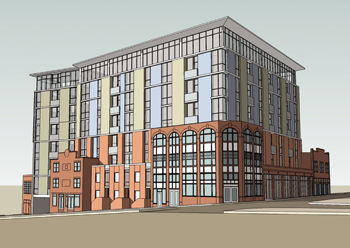
| Architectural rendering of the proposed plan for the DelCardo building in Asheville’s historic Eagle-Market Street (Block) District. |
By Moe White & Johnnie Grant
Community leaders, developers, and members of the public met at the Eagle-Market Streets Development Corp. (EMSDC) office on August 25 to preview plans for a long-awaited redevelopment of the Block.
The plan, developed jointly by EMSDC and Mountain Housing Opportunities, Inc. is the latest in a long line of proposals to revitalize the Block, the historic center of Asheville’s African American community.
Previous proposals have envisioned high-cost condos, brought in
developers from Atlanta and San Francisco, and considered replacing many
of the historic buildings that still create the ambience of an earlier
era—red brick and a neighborhood scale. In contrast, the EMSDC/MHO
proposal would incorporate a fully renovated DelCardo, retain the
facades and some structural elements of most of the existing buildings,
and offer affordable rental units throughout the complex.
The Background
Cindy Visnich Weeks, Community Investments Manager for MHO, noted,
“This is a historic development. Asheville has wanted to revitalize this
area for at least twenty-five years.” She explained that Darryl Hart,
Board Chair of the Eagle-Market Streets Development Corporation (EMSDC),
and Stephanie Twitty, its CEO, had called Mountain Housing
Opportunities in the spring of 2010 to look into the possibility of a
joint project.
“The first three months were spent listening to Eagle-Market to
understand their board’s vision, their philosophical goals for this
project,” Weeks said. “Infill was important to them because of the
history of the existing buildings which they wanted to retain.”
The two organizations set up a joint committee, and Weeks was appointed
to lead the effort, investigating possibilities for tax credits for
affordable housing, what state or other financing might be available,
and what hoops they would have to go through.
Weeks said, “We met with the Downtown Commission, the Planning and
Zoning Commission, the Historic Resources Commission, the South Pack
Square Community Committee, and the Preservation Society, because we
wanted to keep as much of these historic buildings as we could. We’re
even going to salvage and reuse the bricks from the portions of the
buildings we have to remove.”
“The only concern from those meetings was that the cap”—the top of the
building—“should be glass rather than enclosed, so we made that change.”
The proposed development will use the Housing Tax Credit Program,
through which a developer sells tax credits to private investors who can
use those credits against their owed taxes over a period of 10 years.
The program is run by the North Carolina Housing Finance Agency. Banks
such as First Citizens Bank, BB&T, TD Bank and other financial
powerhouses like State Farm Insurance are among the typical investors.
|
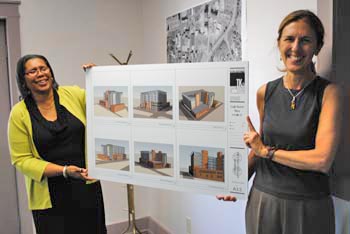
| Stephanie Twitty (left), CEO & President of Eagle-Market Streets Development Corporation, and Cindy Week, Community Investments Manager for Mountain Housing Opportunities, show the design for the Block development plan. Photo: Urban News |
The Plan
Under the plan, designed by Chapel Hill architect Don Tise, an expert
in historic preservation architecture and affordable housing, only two
buildings will be razed: the Dailey building on S. Market Street will
give way to an entrance for an underground parking garage for the
complex, and a small building at 3 Wilson Alley that has been condemned
by the City of Asheville will also be razed. The rear of the Collette
building on Eagle Street will be partially demolished, though a
significant part of the building including the original historic facade
will remain. In addition, the back addition and patio area of the Ritz
building will be removed, but the interior from the street to the
kitchen area will remain intact; the top floor is to be used as a
community youth center.
The main entrance to the complex will be on Eagle Street through the
front of the Collette building, which will also have several completely
restored store-front spaces that can be used for community events,
residents’ meetings, etc. The main lobby will lead to elevators to the
upper floors of the DelCardo to make it handicap-accessible, while a
separate elevator will lead to the residential floors of the new
building.
The complex also includes five rental town-home style units, with
individual entrances on S. Market Street across from the YMI Cultural
Center. Each will have a small stoop to encourage the return of
residential street life to the Block.
It was noted that historical records show that 65-75 homes existed in
buildings and small homes on and near the Block before the advent of
Pack Place, the parking garage, and other results of urban renewal in
the 1960s. The new structure, called Eagle Market Place, will try to
restore that density with 70 apartments ranging in size from one to
three bedrooms, including the townhouses. When completed, the Del Cardo
building will be used by Eagle Market Streets Development Corporation
for minority business incubation and entrepreneurship and job creation
training, under Eagle Market’s BLOCK (Building Lifelong, Opportunity,
Community, and Knowledge Academy, with the goal of restoring minority
business to the Block.
The Impact
Willie Vincent, a former board member of MHO and a longtime supporter
of the restoration of the YMI to a place of prominence in the African
American community, applauded the plans. “I came here in 1964 with my
husband. He was a doctor, with an office where the parking garage is
now, but it was torn down. There was a drugstore in the YMI – there were
two drugstores on the Block. It’s good to see restoration happening
here.”
Asked why the building needs to be so tall, MHO Executive Director
Scott Dedman pointed out, “We are repopulating this neighborhood, which
lost hundreds of families. So this is about the strength and vitality of
the neighborhood. It needs a scale that matches the number of people.”
He noted that at the MHO’s Glen Rock development on Depot Street, “You
see people walking, jogging, out on the street, and it’s not just youth.
There are families, old folks, all sorts of people living there.”
The building has to have a high number of residents to be economically
viable, according to Weeks. A small number of expensive condos could
bring in sufficient money, but that market is very soft, and it would
change the nature of the area. The apartments will rent for $200 to $800
per month, so they will be affordable to people on fixed and limited
incomes; the townhomes will rent for slightly higher rates, though still
well below typical downtown prices.
The Price
To be eligible for affordable housing, an individual must have an
income at or below 60 percent of the median income for the area. The
median income in Asheville is approximately $55,000 per year for a
family of 4 and 60 percent of that is $33,000, so families with an
income below $33K will be eligible to apply to live at Eagle Market
Place. For the individual, what is affordable is gauged by income;
someone earning $12,000 per year from Social Security has an income of
$1,000 a month; 30 percent of that, or $300 a month, is considered an
affordable rent for that person.
Mrs. Vincent praised Mountain Housing for the quality of its buildings.
“I have long said about Mountain Housing that they don’t build
affordable housing; they build homes and make them affordable.”
As noted by Matthew Bacoate, who has served on the boards of Mountain
Housing Opportunities and Community Action Opportunities, “We have an
opportunity now to do something significant on the Block, bringing a
historical community into current-day living patterns—something we can
be proud of.”
“The Block is changing,” said Curtis Canty, a board member with EMSDC.
“Change is good to those involved, and it’s scary to the people impacted
by it. So you have to try to be at the head of it.”
Angela Benton, a retired music teacher who is active with Delta House,
added, “I think this can bring blacks back to downtown Asheville. They
have been pushed out, and it’s time we come together if this is going to
bring some blacks back to where they were dislocated from.”