Shiloh Community Plans School Reunion
By Sarah Williams
Shiloh is an historically African American community inhabited since the late 1880s.
Older residents refer to this area as “New Shiloh.” Shiloh evolved and prospered around three cornerstones, its churches, its schools, and its people.
According to oral and church histories, Old Shiloh was located north of the Biltmore Estate. When George Vanderbilt bought the land for his mountain home, he moved the entire Shiloh community, including Shiloh Church and the church cemetery, to its current location.
In the early nineteen-twenties the first two-room school for African American students in Shiloh burned down. In 1927 a six-room elementary school was built on a five-acre site on Shiloh Road next to Shiloh Church. Public money built the school; and the Rosenwald Fund, founded by Julius Rosenwald, president of Sears, Roebuck & Company, made a large monetary contribution.
Shiloh Elementary School educated first-through-eighth-grade African
American students from Shiloh, Brooklyn, Petersburg, Rock Hill, Arden,
Concord, Fletcher, and Weaverville. The school graduated its last class
in 1969. The school was also a meeting place for local clubs, athletic
events, and theater productions. A decade after the school closed the
city demolished the original Rosenwald building and replaced it with a
structure that is now part of the Linwood Crump Shiloh Recreation
Complex.
During the early years the residents of Shiloh worked on a
variety of jobs ranging from domestic and custodial work, to teaching
and dentistry. Still others developed professions providing services to
others in the community such as midwifery, ministry, and storekeeping.
Although the residents worked hard, they still found time to support
activities for neighborhood children.
Deirdre Wiggins, a former Shiloh Elementary School student,
stated, “As students living through segregation, we weren’t fully
cognizant of the richness of cultural heritage that was inculcated in us
during that time. The weaving of a curriculum centered on cultural
ethos defined a sense of respect for our teachers, parents, and
schoolmates. That respect yielded a wealth of uniqueness that cannot be
sewn in any other venue.
Growing up and looking back on this time, we realize just how
vast our blessings were — and are. Our older and more mature minds have
recognized the strength of resolve, fortitude, and pride that fortune
placed on each of us from living through that era. Along with the
rekindling of comrade experiences, it is these things and more that we
want to celebrate, honor and fondly remember during this reunion time.”
This reunion is organized in collaboration with Kenya Webster,
Community Center Director of the Linwood Crump-Shiloh Complex. The
community can help by sending names and contact information for former
attendees of Shiloh Elementary School. Pictures of the school and its
students are needed as well.
For more information about the reunion or for registration
information, contact the Shiloh Reunion Committee, PO Box 7278,
Asheville, NC 28802,
email [email protected], by phone (828) 777-8337.
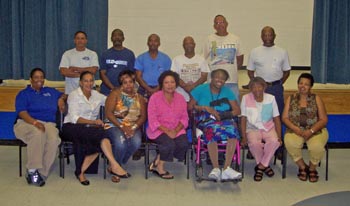
Members of the Linwood Crump-Shiloh Complex. 1st row (L-R): Kenya Webster, Center Director; Deirdre Wiggins, writer, historian; LaVerne Duncan; Lucy Hunter, secretary; Bernadette Thompson, recording secretary; Barbara Payne, and Joan Martinez. 2nd row: Allan Johnson, co-president; Ulysses Mills, co-president; Ronald Scott, Parliamentarian; Eric Foster, liaison to Shiloh Center; Dennis Hill, treasurer; and George Holloway, sergeant-at-arms.