Book Bag: Tracing the Roots of White People from Antiquity to Modernity
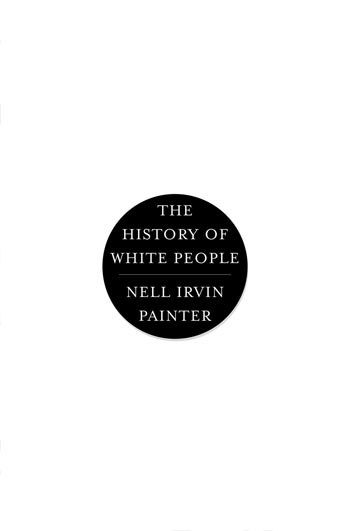 Review by Sharon Shervington
You may not have heard of Nell Irvin Painter, one of America’s foremost historians. Not yet. But hopefully that will change. She already has several other well-received and innovative titles available. Her new book The History of White People proves that no one writing in the academy today can touch her in terms of sheer insight and originality. She synthesizes a huge array of sources, and then weaves them into a smooth narrative with subject matter that is greater than the sum of its parts.
In White People we go back to the Greece and Rome of Antiquity and see
an empire with an economy totally based on slavery, but where skin
color was irrelevant. It was unremarkable, she argues, that most slaves
in Europe were white. We learn how human trafficking in Eastern Europe
led to the wide use of the phrase “white slavery,” and the connotations
of that, especially regarding what came to be Eurocentric ideals of
beauty that are still with us today.
Through art, literature and science, we are shown how theories of white
as a race were “proven,” and came to permeate society. In science,
skull measurement, the concept of multiple European races, the
Teutonic, Saxon, Anglo-Saxon, and the Celts for example, and much other
“scientific data” were used to bolster these ultimately self-serving
theories.
It was Johann Friedrich Blumenbach, born into a comfortable academic
family in Germany, who named whites “caucasian.” He believed in a
strict racial hierarchy, and argued that there were somewhere between
five and twelve races. It also was centuries before the Italians, Irish
and other such groups in America were considered white, or that Indians
were included in the term Native American. Also fascinating is the way
poor whites were seen; after being deemed degenerate less than a
century ago, a program of sterilization was implemented against many
poor whites.
One of the biggest surprises is the list of storied Americans who
supported and disseminated these ideas, especially Ralph Waldo Emerson,
one of the most revered intellectuals in this country’s history, who
was obsessed with specific racial traits. To him it was beauty and
bloodthirstiness that mattered. Many, many scholars made their careers
and reputations with these now-discredited theories at top universities
all over Europe and the U.S.
Ms. Painter describes four of what she calls “enlargements of
whiteness,” often involving war, politics and immigration. The first
was the ending of property requirements for voting in the first half of
the 19th century. The wartime need for immigrant labor and soldiers was
responsible, she says, for other “enlargements of whiteness.” Finally,
Ms. Painter argues, we are in the midst of the fourth enlargement,
bolstered by the end of legal recognition of discrimination and a huge
surge of people marrying outside of their own groups.
This is a book that readers will refer to again and again, to at last
make some sense of the bizarre story of whiteness — the mad
confluence of skin color, class, gender and law — that has indelibly
marked, and marred, the democratic dream of America.
The History of White People, by Nell Irvin Painter; W.W. Norton; 496 pages.