Our Own Holiday
by Meta Commerse
Most of us feel holiday stress: the squeeze of spending and frenzy that sweeps our nation this time of year. Many acquiesce. Some back out altogether. Some give it a lighter touch.
Others remember the ’60s, those days when Kwanzaa emerged from our Movement, offering us more. Did we stop to think of Kwanzaa’s deeper significance?
Thumbing through “The African American Holiday of Kwanzaa: A Celebration of Family, Community & Culture” by Maulana Karenga, (1988), I found a goldmine of insights. Having experienced Kwanzaa from its inception, I pose a question of purpose.
“How do we begin to restore what was taken, heal what was broken, tell the untold story and mend what was ripped apart in the heart of African people?”
Very recently, in her West African Grief Ritual, Sobonfu Somé said, “We have all benefited from the West.” Her statement silenced the voices in the room, those primed and ready to engage this question of racism and the legacy of slavery honestly, from our hearts. We who are not just descended from African slaves but have lived this American life in earnest do indeed have a vastly different experience from Africans who have not.
This difference glares most when it comes to education and lifestyle, the effects of materialism on our psyche, and what we expect to attain. And I remained quiet because I knew this. How does this relate to my initial question?
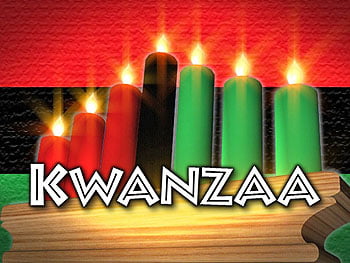 To celebrate Kwanzaa without knowledge of African history is alright. Knowing who our ancestors were is a good start. We use Swahili, for that language is accessible to us who speak European tongues. We respect an African value system. This generally entails the following five elements: gathering of the people for ritual, reverence for the Creator and Creation, commemoration of our past, recommitment to cultural ideals, and the celebration of good. This is resonant, yes? It meets the need for something authentic that pertains to us, something that authorizes and helps us begin this work of self-repair.
Dr. Karenga tells us that, “in African First Fruit festivals, a profound reverence for Creator and Creation is part of our progress. In our prayers and rituals, we show concern for being in harmony with nature and the universe.” (Karenga, 19) To commemorate the past is to honor the bridge that brought us over. To venerate the ancestors is to honor our lineage that gave us life. To recommit to cultural ideals is to embrace wholeheartedly our values or, the Nguzo Saba (the seven principles), each of which is used as the daily themes of Kwanzaa.
Finally, to celebrate the good in us, our people, our history, is to be inspired by what we have achieved in spite of our suffering and the tremendous odds our people have faced and overcome. This reinforces the possibility for continued healing in our lives and communities. Presently, the passing of our most honorable elder, Madiba Nelson Mandela, commemorates the struggles of our people, calls us to recommit to the ideals of our freedom, venerates him now as an ancestor, and celebrates the good in us, exemplified by his life, work, and legacy.
Each day between December 26 and January 1, we concentrate upon a principle in the following order: Day one is Umoja, or Unity; day two is Kujichagulia, or Self Determination; day three is Ujima, or Collective Work and Responsibility; day four is Ujamaa, or Cooperative Economics; day five is Nia, or Purpose; day six is Kuumba, or Creativity; day seven is Imani, or Faith.
We prepare a table draped in African cloth with crops in season. We place these in a handmade basket. On the mat or mkeka, we place the kinara or wooden candle holder. We light the mishumaa saba (seven candles) red, black, and green, on the kinara, one each night, teaching on the day’s principle with stories. We drink from the kikombe cha umoja (unity cup) to celebrate our oneness. On the seventh night, we have a feast of nourishing foods and exchange culturally appropriate gifts to inform and inspire each other.
Activist/artist Ebon Dooley, now an ancestor, once told me something unforgettable. “Slavery made us one people,” he said. His words silenced and humbled me. Does this constitute a benefit from Western civilization? I can’t say absolutely yes, for I personally would have preferred freedom from interference. Yet, with Kwanzaa, we mindfully heal this legacy with good, sound African principles.
Unity (oneness), self-determination (naming and reclaiming our selves), cooperative economics (trading among ourselves), collective work and responsibility (sharing the load/burden, profit/loss, success/failure), purpose (fulfilling our life mission), creativity (solving problems with our minds and beautifying our communities), and faith (in something greater than ourselves) are all aspects of our lives which, if fueled and brought back into pure balance, would leave us and our communities whole and therefore improved. Yes, for one people, this is good medicine.
Happy Kwanzaa!
*Reference: Karenga, Maulana, 1988, The African American Holiday of Kwanzaa: A Celebration of Family, Community & Culture, University of Sankore Press, Los Angeles.
Meta Commerse, M.A., M.F.A. is Director of Story Medicine of Asheville, a unique healing program. She is also an author, activist, and public speaker. Meta is also a professor of English and History at Haywood Community College. Her novel, The Mending Time, is forthcoming. Meta is available to speak to your group on the healing power of story and other topics of interest. Contact her on Facebook.