The People Speak
Election results reshape power from Raleigh to Washington.
By Moe White –
North Carolina voters offered a solid rebuke to the Republican Party on November 3, overwhelmingly rejecting the gerrymandered maps and goals of the national party.
The state House of Representatives flipped from 71 – 49 Republican majority to a mirror-image Democratic majority—71 Democrats, 48 Republicans, one Independent—while the NC State Senate moved from a 34 – 16 majority to either 26 – 24 Democratic advantage or a tie of 25 seats each—depending on the outcome of one close race yet to be called (and sure to be subject to a recount). If the chamber is equally divided, Lt. Gov. Rachel Hunt, a Democrat, will cast the deciding vote in case of any ties.
Democrats also won every statewide race on the ballot, including four judicial races and the US Senate seat long held by retiring Republican Thom Tillis. Former Governor Roy Cooper easily (58.7%) won against former Republican Party Chairman Michael Whatley (39.1%) in the Senate race; his victory was so overwhelming it was called by the Associated Press less than an hour after polls closed on Tuesday, Nov. 3.
Earls Reelected Along With Appeals Court Judges
NC Supreme Court Justice Anita Earls handily (58.5 – 41.5%) defeated her opponent, former Assemblywoman Sarah Stephens, positioning the party to retake a majority on the court in 2028, when three Republican-held seats are on the ballot. Also, all three State Court of Appeals seats were won by Democrats: incumbents John Arrowood and Toby Hampson, and Wake County District Court Judge Christine Walczyk.
Arrowood will have to step down in six years as a result of the state’s Court of Appeals requirement that judges retire at age 76. After being appointed to the court in 2017, he was elected to a full term in 2018, becoming the first openly GLBTQ candidate elected to statewide office in the state. The final two years of his term will be filled by a replacement named by whoever is governor when he retires.
Congressional Seats
Democrats also flipped the majority of the state’s 14 congressional districts. Since taking power in 2012, the Republicans in Raleigh have redistricted five times, always with the intent of making it impossible for Democrats to win. At one point their redistricting chief publicly asserted that “the only reason we’re making it 10 to four is because we couldn’t figure out how to get to 11 to 3.”
After the 2022 state Supreme Court ruling that resulted in an unbiased districting map, the delegation became 7 to 7 for one cycle, reflecting the reality that the Tarheel State’s electorate divides fairly equally among Independents, Democrats, and Republicans. But that fall the GOP won a majority on the NC Supreme Court, which, in an almost unprecedented action, reheard and overturned the ruling of its predecessors in April 2023. Democrats won every statewide race on the ballot, including all four judicial races for the state Supreme Court and Court of Appeals. They also currently lead in nine of the state’s 14 congressional districts.
East, West, and Central
In late 2025, in line with President Donald Trump’s demand that states redraw district lines to help Republicans, the NC legislature thought it would at last achieve the goal of 11 – 3 by eliminating the one Congressional seat held by a Black Democratic representative, Don Davis of District 1 that runs along the northwest NC coast and the traditional “Black Belt” of rural, agricultural counties. Defying expectations, Davis won 50.06% of the vote, defeating Republican Laurie Buckhout (46.77%) and Independent Tom Bailey (3.16%).
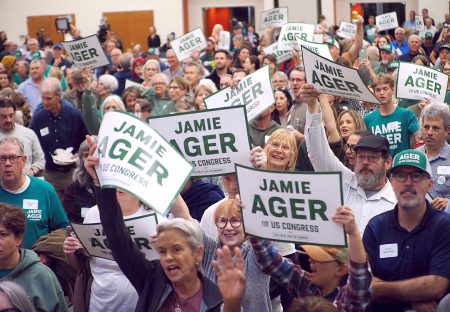
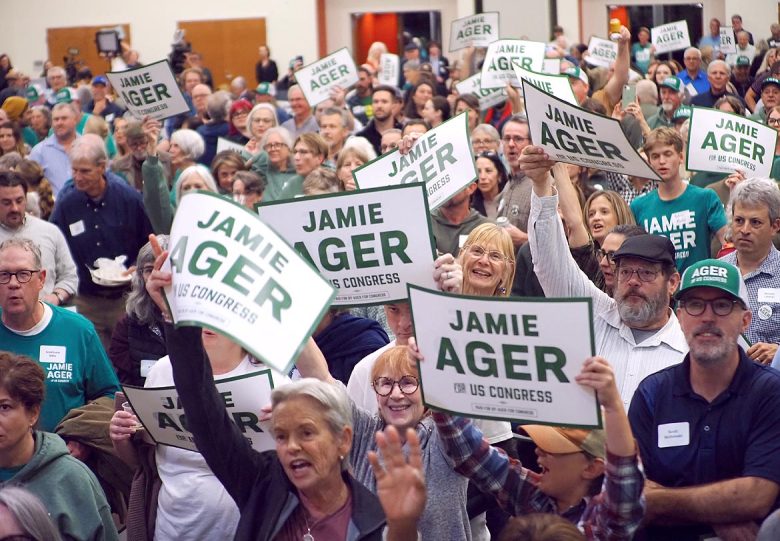
Simultaneously, voters in WNC’s 11th District, home of Asheville and Buncombe County on the opposite end of the state, elected Jamie Ager to the seat once represented by his grandfather, Jamie Clarke. That seat had been held for more than a dozen years by Republicans Mark Meadows (2013-20), Madison Cawthorn (2021-22), and Chuck Edwards (2023-26).
In addition to running a no-frills, message-oriented, back-to-basics campaign, Ager became the strong favorite to win after Edwards’s censure by the House for sexual and financial improprieties caused him to withdraw from the race. Edwards was replaced as a candidate by Henderson County native Jennifer Balkcom, who gained only 41% to Ager’s 57%—a margin of more than 50,000 votes out of more than 342,000 cast.
Districts 6, 9, 13, 14—and Maybe 5
Voters in four other districts around the state also ousted incumbent Republicans, leading to a 10 – 4 majority (possibly 11 – 3) of Democrats in the state’s US House delegation—the precise opposite of what GOP gerrymanders were expected to achieve. Voters in Districts 5, 6, 9, 13, and 14, all designed to be solidly Republican, elected Democrats—though in District 5, a recount is likely.
Three of those districts (6, 9, and 13) cover a swath across the center of the state, mostly rural areas between Winston-Salem, Charlotte, Durham-Chapel Hill, and Raleigh—avoiding high-population urban centers so as to dilute and divide the Black vote. The fourth, District 14, encompasses Burke, Cleveland, Gaston, and Rutherford Counties (Morganton, Shelby, Gastonia, and Forest City) along the SC border, also designed to be firmly in GOP hands.
Splitting the Black Vote
The 5th District is a rural strip along the Virginia and Tennessee borders, but in 2023 it was redrawn to include Greensboro. Then in 2025 the city was newly split among the 5th, 6th, and 9th districts. Home of NC A&T, the nation’s largest HBCU, Greensboro has both a large student population and an estimated 60% majority of non-white residents: 41.5% Black or African; 10.5% American Hispanic or Latino (of any race); 5.3% Asian; and 39.8% White.
Moving a portion of those Black voters into such a rural constituency, it was thought, would have little impact on the 5th District overall, and would simultaneously dilute the Black urban vote. But student residents were determined to vote, even walking 40 to 45 minutes each way to vote early after the only early voting location on the university campus was eliminated.
The 5th District has long been represented by 83-year-old arch-conservative Virginia Foxx. If the final count confirms the loss of her seat to Democrat Chuck Hubbard, it will lead to the opposite of what Republican redistricting committees have intended for more than 15 years.
Local Races Reflect National Trend
Here in Buncombe County, voters were strongly behind Democratic candidates up and down the ballot, including African Americans. Sheriff Quentin Miller easily won a third term with nearly 70% of the vote, while Martin Moore was elected (unopposed) to be Buncombe’s first Black District Attorney. He will succeed Todd Williams, who chose to step down after three terms. In other races, incumbent Al Whitesides ran unopposed for reelection to the Buncombe County Commission (District 3), where he will be joined by newcomers Lonnie Israel (District 2) and Anna V. Stearns (District 1), who won their races by 60% – 40% and 66% – 33% respectively.
Asheville City Schools Board reelected three incumbents, Chair Sarah Thornburg, Vice Chair Rebecca Strimer, and member Liza English-Kelly. They will be joined by newcomer Gordon Grant, who topped the field with 13,668 votes (20.73%).
In the Buncombe County Board of Education, incumbent Democratically-aligned candidates won against strongly conservative opponents. Judy Lewis (District 5, Enka) gained 72% to 28% for Alina Moiseyev, and Kim Plemmons (District 6, Erwin) won more than three-quarters of the vote (77% – 23%) against Taras Schevchenko.
Council, Mayoralty Move Left
In Asheville, where voters could choose three out of six candidates, current Vice Mayor Antanette Mosley and Councilwoman Maggie Ullman Berthiaume won reelection with 18% and 21% of the total votes respectively, and current County Commissioner Drew Ball led the field with 23%. All are considered progressive and people- rather than corporate-oriented.
Because Asheville voters could cast ballots for up to three City Council candidates, election percentages were calculated using the total number of votes cast rather than the total number of voters. In all, 112,522 votes were cast in the race, including write-in votes.

Roney v. Manheimer
In what many considered the night’s biggest surprise, Asheville City Councilwoman Kim Roney defeated three-term incumbent Esther Manheimer to become Asheville’s next mayor. It was Roney’s second try, and the 58% – 42% margin of victory reflected a clear desire for change.
Part of Manheimer’s campaign appeal was that she could work with the Republican majorities in the NC Legislature and US Congress to get things done for WNC, especially following Hurricane Helene’s devastation. That argument fell flat with voters, and it now seems irrelevant, as both the legislature and the US Congress will soon be controlled by Democrats—many of them far more progressive than the moderates who have led the party for decades.
So, the 2026 election is over, the results are (almost) in, and the political landscape of the country has changed from Washington to Asheville, from Raleigh to the Buncombe County Courthouse.