Black, Minority Leadership Takes Giant Strides
A New Chapter in American History
By Moe White –
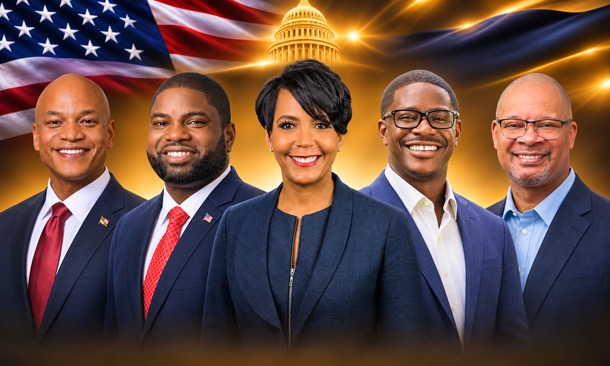
For the first time in US history, and for the next four years, five states will be led by Black governors.
Two are in southern states that have never before elected Black statewide officials: Georgia, where former Atlanta Mayor Keisha Lance Bottoms will lead a cabinet of eight Black women, and Florida, where the only Republican among the five, Representative Byron Donalds, will take the reins from fellow GOP Gov. Ron DeSantis.
Rounding out the roster are Gov. Wes Moore of Maryland, who won reelection to a second term, David Crowley of Wisconsin, and Aaron Ford of Nevada. Prior to 2026, the only three African American men ever elected state governors were Moore (first elected in 2022), VA Gov. Doug Wilder (1990-94), and Massachusetts Gov. Deval Patrick (2007-15).
A few other Black men had previously served as state governors, though none was elected to the post. Lt. Gov. David Patterson took over from disgraced Gov. Eliot Spitzer to serve NY from 2008 to 2010.
Two other men, Oscar Dunn and P.B.S. Pinchback, became acting governors of Louisiana during the Reconstruction-era travails of Gov. Henry C. Warmoth. Dunn served (without taking the oath of office) for 39 days in 1871 while Warmoth was out of state recuperating from an accident; when Dunn died later that year at age 49 (some say he was murdered), Warmoth named Pinchback Lt. Governor. The following year Warmoth was impeached, and Pinchback was sworn in as governor during the trial until the end of Warmoth’s term a month later.
Georgia Sweep
The 2026 election of Keisha Lance Bottoms in Georgia is particularly noteworthy. Not only was she elected as the first Black and first woman governor, but she will be joined by Attorney General Tanya Miller; Secretary of State Penny Brown Reynolds; Commissioner of Agriculture Katherine Juhan-Arnold; Insurance Commissioner Keisha Sean Waites; Labor Commissioner Nikki Porcher; Superintendent of Public Instruction Dr. Lydia Powell; and Public Service Commissioner Sheila Edwards.
All eight women are African American, but in Brown Reyolds’s words, “Georgia chose competence. We were not selected because we were Black women. I believe that we were selected because all of us bring something that Georgia desperately needs… ‘the content of our character’ and the experience and leadership that we bring.” Georgia chose competence.
Georgia has been a bellwether for the assertion of the right of any American to serve their state or country. In 2020 the state elected Jon Ossoff, a Jewish man, as one of its senators at the same time it elected its first Black senator, Rev. Rafael Warnock, to fill out the term of Johnny Isakson. Warnock faced reelection in 2022 and won handily, as did Ossoff in his first reelection campaign this year.
The Georgia experience—energizing Black and liberal voters whose voices have long been ignored or silenced across the South (or who have given up voting in despair)—has now been echoed by such states as Texas, North and South Carolina, and Mississippi. All four states elected Democrats to the US Senate in 2026—James Talarico, Roy Cooper, Dr. Annie Andrews, and Scott Colom, respectively—and Texas voters chose the state’s first-ever Hispanic governor, Gina Hinojosa, defeating three-term incumbent Greg Abbott.
Nationwide Sweeps
Across the country similar firsts took place. Julia Stratton, a Black lawyer, was elected to succeed Illinois Sen. Dick Durbin. She will join Senator Tammy Duckworth (of Chinese, Thai, and British descent) to be the first state Senate delegation comprising two women of color. Chris Pappas of conservative New Hampshire will be the first openly gay man ever elected to the Senate; New Mexico’s Deb Haaland the first Native American governor of a state; Peggy Flanagan of Minnesota the first Native American woman in the Senate; and Detroit, Michigan-born Abdul El-Sayed the first Muslim American senator. While returns are incomplete, it’s likely that Mary Peltola will be elected Alaska’s new senator, joining Flanagan in Native American representation in that body. And Xavier Bercera will be California’s first Hispanic governor when he takes the oath of office on Jan. 4, 2027.
Long-Term Impacts
These remarkable changes will have lasting effects on American government and politics. For decades—generations—really, the entire history of the nation—the power to rule has rested in the hands of a narrow range of almost exclusively wealthy white men. With the exception of Barack Obama, every president for 250 years has been a white man. In 1948, Maine’s Margaret Chase Smith became the first woman elected to the US Senate. Two women, both white, were elected governors of the states of Wyoming and Texas in 1925, but no Black governors were ever elected before Wilder of Virginia in 1990.
“Bring a Folding Chair”
This year, that pattern—the broader power that Hillary Clinton called “the glass ceiling”—has been broken. Diverse voices from the Black, Hispanic, Native American, GLBTQ, and disabled communities will be heard, and therefore empowered. Mitt Romney once said that decisions are made in quiet rooms behind closed doors. But as of 2027, while white men will not be silenced, their murmurings and shouts will no longer be the only voices in the room. For, as the late Brooklyn, NY Rep. Shirley Chisolm—the first woman to mount a serious bid for the presidency in 1972—said, “If they won’t give you a seat at the table, bring a folding chair!”
We look forward to the unfolding of many new chairs in the boardrooms of power beginning in 2027.