Youth Rising in India
A generation stands up for its future.
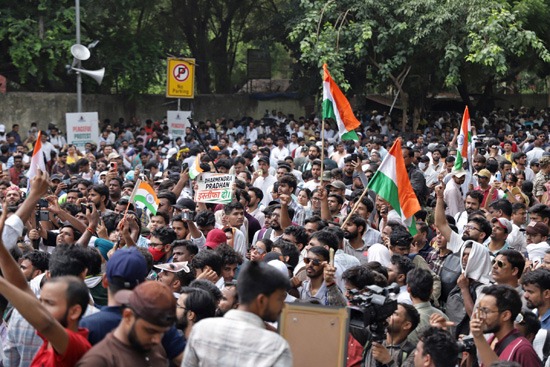
The uprisings unfolding across India this summer began with something painfully familiar to many young people: a system that promised opportunity but delivered uncertainty.
When their exam papers were leaked, millions of students felt the ground shift beneath them. These tests shape futures, careers, and family hopes. Seeing them compromised was more than a bureaucratic failure. It was a breach of trust.
What followed was a wave of youth-led protest that moved with remarkable speed and courage. Students gathered first in small groups, then in crowds that filled streets from New Delhi to Mumbai, Bengaluru, Kolkata, and beyond. They carried handmade signs, shared live videos, and spoke openly about the pressure they carry. Their message was simple and deeply human: they want a fair chance.
The government’s response was uneven. Police used tear gas and batons on these young people who were largely peaceful, and the images of injured students were shared online. Instead of silencing the movement, the crackdown widened it. More students joined. Parents joined. Teachers joined. The country watched as young people refused to back down, even when the cost was high.
In the middle of all this, the protesters adopted a name, Cockroach Janta Party (CJP), turning an insult from a public official into a symbol of resilience. It was a reminder that humor and defiance often travel together in moments of struggle. Their organizing was loose, creative, and deeply digital. Memes, reels, and livestreams carried the movement farther than any single leader could have.
By late July, their persistence reshaped the national conversation. India’s education minister stepped down, and the government agreed to major reforms, including compensation for families who lost children to exam-related stress and the withdrawal of charges against protesters. It was a hard-won victory, and the students knew it. They paused their demonstrations, but they did not declare the work finished.
What stands out most in this moment is not just the political impact, but the emotional one. These young people showed what happens when frustration turns into collective action. They reminded their country, and the world, that dignity matters, fairness matters, and the voices of students can carry farther than anyone expects.
The movement is quieter now, but its impact remains. India’s youth have shown they are willing to speak up for their future, and that they can create beneficial change. A generation stepped forward, and a nation felt the shift.
The Power to Demand a Better Future
Across history, the strength of a nation has often been shaped by the collective will of its people. When masses rise with purpose, they hold the power to reshape the course of a country. It is not the actions of a few, but the unified voices of many that ignite change.
In every corner of America, from small towns to sprawling cities, the potential for transformation lies within communities coming together. When people stand united, across differences of background, belief, and experience, they create a force that no obstacle can withstand.
This is a call to remember that democracy is alive not just in voting booths, but in the streets, in conversations, and in the courage to demand a better future. The power to reshape America is in the hands of its people, and when we move as one, we can also write the next chapter of this nation’s story.
Let this moment be a reminder: the masses are not just spectators of history, they are its makers.