Waking the Sleeping Giant
On Saturday, March 2, 2024, mass assemblies were held across the country.
Amidst all the nail-biting uncertainty over the 2024 election, one thing’s for sure: turnout will be key. Will politicians be listening?
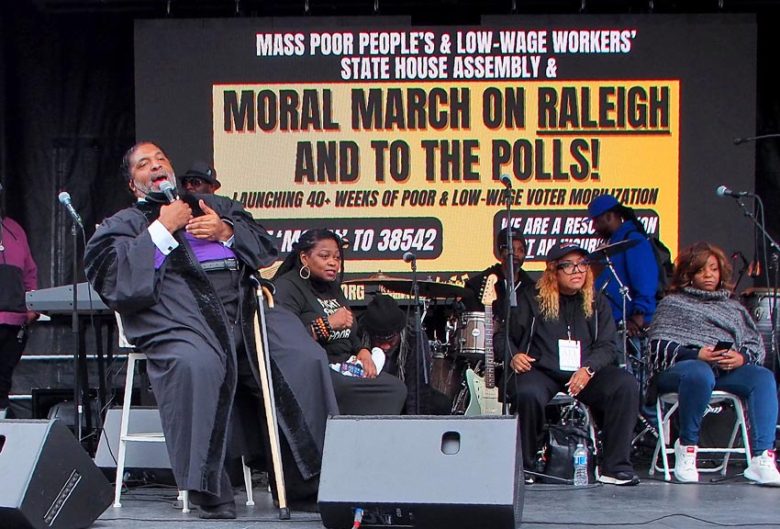
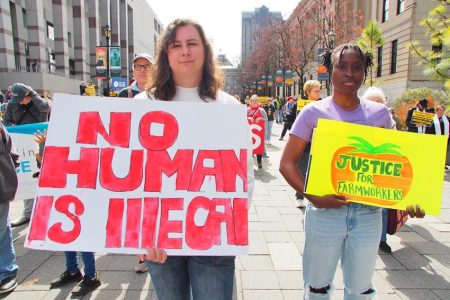
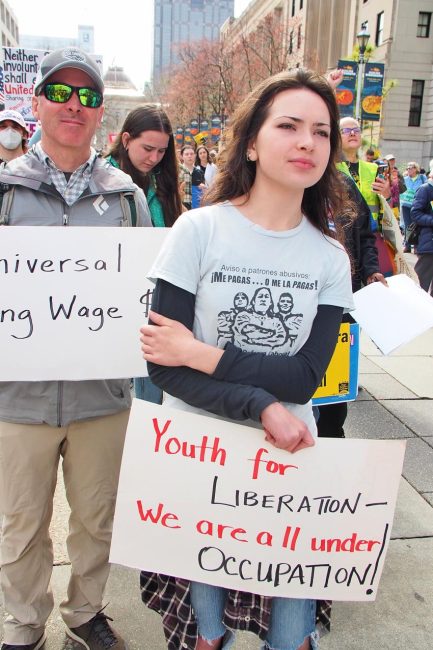
On Saturday, March 2, 2024, mass assemblies were held across the country as ordinary working people, faith leaders, and advocates lifted up policy demands and called on lawmakers to take immediate action to end the crisis of death by poverty in the United States.
State-based fusion coalitions came together in 32 state capitals and Washington, DC, to launch a simultaneous voter mobilization effort to 15 million poor and low-wage voters. These assemblies mark the beginning of a 40-week push to mobilize poor and low-wage voters and amplify a moral public policy agenda, throughout and beyond the 2024 election season.
What’s the biggest factor discouraging poor and low-wage people from exercising this basic right?
“Political campaigns do not talk to them or speak to their issues,” explained campaign co-chair Bishop William J. Barber II. “It is morally reprehensible that poverty is the fourth-leading cause of death in the United States. In a country with so much wealth, poor and low-wage voters are fighting against the myth of scarcity and instead are declaring that our votes are demands for living wages and other policies to save lives.”
Personal Stories Aimed at Candidates
Their powerful testimony and messages put politicians on notice: “If you want our votes in November, you must address the crisis of death by poverty.”
Eric Winston, a member of the Union of Southern Service Workers and a catering cook for a minor league baseball team, told the crowd in Raleigh, “I’m tired of working 70 to 80 hours a week and still not having money for the necessity of bills. I’m tired of getting sick and not being able to go see the doctor. I’m here because I’m sick and tired of fighting by myself.
“There’s more people in my situation who may not look like me but go through the same struggles as I do,” Winston continued. “As working people, we should only vote for politicians who support the rights of workers. Period.”
A Huge, Untapped Electorate
More than 74 million poor and low-income live in the United States, accounting for nearly 30% of the United States voting-age population.
“In North Carolina, there are over 3.4 million poor and low-wealth eligible voters. Over the past weeks, I have traveled across the Tar Heel State—from Raleigh to Charlotte and from Hickory to Asheville—to energize meet these voters and other impacted communities, to take back the mic from extremist lawmakers,” said Dr. Barber. “As I reminded you, low-wage brothers and sisters are of every race, creed, color and they are voters, too.”
How often do we hear this startling statistic on the news? “There are millions of poor and low-income people in the United States today. This includes more than half of our children, 74 million women, 38 million Hispanic people, 23 million Black people, 8 million Asian people, 2 million Native people and 66 million white people, with a disproportionate number of LGBTQ+ people and people with disabilities.”
Votes Bring About Change
Yet when it comes to voting, many of those most affected by the outcome of elections don’t show up at the polls. In North Carolina, the March 5 primary electorate was the smallest in decades, averaging less than one-quarter of registered voters. More to the point, Democratic candidates, who generally are most responsive to the demands of Barber’s Poor People’s Campaign, received only two-thirds as many votes as their Republican counterparts. Yet almost without exception, GOP office-holders oppose such remedies as raising the minimum wage, establishing a living wage and access to healthcare, and working to make housing more affordable for working people.
In the presidential primary, Tarheel voters cast 694,700 votes for Democratic candidates compared with 1,040,630 for Republicans. Democratic candidates for governor received 684,523, while 1,059,992 voters chose among Republican candidates. That discrepancy could bode ill for Democrats in November, whatever the reason.
Results, Causes, or Coincidence
It is not certain whether the difference was a result of less enthusiasm by Democrats, more successful turnout efforts by Republicans, or other factors. One possibility is the difference between the two parties’ races for president.
Joe Biden will be the 2024 Democratic nominee, as Donald Trump will be the nominee of the GOP. But former SC Governor Nikki Haley energized millions of Republicans who oppose former President Trump, and gained 24% of the votes cast in her party primary. Many of her voters—from 20% in Vermont to 80% in North Carolina—have stated they will not vote for Trump under any circumstances. So their protest vote for Haley, even knowing she could not win the nomination, may have increased turnout in that party.
Conversely, the 12.7% protest vote of “no preference” against President Joe Biden could have several causes: many Democrats are angry with the president for his support of Israel against the Palestinians; others may have absorbed the meme that Biden is “too old” to serve, just as many Democrats voted against Hillary Clinton in 2016 and Biden in 2020 as “too conservative” or “business-as-usual” compared to Bernie Sanders. (However, Biden’s energetic performance in his State of the Union address two days after the Super Tuesday primaries might have put much of the “too old” worry to rest.)
The Power of Every Voter
A third possibility, stated by some voters from both parties, is that they knew their primary protest vote would make no difference in November, when the real importance of voting will be manifest. Cheri Beasley would still be a NC Supreme Court Justice if not for the fact that 401 voters stayed home, or didn’t bother voting for that office in 2000. That small number of voters helped change the state’s highest court from a progressive, Democratic majority to MAGA-based Republican control. As a result, Beasley’s loss allowed the NC Supreme Court to rewrite the state’s redistricting rules in time for the 2024 election.
The NC electorate is very evenly divided: as of last September, 36% of its voters (2,665,176) were registered unaffiliated; 33% (2,414,900), were registered Democrats; 30% (2,208,932) were registered Republican; and 0.71% (51,320) were registered to another party. That’s about as purple as a state can get. (For totals as of this month, see ‘Low Voter Turnout’ on page 5.)
Reflecting that fact, in late 2022 the Court had demanded and enforced fair districts, and NC voters chose a perfectly divided Congressional delegation. Seven Republicans and seven Democrats were elected; unaffiliated voters broke evenly for each major party.
But early in 2023, the newly empowered and highly partisan court majority overturned that ruling. Under its reversal, out of 14 Congressional seats, the delegation now will have at least 10 Republicans, possibly 11, with only three, or a maximum of four, Democrats.
Resurrecting Love, Righteousness, and Justice
Thus it is imperative for working people, low-income or poor people, and all those who are disenfranchised, to be inspired by the potential power of their votes. As Bishop Barber stated at his Raleigh demonstration, “We are not an insurrection. But you better believe we are a resurrection—a resurrection of justice and love and righteousness.”